Sunway Construction Group Bhd (SunCon) has bagged a RM508 milion contract from National Highways Authority of India (NHAI).
SunCon, in a statement today, said the project was awarded to Sunway Construction Sdn Bhd – RNS Infrastructure Ltd, a consortium formed by Sunway Construction Sdn Bhd and RNS Infrastructure Ltd.
The project consists of developing a new road and widening of the existing road to four lanes on a 36.75 kilometre highway stretch in the state of Tamil Nadu.
The project will be operated under the Hybrid Annuity Model (HAM), where NHAI will pay 40 per cent of the project cost during the construction period.
The remaining 60 per cent will be paid over a period of 15 years as fixed annuity amount.
HAM is an initiative by the government of India, which was introduced to have a better financial mechanism for road development.
The project also includes a 15-year operations and maintenance contract which will bring about an additional RM4 million per annum.
“We are very pleased to clinch our first overseas project for the year as this is part of our plan for geographical diversification focused on Asean and India,” said SunCon managing director Chung Soo Kiong.
SunCon said the development and widening works of the highway stretches from the Thorapalli Agraharam to the Jittandahalli sections of national highway (NH) 844.
Work is expected to commence in October and to be completed in two years.
SunCon’s consortium partner for the project, RNS Infrastructure is an Indian company that provides a wide range of infrastructure construction services such as construction of dams, highways, bridges, tunnels, power houses and residential buildings.
SunCon previously partnered with RNS Infrastructure in June 2001 for its first two infrastructure projects.
Migrant workers stuck in Odisha capital Bhubaneswar due to the countrywide lockdown are facing a nightmarish situation, going without food for several days and left with no money in a place far away from home. About 50 migrant workers are sleeping in the open near the Nayapalli Durga Mandap waiting for food and cash aid from the authorities. With all forms of transport suspended, they are unable to return to their homes.
Odisha was already under lockdown before Prime Minister Narendra Modi announced a 21-day countrywide lockdown on March 25.
Most of these workers are from different parts of the state who had migrated to the capital in different points of time to do daily labour for their livelihood. One among them, who identified himself only as Rakesh, broke down as he begged for food and financial support. “I have not eaten for the last three days,” said Rakesh, who is from Ganjam district.
In normal days, they offer their labour in an informal market in the Crown Hotel-Durga Mandap service road. Even though some of them are working here for several years, they have preferred not to spend money on accommodation but to save for their families back in their villages. Thus they end up sleeping in the open.
As per the census 2011, the number of homeless in Bhubaneswar is 1,245. But this is a gross underestimation. A study conducted by the NGO, ActionAid, in 2017 puts the number at 6,559. The city is not equipped with enough night shelters to provide asylum to these people.
After the lockdown, these migrants have multiple burdens to face. The immediate impact is the loss of income, as hardly anyone needs their labour now. They cannot go back due to the suspension of transport. More importantly, as they have no homes, they are vulnerable to coronavirus. And finally, the hunger. On a regular day, they would either eat in the Aahar centres or in a restaurant–all of which are shut down now. Some may even cook in the open. But now, the police are not allowing them to cook as the location is beside the golden quadrilateral connecting Chennai and Kolkata.
The labourers also complained of police excesses. Rakesh said, “The police are chasing us away. They are saying to leave the place. Where shall we go? We do not have a house here.” Other labourers said that they have exhausted their savings. “Our income is very meagre. We need food and money. Otherwise, we will die,” said another labourer who is from Kandhamal district.
The number of positive novel coronavirus cases in India surged to 830 on Friday, the third day of the 21-day lockdown imposed to combat the Covid-19 outbreak, while the death toll rose to 20. Almost 100 new cases were reported across India after the health ministry on Friday morning said that the total number of cases stood at 724.
Out of the total cases reported in India on Friday, 39 new Covid-19 infections were reported from Kerala, 28 from Maharashtra, out of which 15 were from Sangli district alone, two from Andhra Pradesh, seven from Uttar Pradesh and several more from other different parts of the country.
Meanwhile, the Reserve Bank of India (RBI) on Friday introduced a barrage of relief measures to alleviate financial difficulties arising due to the novel coronavirus outbreak. From boosting banks’ liquidity to providing relief to their customers, RBI came out all guns blazing to tackle the economic disruptions caused by the novel coronavirus outbreak.
The most important takeaway from RBI’s press conference was a three-month moratorium on term loans and equated monthly instalment (EMIs) payments. The RBI allowed banks to defer EMI payments on loans by up to three months.
In Delhi, the issue of migrant labours was taken up by the home ministry on Friday. Union Home Minister Amit Shah spoke to chief ministers of some states and asked them to look into the issue of mass exodus of migrant workers from different parts of the country after the announcement of the 21-day lockdown.
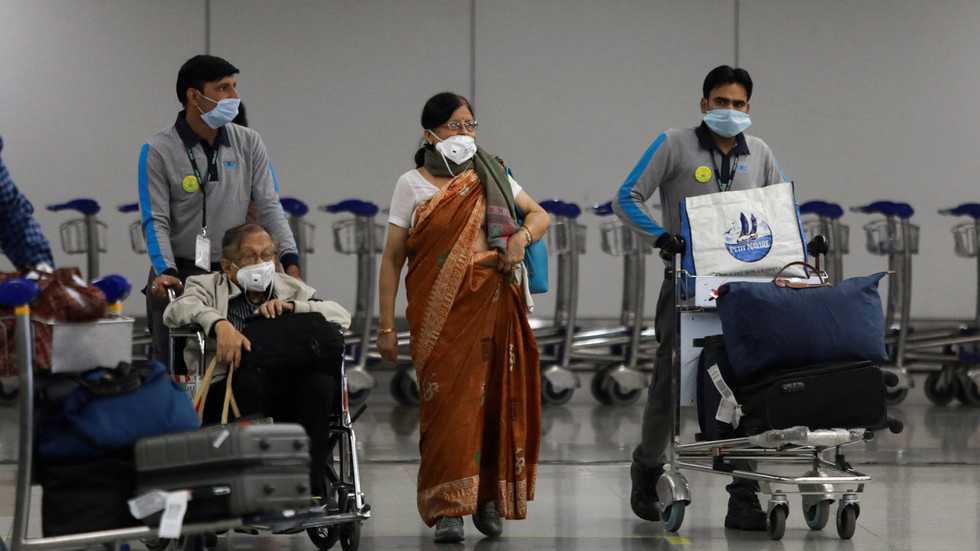
Special flights dotted the Indian airspace as foreign nationals were ferried out to their respective countries in the wake of the novel coronavirus outbreak.
Social distancing became the ‘it’ thing in the nation on Thursday as Indians settled into the second day fo 21-day lockdown. Several interesting cases of social distancing means came forward, while good samaritans made headlines for helping out poor and needy during the lockdown in the wake of the novel coronavirus outbreak.
The central and states governments continued to make efforts to sort of glitches in the home delivery services for essential goods like groceries and dairy. MPs and MLAs cutting across party lines, celebrities, business heads and Bollywood celebs came forward to pitch in the fight against the Covid-19 pandemic, which has claimed the lives of over 22,000 people across the globe.
Fresh casualties reported from Maharashtra, Jammu and Kashmir, Madhya Pradesh, Karnataka and Rajasthan took India’s total toll to 17, while the number of cases confirmed as positive for Covid-19 reached 694. It is a jump of 88 cases in one day. During the lockdown, heartbreaking reports of migrant labourers leaving for their homes on foot have emerged. Chief ministers of different states have pleaded others to help these migrants in times of crisis.
The health ministry said that the lockdown has been successful in breaking the chain of transmission as is ‘evident from the stability in the rate of increase in numbers’. However, a ministry official said, that everyone will have to stick to lockdown guidelines issued by the government to ensure that we come out of the lockdown victorious.
Meanwhile, Prime Minister Narendra Modi attended a G20 meet via video conferencing. During the meeting, PM Modi pitched for developing a new crisis management protocol to deal with the global health crisis and urged the powerful G20 grouping to work towards addressing shockwaves triggered by the pandemic. As per MEA briefing, G20 leaders have agreed to take all necessary measures to contain the Covid-19 pandemic and protect people.
Total number of cases
The number of coronavirus cases climbed to 694 in India on Thursday. According to the ministry data, the number of active COVID-19 cases in the country stood at 633, while 44 people were either cured or discharged and one had migrated.
The total number of 694 cases included 47 foreign nationals, the ministry data said.
Maharashtra has reported the highest number of COVID-19 cases so far at 124, including three foreign nationals, followed by Kerala, where the number of cases has climbed up to 118, including eight foreign nationals, according to the ministry data.
The number of cases in Karnataka has gone up to 55 while cases in Telangana rose to 44, including 10 foreigners.
The number of cases in Gujarat has climbed to 43, including a foreigner.
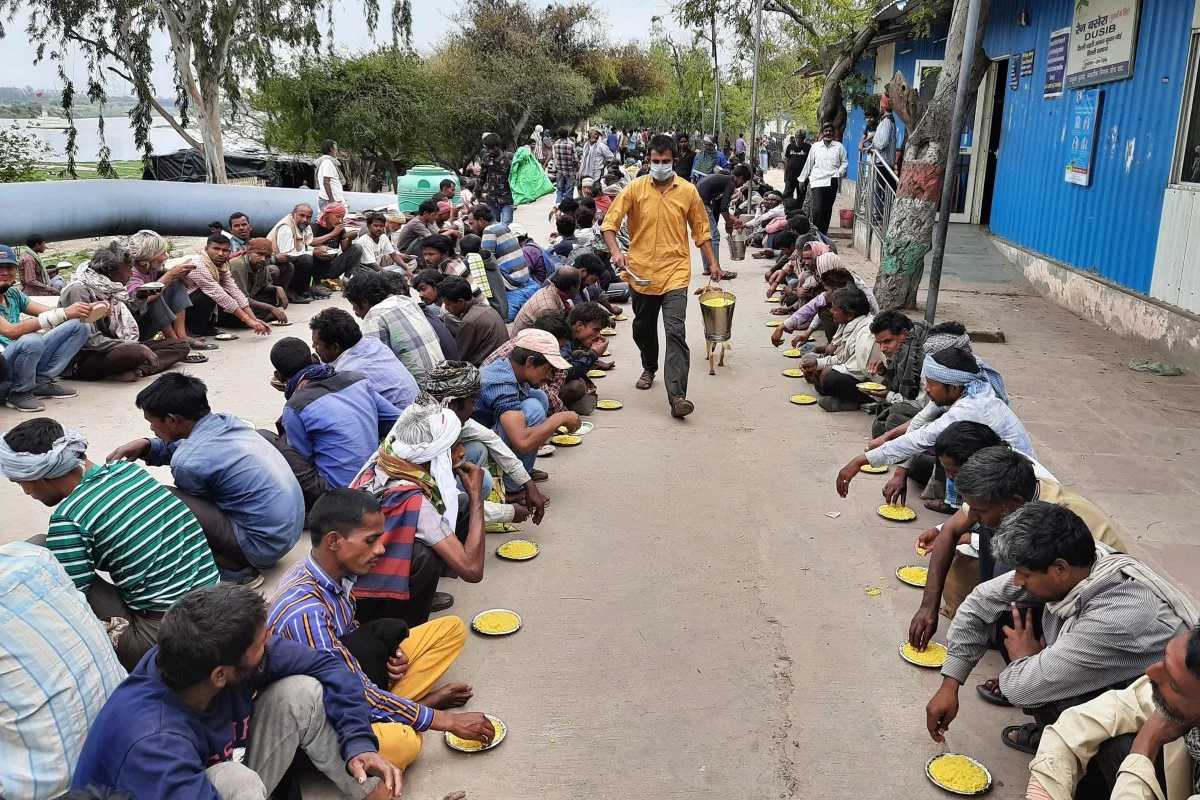
People receive food at a government shelter in New Delhi, after the lockdown to stem the spread of coronavirus meant many poor people were unable to make a living
India has unveiled a US$22 billion package to provide food rations and cash transfers to about 800 million people hit by the coronavirus lockdown.
Although India had a record harvest and has enough reserves, there are concerns about the food supply chain disruptions, especially for the poor
When Indian Prime Minister Narendra Modi announced that a 21-day nationwide lockdown would take effect from Wednesday to stem the spread of the deadly coronavirus, anxious Indians thronged grocery shops and vegetable stores in a spate of panic buying.
But authorities were quick to offer reassurances of sufficient grains such as wheat and rice for the country’s 1.3 billion people for the next four months, thanks to record harvests.
On Thursday, Finance Minister Nirmala Sitharaman announced an initial 1.7 trillion rupee (US$22.5 billion) package chiefly targeting poor households, while prioritising food distribution.
Under the newly launched “Pradhan Mantri Gareeb Kalyan Jojana” (Prime Minister’s Poor Welfare Scheme), each individual who already benefited from a subsidised public distribution system will be able to receive an additional five kilograms of either wheat or rice, and each household will get one kilogram of pulses free of cost for the next three months. The package will benefit about 800 million people.
Direct cash transfers of between 500 and 2,000 rupees will also be made to the most economically vulnerable, such as farmers, daily wage labourers, construction workers, disabled people, poor widows, and women self-help groups.
In what could be the most decisive and crucial action against the spread of the coronavirus (Covid-19) in India, Prime Minister Narendra Modi announced a nation-wide lockdown, a move that health experts say will help in flattening the curve.
This means that once the people-to-people contact is reduced the chances of the virus spreading are also reduced. The next three weeks will be crucial for the country in its fight against the Covid-19 outbreak which has disrupted normal life as we knew it.
But even as we go into lockdown there is some definite good news from the war-front. A total of 41 people who were tested positive for the virus have recovered and have been discharged from hospitals.
As per the figures of the Union Health Ministry, there are 41 cases who have recovered, while independent, state-wise data showed the numbers at 48. With 11 cases each of recovery, Haryana, and UP have topped the list, followed by Maharashtra at 8. However, the Health Ministry figures showed ‘0’ recoveries in Maharashtra.
At 112, the state has also the highest number of positive cases in the country followed by Kerala where 109 people have been confirmed. Maharashtra has so far recorded three deaths while there are no fatalities in Kerala where four people have recovered.
India spent day 1 of the 21 days lockdown scrambling for groceries, vegetables and milk even as the government issued several assurances that essential services and commodities will not be hampered by the lockdown imposed to curb the spread of deadly novel coronavirus.
On Wednesday, India registered 101 new cases of novel coronavirus despite a nationwide lockdown. Total number of deaths due to Covid-19 has reached 12 in India.
Globally, the world tally of positive coronavirus cases has reached at least 427,940 in 181 countries, with 19,246 dead.
In India, the central and state governments held a series of meetings with e-commerce websites, retail chains, vendors and other stakeholders to ensure a seamless supply of essential goods across the nation during the 21-day lockdown period.
While the streets across India bore a deserted look, cops across states ended up booking umpteen number of people for violating norms of lockdown. People were booked for venturing out for no emergency, opening businesses and home quarantine violations.
Meanwhile, Prime Minister Narendra Modi addressed his constituents in Varanasi via video conferencing. During the address, he urged people not to discriminate against frontline workers, including healthcare workers and cops. His statement came as several doctors and policemen reported evictions by landlords after being accused of being coronavirus carriers. The PM said that doctors must be treated like Gods during the current situation as they are helping us fight novel coronavirus pandemic.
A report suggests that the central government is set to announce a fiscal package for the 100 million poors and businesses hit by the shutdown amid the clamour for financial assistance by states.
India has evacuated 277 Indians from Iran. The evacuees have been kept at an army facility in Jodhpur.
Here is your capsule on latest developments on coronavirus outbreak in India:
Death toll reaches 12
India on Wednesday registered three deaths due to novel coronavirus. An 85-year-old woman who had been diagnosed with coronavirus died on Wednesday. It was the second COVID-19 death in the state.
“One coronavirus positive patient, female, 85 years, died in Ahmedabad today. She had traveled abroad, and after developing symptoms of COVID-19, she was admitted at civil hospital on March 22,” the government said in a tweet.
“She was suffering from many complications,” it added. On March 22, a 67-year-old coronavirus patient had died in Surat.
In another case, a 65-year-old woman succumbed to coronavirus at a government hospital in Indore, becoming the first case of COVID-19 death in Madhya Pradesh. The woman, who had no history of travelling abroad in recent times, originally hailed from neighbouring Ujjain and was undergoing treatment at the government-run M Y Hospital in Indore.
Tamil Nadu also registered its first case of Covid-19 death on Wednesday. A 54-year-old man infected with the coronavirus died at a hospital in Madurai in the early hours of Wednesday. The man had a medical history of prolonged illness with uncontrolled diabetes.
The Union health ministry clarified that the second confirmatory test of a Delhi patient who died on Tuesday, came negative. Therefore, the death was not included in the updated toll, it said. The death was shown against coronavirus in Tuesday’s tally. The total death of coronavirus in India now stands at 12.
As per the latest numbers available at the time of filing this report, India registered at least 93 new cases of novel coronavirus on Wednesday, mcuh higher than the previous day’s tally of 52. New cases have been reported from Jammu and Kashmir, Karnataka, Andhra Pradesh, Maharashtra, Kerala, Delhi and Telangana
As per the Health Ministry, India saw 52 new cases of coronavirus on Tuesday. At 99, India had seen the highest surge in infections on Monday.
Goa reported its first three confirmed Covid-19 cases late Wednesday. Three persons, all with travel history abroad, tested positive for coronavirus in Goa on Wednesday, health department officials said, as the tourist haven joined the states which have reported Covid-19 cases.
In Madhya Pradesh, a total of 20 cases have been reported so far — six in Jabalpur, two in Bhopal, nine in Indore and one each in Gwalior, Shivpuri and Ujjain. One person had died of the novel coronavirus in the state.
Uttar Pradesh has a total of 38 positive cases, including a foreign national. A 33-year-old resident of Pilibhit, meanwhile, tested positive for coronavirus on Wednesday. Lucknow’s King George’s Medical University said the patient has no travel history and is a confirmed case of contact transmission,
Three new coronavirus positive cases have been reported in Gujarat. The total number of confirmed cases in Gujarat now stands at 39.
The Maharashtra count has climbed to 128 with 17 fresh cases reported on Wednesday. A 65-year-old coronavirus patient had died in Mumbai on Tuesday, taking the death toll due to Covid-19 to three in the metropolis. The second-highest number of coronavirus infections have been reported by Kerala (109).
India will go on a 21-day nationwide lockdown from today to fight the coronavirus pandemic, PM Modi announced via a televised address on Tuesday night. The national lockdown comes as India reported more than 50 new cases of Covid-19, taking the latest total of patients to 557.
Covid-19 has claimed 11 lives in the country with authorities reporting one death each in Delhi–the second in the national capital–and Maharashtra on Tuesday and over 500 persons being afflicted by the viral infection. Fears are also mounting that more could be hit as the global coronavirus toll inches towards 17,000.
PM ANNOUNCES NATIONAL LOCKDOWN
Prime Minister Narendra Modi on Tuesday announced a complete lockdown of the entire country for 21 days in an unprecedented drastic measure to try halt the spread of coronavirus shortly after which the Centre said all road, rail and air services will remain suspended during this period.
In his second address to the nation in less than a week on the growing concerns over Covid-19, Modi said the lockdown will be in force from Tuesday midnight, as he announced a Central allocation of Rs 15,000 crore to strengthen the health infrastructure to tackle the disease.
BSEB released the Bihar Board 12th Result 2020 today evening on March 24 after an afternoon announcement by BSEB Chairman Anand Kishor who said no press conference would be carried out to declare the BSEB 12th Result 2020.
But since the BSEB Intermediate Result 2020 was declared in the middle of the short lockdown process to slow down the spread of Coronavirus Covid-19, and right before PM Narendra Modi gave his address declaring an extended country-wide lockdown for 21 days, many Bihar Board students are wondering when the BSEB 10th Result would be declared.
As per comments by BSEB Chairman Anand Kishor, the Bihar Board 10th Result 2020 would be declared much after March 31, 2020. This is because the answer sheet evaluation of the BSEB 10th students have been suspended temporarily till the time the lockdown continued. It was presumed earlier that the answer sheet evaluation would probably continue after March 31.
But since PM Narendra Modi has declared a country-wide lockdown till April 15 or for a period of 21 days starting at midnight on March 24, the answer sheet evaluation for the Bihar Board 10th Result 2020 is likely to be further delayed. No official information has been declared yet on the result declaration date.
Around 20,000 board examiners were supposed to evaluate the BSEB 10th board exam answer sheets at over 100 evaluation centres in Bihar. But when the lockdown was announced earlier, there were around 50% Bihar Board 10th answer sheets still to be checked as per an HT report.
The answer keys of both the BSEB 10th board exams and the Bihar Board 12th board exams have been declared.
Kerala decided to go in for a total lockdown from midnight tonight till March 31 with 28 new positive COVID-19 cases, the highest on a single day, being reported on Monday, taking the total number of people under treatment to 91 and more than 64,000 under surveillance.
With positive cases continuing to rise, the government decided to go in for the lockdown from midnight tonight till month end, Chief Minister Pinarayi Vijayan, who held a series of high-level meetings with various departments and stakeholders, said.
At least 64,320 are under surveillance in the state and 383 are in isolation wards of various hospitals.
Of the 28 new cases, 19 are from the worst-affected northern district of Kasaragod, five are from Kannur, one from Pathnamthitta, two from Ernakulam and one from Thrissur, Vijayan told reporters after a COVID-19 review meeting.
This is the highest number of positive cases detected in the state on a single day.
Within the last four days, the state had recorded 67 positive cases.
“Twenty-five of the 28 found positive today had returned from Dubai,” Vijayan said, adding as of now there is no evidence of community spread of the virus.
As part of the lockdown, the state’s borders will remain closed, state run KSRTC and private buses would be off the roads, but private vehicles would be allowed.
Banks would be open only till 2 pm.
“All essential materials will be made available. All state borders will remain closed. There will not be any public transportation.KSRTC and private buses will not ply, but private vehicles would be allowed. Petrol pumps would not be shut and LPG distribution will not be affected,” Vijayan said.
Indian Prime Minister Narendra Modi proposed setting up a ‘SAARC Covid-19 Emergency Fund’ and pledged to contribute $10 million toward it, during a teleconference this Sunday with the leaders of Afghanistan, Bangladesh, Bhutan, the Maldives, Nepal, Sri Lanka and Pakistan.
The initiative is the brainchild of Modi himself, and suggests that India is serious about coping with the contagion at a time when some Western media outlets have insinuated that it may fail to contain the deadly virus. It is worth bearing in mind that India has an open border with Nepal and a porous one with Bangladesh, which may explain Modi’s eagerness to help out the neighbors.
Novel coronavirus cases in India climbed to 250 on Friday after over 40 people were infected with the fast-spreading virus in various parts of the country. The new cases in India were reported from Madhya Pradesh, Himachal Pradesh, Gujarat, Telangana, Odisha and Chhattisgarh.
In fact, India reported the highest number of Covid-19 cases in a day on Friday, as Prime Minister Narendra Modi discussed with chief ministers ways and preparedness of the states to check and prevent the spread of coronavirus, which has claimed more than 10,000 lives globally.
PM Modi, in a conference call, told the chief ministers of all the states to not believe that higher temperature will be of any help to contain Covid-19 cases from spreading. As per the information, the testing capacity of the country will be increased up to 20,000 tests per day by March 23.
During the conference call, many states also pushed the prime minister to enforce a complete shutdown in the country.
A spike in confirmed coronavirus cases prompted the states and UTs to reinforce its efforts to contain the spread. While the Maharashtra government said all workplaces in major cities, including in country’s commercial hub Mumbai and Pune, will remain closed till March 31, the Delhi chief minister announced shutting down of all malls in the city, but exempted grocery stores and pharmacies in them.
MEGHALAYA ANNOUNCES 24-HOUR SHUTDOWN ON SATURDAY
Meghalaya Chief Minister Conrad K Sangma announced a 24-hour statewide shutdown from Saturday midnight and said it will be observed as ‘coronavirus awareness day’. It is not to be taken as a “lockdown”, he urged.
Speaking to reporters after chairing a Cabinet meeting on Friday, he said all public transport, commercial establishments and markets will remain shut to create awareness about the pandemic among the people of the state.
JANATA CURFEW: NO PASSENGER TRAIN TO RUN FROM MIDNIGHT ON SUNDAY
No passenger train will originate from any railway station in the country from midnight to 10 pm on Sunday in view of the “Janata curfew” announced by Prime Minister Narendra Modi, according to a railway order issued on Friday.
“All passenger trains originating between midnight of March 21/March 22 to 22:00 hours of March 22 (approximately 2,400 services) shall not be run. However, the passenger train services already on run at 0700 hours on the day will be allowed to run to the destinations. Divisions should keep a watch and trains which are empty could be short terminated, if required,” the railway order said.
The four men convicted for the grisly 2012 gang rape and murder of a young student in India have been executed by hanging, finally bringing the seven-year ‘Nirbhaya’ case to an end after a lengthy ordeal of appeals and delays. The assailants were hanged at New Delhi’s Tihar Jail 5:30am local time on Friday, following marathon legal proceedings the night prior which saw last-ditch attempts to appeal their sentence shot down.
“Now I will get peace,” said Asha Devi, the mother of the victim who has come to be known as ‘Nirbhaya’ or ‘the fearless one’ in Hindi. She was speaking to PTI after the men’s final hanging date was set in stone early on Friday morning.
The ghastly crime saw a group of attackers descend upon a 23-year-old student and her male companion on a bus in India’s capital on the evening of December 16, 2012, savagely beating both and taking turns raping the young student. Though the woman lived through the initial onslaught, she later died of severe internal injuries, while her friend was critically injured but survived the encounter.
Justice delayed Six men were arrested for the horrific assault, but one of them – a juvenile at the time of the incident – was tried as a minor and released in 2015 after a three-year sentence. An adult suspect, Ram Singh, was found dead in his jail cell in March 2013, a suspected suicide, but police never ruled out murder.
The remaining four men – Vinay Sharma, Mukesh Kumar Singh, Pawan Gupta and Akshay Singh – were convicted of rape, murder, unnatural offenses and destruction of evidence in 2013, with all sentenced to execution by hanging within days of the verdict.
So began a years-long process of delays, which saw each convict exhaust a seemingly endless series of appeals that repeatedly pushed back their date of execution. At various points throughout the ordeal, the courts accused the men of “delaying tactics,” but nonetheless recognized their right to appeal.
A Delhi high court upheld the death sentence in 2014, prompting the men to bring the case to India’s Supreme Court, the country’s highest judicial body. After years of stop-start proceedings, the court struck down their final remaining appeal last December – some seven years after the attack.
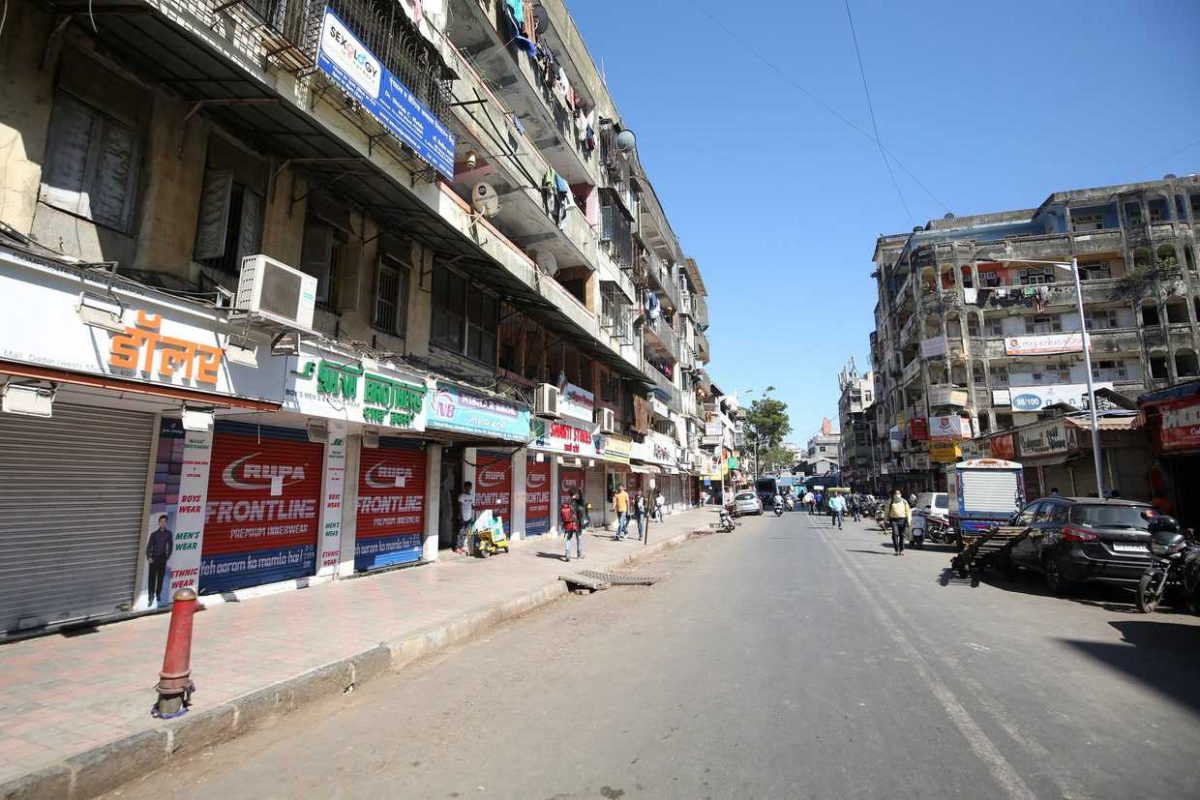
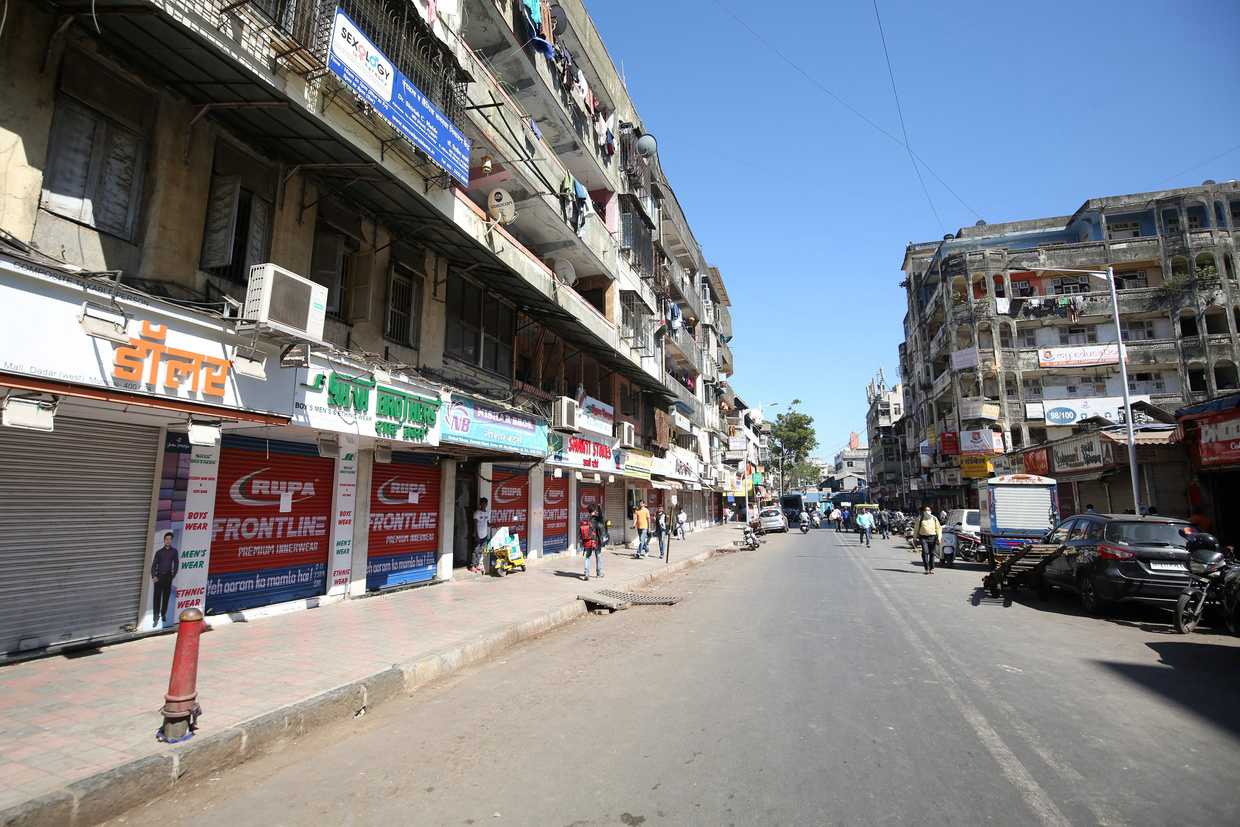
Near-deserted streets of Mumbai, India, after government imposed restrictions on public gatherings in attempts to prevent spread of COVID-19, March 19, 2020
India’s secondary education exams, a touchstone for millions of teenagers aspiring to a quality higher education, have been postponed. Universities have been asked to shutter till the end of March. A government advisory has asked persons above 65 and children below 10 to stay at home. There is no telling when an evening out in shopping malls, now closed, will be in the realm of possibility again.
India’s health ministry has been converted into a virtual war-room. Screenings are no longer limited to the airports alone. Random tests are being administered to citizens, albeit on a very small sample still. Approved laboratories are training new ones. Quarantine beds and virus kits are being built up, while the export of drugs has been halted.
India has reasons to be concerned. If the worst fears were to come true, it would struggle with medical preparedness. It is a densely populated country, with big cities having upwards of 20 million residents. Hygiene is still a worry. Millions of Indians can’t stay indoors all the time, either: if they do, they could spend nights on an empty stomach. An urban civilization, breathing in a tropical climate where infectious diseases thrive, is flirting with a horrific tragedy.
India simply can’t afford to overburden its medical infrastructure. Indeed, Modi has asked citizens to avoid hospitals if they can.
“Postpone surgeries if you could; don’t burden hospitals; seek advice from family doctors or on phone,” he said.
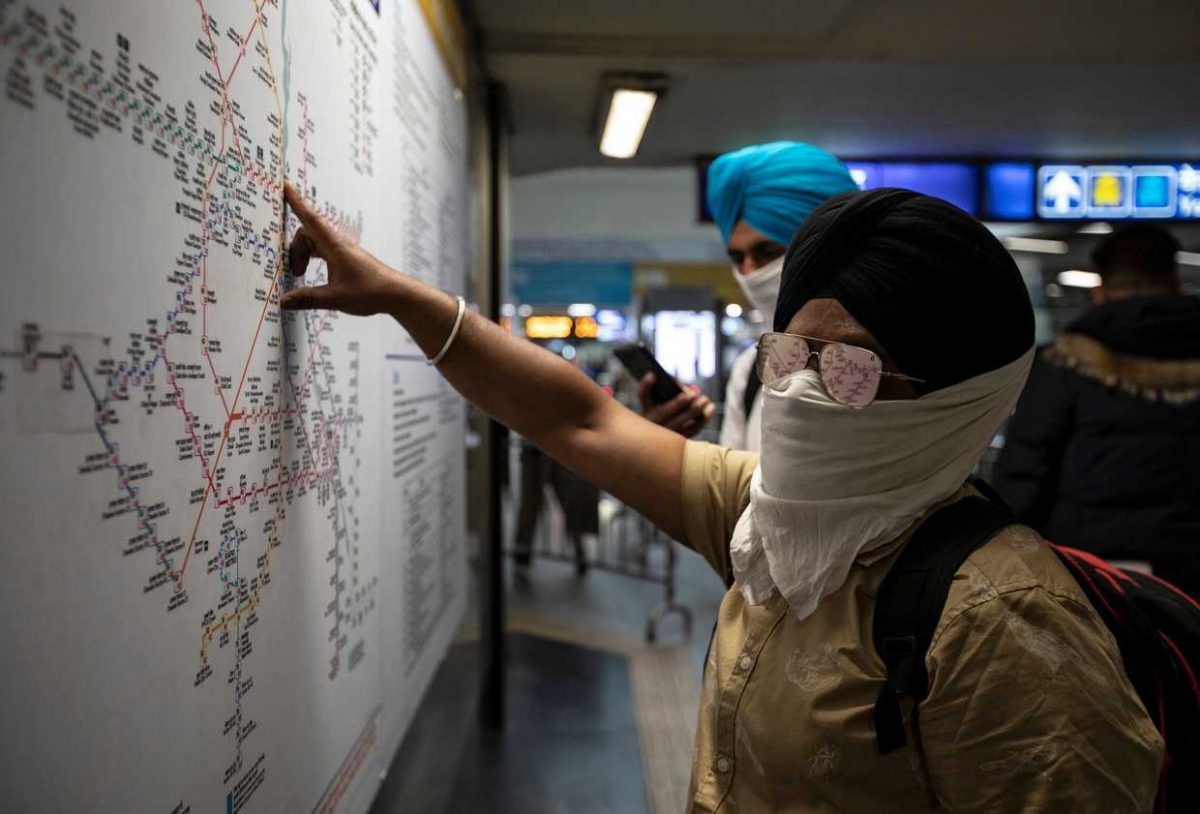
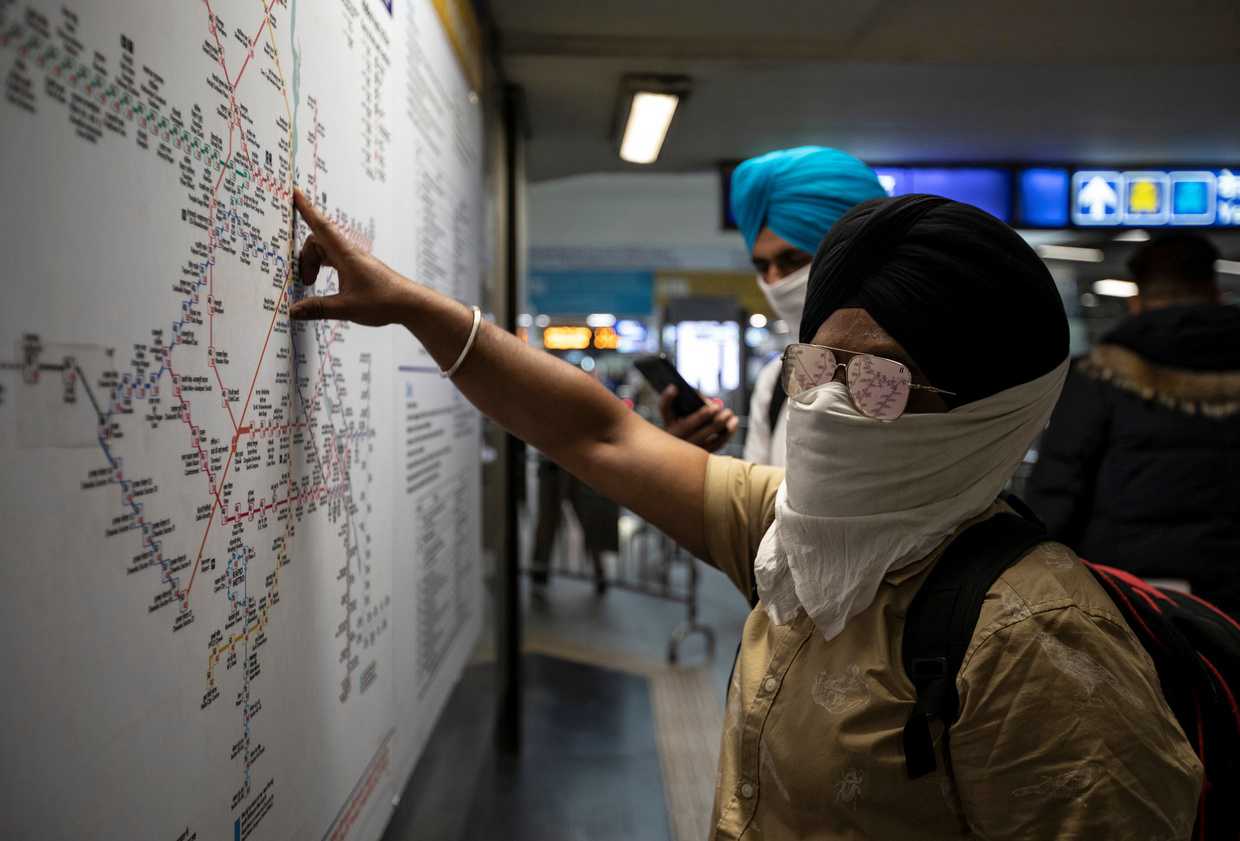
Commuters wearing handkerchiefs as masks look at a metro train map at a station, amid coronavirus disease fears, in New Delhi, India
The telltale signs on the streets and in the neighbourhood do convey that people are on the edge. Long stretches of once-busy streets are now deserted. Neighborhood parks, usually bustling with humanity in the morning and evening hours, are now almost empty. House-wives are stacking up shelves in kitchens with essentials, lest they run out of stocks. Masks and sanitizers are not easy to come by.
If Modi’s words are heeded, we could see a spectacle at 5 pm on Sunday, when millions could be whistling or clapping for those legions of masked medical and other essential staff who are standing between “you and corona,” in the PM’s words.
“We should be at the forefront of this fight against the pandemic. Like the doctors and nurses, baggage handlers and crew members of aircrafts who are evacuating stranded Indians from abroad,” Modi said.
Although the PM has said he does not intend to abandon the ongoing budget session, it is clear that the pandemic has disrupted many of his ambitious plans, from modernizing India’s army and economy to expanding trade and becoming a leader in the region. All of that will now have to take a back seat to battling the coronavirus – with Modi’s political survival, as well as that of millions of Indians, on the line.
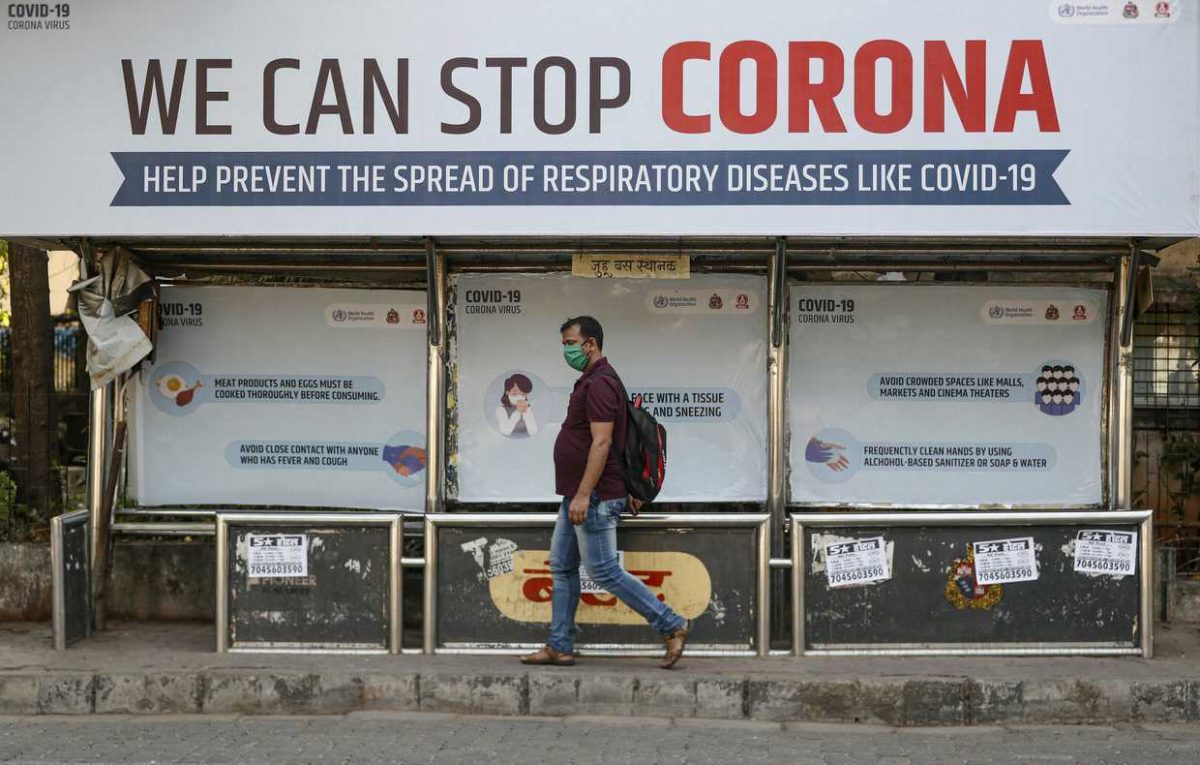
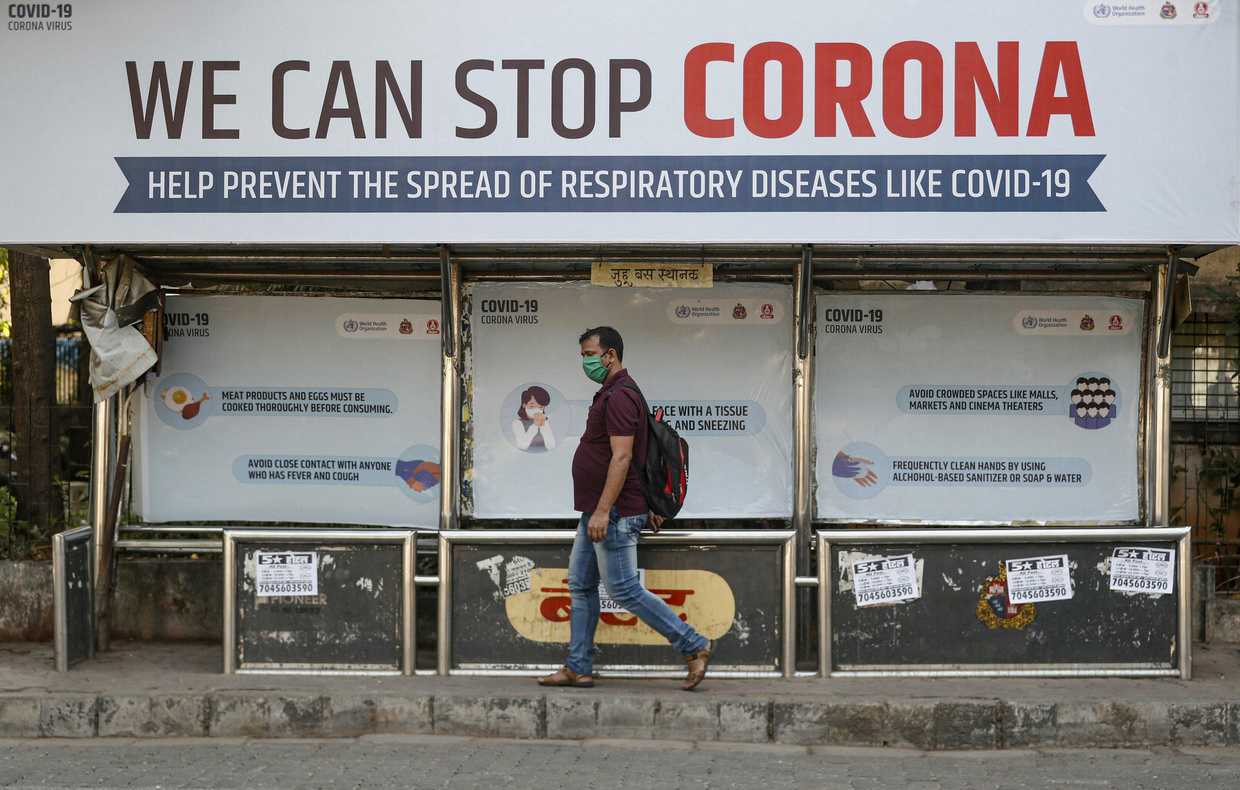
A man wearing a protective mask walks past a bus stop displaying preventive measures against the coronavirus in Mumbai, India, March 18, 2020
With China seemingly out of the coronavirus woods, the world’s second most populous nation is yet to face the worst of it. For Indian PM Narendra Modi, the coming days might be his greatest disaster… or greatest triumph.
It’s easy for headline-hunters to run away with the screamer that Modi “asks citizens for self-curfew on March 22,” which indeed he did in his address to the nation on Friday. However, the seriousness of his warning to citizens that they need to “isolate” themselves wasn’t lost on anyone.
“Science still doesn’t have a vaccine for [the coronavirus]. The trend in countries shows it explodes after a few benign weeks,” warned Modi, lest Indians be lulled into complacency by the reports of four deaths and 180 cases thus far, and come to think that India’s 1.37 billion people are somehow immune to the lurking danger.
Quietly preparing for siege
The Indian state itself has slowly switched to a “lockdown” footing, though the government has desisted from a formal announcement, figuring it would only further the panic and not the cause.
Starting March 22, international flights will not be allowed to land for a week. Railways are cancelling trains by the hundreds. States are shutting down public transport. Formal curfews are being imposed in India’s busy hinterland cities. Shops have been forcibly shut down, except for essential services such as groceries and chemists – as has been the case in Jammu, a city in the Himalayan foothills.
India’s secondary education exams, a touchstone for millions of teenagers aspiring to a quality higher education, have been postponed. Universities have been asked to shutter till the end of March. A government advisory has asked persons above 65 and children below 10 to stay at home. There is no telling when an evening out in shopping malls, now closed, will be in the realm of possibility again.
India’s health ministry has been converted into a virtual war-room. Screenings are no longer limited to the airports alone. Random tests are being administered to citizens, albeit on a very small sample still. Approved laboratories are training new ones. Quarantine beds and virus kits are being built up, while the export of drugs has been halted.
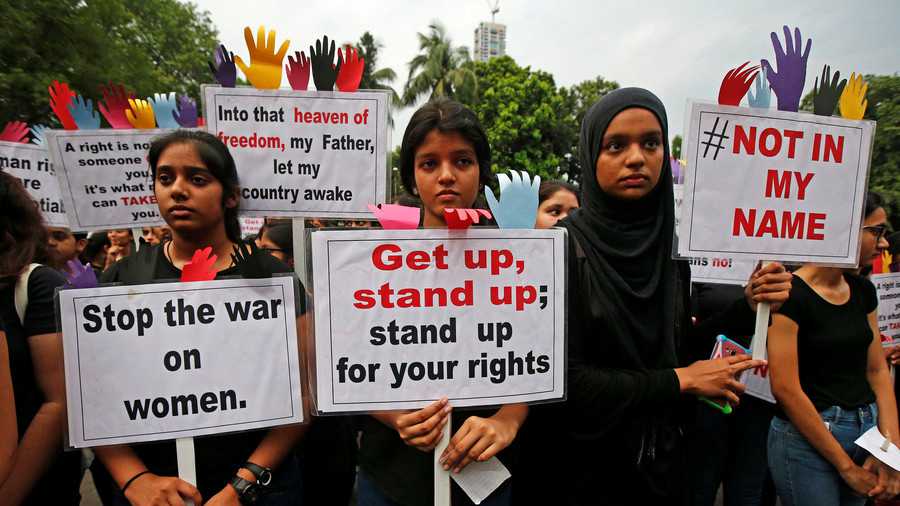
India’s Supreme Court confirmed that the men who gang-raped a 23-year-old paramedic in 2012 will be hanged. The brutal incident shocked the nation, sparking protests and changes in laws regarding sex crimes.
“There is no material to review our order,” the judges said on Monday as they upheld the death penalty verdict for the three men involved in the shocking rape case, local media reports.
All three men were earlier sentenced to death by hanging but launched a lengthy process to review the verdict, claiming that is was “cold-blooded killing in the name of justice.” The fourth man who is also sentenced to hanging chose not to appeal the ruling.
The crime also involved two other perpetrators. One of them committed suicide in custody, while another, who was underage at the time, was sent to juvenile home and released after serving a three-year term.
The 23-year-old female paramedic intern was gang-raped and viciously beaten by a group of men on a moving bus in South Delhi in 2012. The victim, who became known in the media as ‘Nirbhaya’ (‘The Fearless’), died of severe injuries.
A male friend who boarded the bus with her that night was also beaten by the assailants, and knocked unconscious.
The brutality of the crime sent shockwaves across India, sparking massive protests in many areas. The public outcry led the government to change criminal law with regards to sexual assault. The legal definition of rape was broadened, while other crimes, such as acid attacks, sexual harassment, voyeurism and stalking were added to the criminal code.
In April, India introduced death penalty for the rape of minors.
Epidemics hold no sex appeal for politicians. For a terror attack, an economic blockade or a flying enemy missile, others can be blamed — but if you mismanage the outbreak of a killer virus, voters will only blame you. Yet, all over the world politicians are directing blame wherever they can over the mayhem coronavirus has wreaked. Italian politicians are busy fighting one another, US President Donald Trump has pointed the finger at his predecessor Barack Obama — and China and Iran have accused Trump’s America itself of unleashing the virus. Amidst all the chaos, Indian Prime Minister Narendra Modi has taken a different approach to the Covid-19 crisis.
India’s PM quickly initiated a video conference with fellow South Asian Association for Regional Cooperation (SAARC) leaders and pledged $10 million to set up a Covid-19 emergency fund for a rapid response team of doctors to serve the entire region. He also proposed a video link-up for G20 nations to unitedly tackle the epidemic. British PM Boris Johnson and Australian PM Scott Morrison immediately lauded his effort and promised to join.
One move, many outcomes Modi managed to achieve several things with this stroke of disease diplomacy.
First, when most nations have been busy shutting out the world over the endemic, India has opened up a new window of international collaboration against the real common enemy: a lethal virus. Even Modi’s many critics and adversaries will find it hard to disrespect or dismiss his effort.
Second, it enhances India’s global soft power, taking it beyond Gandhi, yoga and Bollywood. It gently re-establishes India’s place as a benign force and an ancient nation which has believed in leading with compassion rather than brute force. It is in many ways Gandhian itself. But more importantly, it is a throwback to the old, harmonious diplomatic approach when the Indian civilisation extended far and wide around the Indian Ocean in the east and up to Afghanistan in the west.
Third, while the western mainstream media and certain leaders have been ruthlessly and hypocritically targeting India and trying to tarnish its image globally over a new citizenship law and the Delhi communal riots, Modi’s outreach to the immediate neighbourhood and the world in a time of crisis should do away with some of that criticism.
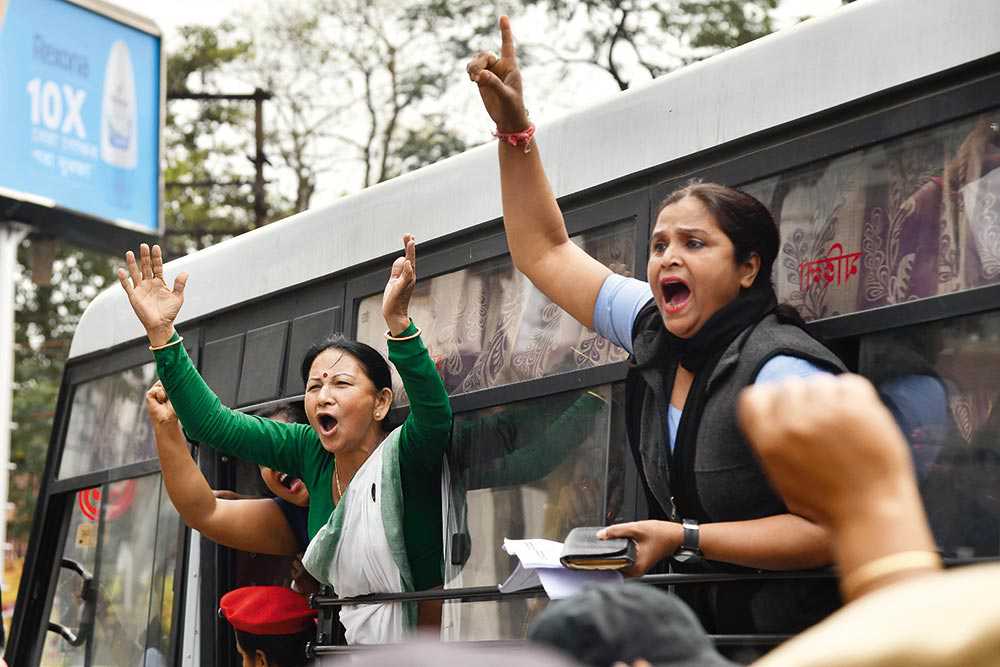
Except for perfunctory condemnations by women’s groups and some social organisations, the gangrape-murder did not see much outrage in Assam, a state which has seen a staggering rise in crimes across women over the past few years. Even the involvement of juveniles without any history of delinquency and the cool calculated manner in which they acted has failed to set alarm bells ringing in the state. For a state which hits the streets more than any other part of the country, the most vocal organisations—including the All Assam Students’ Union (AASU)—appear to have sidestepped the issue.
Writer-activist Akashitora says that influential organisations like AASU have remained highly patriarchal with not a single woman in its leadership since its formation. “They must send out the right message by giving women leadership roles…Our society must shed its misogyny. Boys must be taught the meaning of consent. Is it so hard for educated parents to tell their sons not to look at women just as objects of lust?” Many others feel that easy access to pornography and drugs have also fuelled the spurt in crime against women, especially by underage boys. Activists also blame the “Delhi-obsessed” national media of failing to highlight such crime in the Northeast, which could have put pressure on states’ police to be more proactive. AASU chief advisor Samujjal Bhattacharyya, however, denies the allegations. “AASU is working on the issue (of crime against women) and also working with other women organisations,” Bhattacharyya tells Outlook.
Latest data from the National Crime Records Bureau (NCRB) show another aspect to the issue—a high number of cases under the head of “cruelty by husband/relatives”. A senior official of the state CID says there is a need to go deeper into the components of what constitutes violence against women. “In Assam, around 50 per cent of the cases comprise of cruelty by husband. This is not to say that these cases are fake, but many a time these cases are not followed up by the complainant or resolved or withdrawn and police have little role,” this official adds.
Activists, however, say that such simplification of crime against women only goes to trivialise the issue. A lawyer, who works on gender issues and does not want to be identified, says that “police attribute the large number of cases to the fact that more complaints are lodged by victims nowadays”. What does that mean? She asks. “Crimes are happening, conviction rate is low…serial offenders are naturally emboldened. Policing must be visible. A couple of years ago, at least two women were raped and murdered on trains in separate incidents. This lack of security in public transport is a serious issue,” she says.
Assam Police director general Bhaskar Jyoti Mahanta attributes the rising number of crime to multiple reasons. “One is overexposure to perverse media content, two, the breakdown in social mores, the traditional value systems and thirdly, women are becoming more aware and assertive and reporting such cases,” Mahanta says. He adds that officials involved in POCSO cases have been trained and sensitised to deal with the minor survivors. Besides, police are also partnering with civil society groups, domain and legal experts to tackle crime and ensuring prosecution.
Others point to social issues. Like Anurita P. Hazarika of the North East Network, a organisation working on gender equality and safety. She says Assam’s rate of violence against women stands out in comparison to other states in the region for a variety of reasons, including how Assamese society is composed of communities which have emerged out of tribal and caste backgrounds. In Nagaland and Meghalaya, for example, the communities are mostly tribal.
“The caste strictures are followed rigidly and the onus of following them is mostly on women. When they don’t follow them, violence is used as a means to control them.” However, it does not explain the fact that the nine boys accused of gang rape are from the Mishing tribe. All have sent to an observation home. Police, however, say ‘only’ three of them raped the minor.
A new abbreviation, WFH, is all over. Work From Home isn’t a weekly or monthly amenity anymore—it’s the new normal for the foreseeable future. And people are rediscovering themselves. A big KJo family drama is unfolding in homes across Indian cities…call it Love in the Time of Corona.
It’s like an unofficial, self-imposed Section 144 over most of urban India. Yes, COVID-19 is still an urban disease: from its entry through gleaming, private-run airport terminals, it will percolate out to the hinterland via the city-village interface that unfolds every day, from the NRI and the phoren-returnee to the ATM guard, the Uber driver and the domestic help who flits between condominium towers and subhuman tenements. And we have scores of detective stories unravelling (in between a worldwide medical thriller that could put a Robin Cook in a trauma ward). Who all did the 18-year-old boy who returned from the UK to Calcutta on March 15 meet in his first 36 hours? His IAS mother and doctor father, instead of quarantining the son, threw a welcome party for him. And next day, he was taken for an impromptu tour of Nabanna, the state secretariat complex, by his bureaucrat mother, who, incredibly enough, later held a state-level meeting on coronavirus in those offices! A new kind of visual is being issued with urgency: patient flow charts, detailing every point in their itineraries, every place they visited. Between now-emptied cafes and the very many boxes from a week ago lined up in those flow charts may lie the story of a would-be Malthussian epidemic.
Yes, Malthussian. A world death toll of 45 million is being lobbed around as a possibility by academicians—if governments do nothing. How? That’s extrapolated from an Imperial College modelling of what can happen in the US and UK. Eighty per cent of Americans get infected, and four million die, in that scare scenario—“the whole population of LA”. Even if governments are reasonably proactive, the number is only halved. Health experts in India say finally 85 per cent of us will inevitably get infected. It’s only a question of when, and whether by that time vaccines and treatment protocols are in place. So tracking those flow charts is of paramount importance. That’s why Yuval Noah Harari, author of Sapiens, a 443-page ‘brief history’ of everything human, told CNN’s Christiane Amanpour that the end result will be massive and permanent surveillance states that will use biometrics and every other technological tool to track all of us each moment of our lives, long after Corona again becomes the name of a beer.
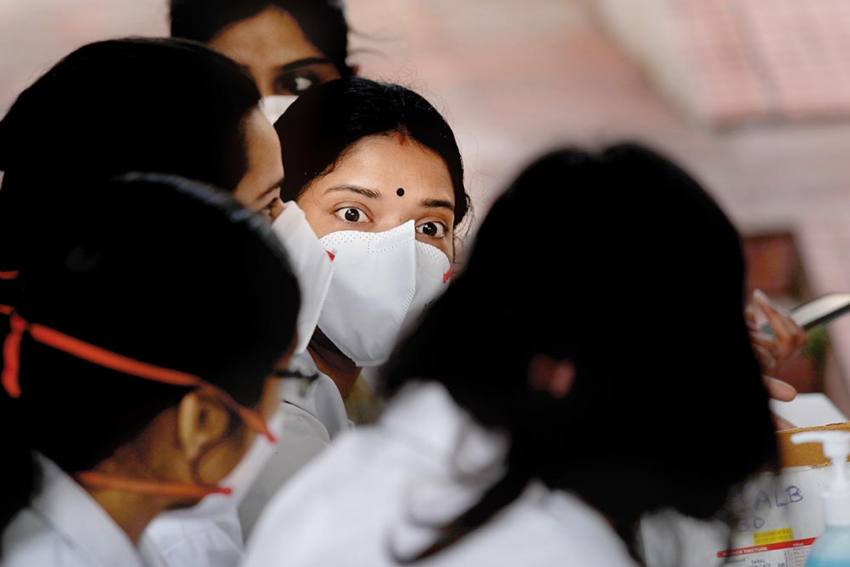
But that’s tomorrow’s nightmare. Today it’s a different battle, a new frontline everyday. Scientists across the world are poring over the virus’s genome sequence to find a way to tame the beast. Potential vaccine formulations—brewing in test tubes from Israel to Canada to a biotech firm in San Diego, and sundry world universities—have already sparked a debate between patenting and cheap access to the poor. In India, scientists under the aegis of ICMR-National Institute of Epidemiology have received DGCI approval for a drug combination (lopinavir, retonovir et al) as an “effective” ad-hoc measure—“we do not have time in this emergency situation,” one of the authors of the protocol told The New Indian Express. There’s another frontline: doctors, paramedics and others who are fighting the war blindfolded, and in the direct line of fire. We dedicate the following package to profiling some of these bravehearts.
But between science and the people, there’s that crucial intermediary: the government. It was the Imperial College report that curbed the schoolboy braggadocio of both Brexiteer Boris Johnson and the White House, and chastened them into a dead serious mode. (The US’s initial tardiness is blamed for the system shock it faces now; and the UK was forced to back out of its controversial ‘herd immunity’ idea, which rested on actually allowing everyone to be infected!)
Where does India stand? Are we really at Stage 2, where only the initial incoming cases from abroad and their contacts are infected, or have we crossed the frightening threshold to Stage 3, ‘community transmission’? If we don’t want to wait for an actual body count, the only way to know is through testing. The crucial debate is over that: who to test, how much to test? South Korea was testing upwards of 4,500 people in a million: some said that was excessive, even if that country had tamped down on its cases for now. India was hugging the other extreme: 3-in-a-million! And many attributed our low official COVID-19 count to the plain fact that we wouldn’t know if we haven’t tested. But on March 17, perhaps a week or two late, we finally had some signs of policy movement. The India Council for Medical Research (ICMR), besides roping in government institutes under the CSIR and DRDO, is now opening up testing to private labs, marking a shift to wider surveillance.
This phase will go beyond those first ones with a ‘virus visa’ and their primary contacts to a wider sample, explains Prof Gagandeep Kang of the Faridabad-based Translational Health Science and Technology Institute, and a Fellow of the Royal Society. “The idea is to start doing syndromic surveillance, which is what ICMR is doing…it is testing through its influenza network,” she says. If and when Stage 3 is actually reached, mass testing doesn’t add much information to the public health system and can be restricted to only the severe cases, she says. The ICMR says India is in Stage 2 and there’s no evidence of community transmission so far—that there’s still a window to contain an outbreak which seems inevitable. These are the moments when faith in the government and official data (which Harari mentioned as crucial) becomes crucial.
“The expert committee has given a revised protocol for COVID-19 testing,” ICMR chief Dr Balram Bhargava said on Tuesday. “We have scaled rapidly,” he added, explaining that the ICMR system has 72 functional labs and another 49 public labs will start by the end of the week—among these, two high throughput systems in two locations that can test up to 1,400 samples a day. Around 51 certified private labs will come on stream soon. And orders have been placed for a million probes—a key component of the polymerase chain reaction test that’s imported—while reagents and primes are at hand, he said. And the bare outline of a collective public-private endeavour is at last visible. “The modalities are being worked out,” Arvind Lal, chairman and managing director of Dr Lal Pathlabs, tells Outlook. “We have already approached our suppliers. Once we get the green signal from the government, within one week the tests will be up and ready.”
India’s government has announced a temporary halt to all commercial flight arrivals, as part of a series of measures being put in place to contain the spread of coronavirus in the country. The Press Information Bureau issued a bulletin on Thursday outlining a series of new policies aimed at combating Covid-19. Passenger aircraft will be barred from landing in India for one week, starting on March 22, the press release said. Discounted railway travel and civil aviation will be suspended except for students, patients and people with disabilities.
Additionally, citizens above the age of 65, and children below the age of 10, have been encouraged to stay at home until the health crisis passes. New Delhi has also called on private firms to ask their employees to work remotely. Government employees will have staggered schedules in order to reduce the risk of human-spread infection.
The new measures will not be accompanied by a nationwide lockdown – a claim that was spread widely on social media, but fiercely denied by the government.
India has fared surprisingly well amid the coronavirus outbreak, with around 180 confirmed cases and four deaths as of Thursday.
Globally, the pandemic has infected 220,000 and killed 9,000, according to current tallies. China – the epicenter of the virus – registered its first day without local infections since the start of the outbreak more than two months ago. However, Covid-19’s spread west has left Europe and the United States bracing for what many believe will be a devastating health crisis.
India runs on coal and travels on oil. Oil and coal and their products make up four of top five imports for India. The only exception is centuries-long longing for gold among Indians. In value terms, crude oil is the single largest import contributor and has consistently accounted for more than 20 per cent of India’s imports basket.
India imports about 85 per cent of its fuel oil needs. It is the third largest consumer and importer of the crude oil in the world. Any fluctuation in the crude oil prices is bound to impact Indian economy. Inflation, current account deficit (CAD), fiscal deficit and overall GDP (Gross Domestic Product) growth rate gets favourably or adversely impacted.
The RBI estimates that a crude price shock will be followed by high CAD to GDP ratio if price increase is passed on directly to the final consumers, this January 2020 RBI paper says.
There have been suggestions that India should stockpile oil when the prices are favourable in the international markets. The current prices of crude oil present one such situation for India. The crude oil fell below $30 per barrel on Monday. On Wednesday, the prices fell below $26 per barrel. The last time crude oil prices had fallen to $26 per barrel level in 2016 after which it started increasing. In January, the crude oil was selling at $70 per barrel.
Indian government has decided to increase its strategic petroleum reserve (SPR) by buying oil from Saudi Arabia and UAE, the principal players responsible for sharp cut in crude oil prices due to rivalry between the factions of oil exporting countries. Saudi Arabia increased its oil output from less than 10 million barrels a day to 13 million barrels per day.
The total number of novel coronavirus-positive cases in India has risen to 153. Three fatalities have also been registered. Italy has lost 2,500 people to Covid-19 and these numbers don’t seem to be slowing down. The novel coronavirus has impacted all forms of livelihood. Countries like Spain and Italy are on lockdown. People are practising self-quarantine in an attempt to slow the spread of the novel virus.
To also put a halt on the increasing number of cases, governments of various countries, including India, has put a ban on people entering their country from abroad. According to a PTI report, India has banned the entry of people flying in from Europe, Turkey and the UK from March 18 to 31. People on vacation or business tours outside the country are currently stuck on foreign lands.
Reports of a lot of passengers being stuck at the Bali airport are doing the rounds on Twitter. One user shared pictures from the Bali airport and wrote, “150 plus Indians stuck at Bali airport. Many more in Bali, no help from the Indonesian government, no support from Air Asia. And other flight tickets are too expensive #helpneeded #indiansstuckatbaliairport,” and he tagged Prime Minister, Narendra Modi and Home Minister Amit Shah in his tweet.
The 33-year-old researcher, who had recently returned from Italy, is lodged at the state-run Capital Hospital here. He is the first confirmed case of the deadly disease in the state after a test report on Monday last.
Bagchi said that the youth “had a good breakfast this morning, he had upma and aloo matter sabzi. In lunch, he had rice, dal and curry. We are praying he gets better soon and comes back safe and sound.”
Bagchi also stated out of 47 samples taken in the state, 46 have tested negative.
He advised religious institutions such as temples, mosques, churches and gurdwaras to strictly adhere to social distancing measures and take necessary steps to restrict the entry of devotees.
“Those institutions which cannot fulfil these guidelines need to make sure that worshippers do not come there and the institution needs to take care of the safety and security of the people who come for worship and rituals as well as law and order for people who are there,” Bagchi added.
Bagchi pointed out that any pilgrim who visited a religious institution and touches any surface has to wash his/her hands with soap and added that anyone having flu-like symptoms with fever will not be allowed to these institutions.
So far, the Odisha government has identified 6,323 buildings in panchayats to serve as temporary medical camps or quarantine if needed.
The total number of confirmed novel coronavirus cases in the country has reached 169 after seven more were tested positive for Covid-19 in Telangana. All seven new cases are Indonesian nationals. Section 144 was imposed in Davangere in Karnataka, Noida in Uttar Pradesh and Rajasthan as the number of confirmed coronavirus cases climbed by 28 on Wednesday.
In Maharashtra, which has the highest number of positive coronavirus cases so far, three more persons, including a woman, tested positive for the Covid-19, taking the number of infections in the state to 45. Pune district’s count touched 19 on Wednesday after a 22-year-old man with travel history to the Philippines tested positive for the coronavirus in Pimpri-Chinchwad.
Meanwhile, a suspected coronavirus patient has committed suicide at Safdarjung Hospital in Delhi, soon after he was admitted to the facility by airport authorities. The man was brought by the airport authorities as a coronavirus suspect and was immediately put in the isolation ward. He forced open the isolation ward and jumped off the seventh floor of the building, the hospital authorities said.
Prime Minister Narendra Modi will address the nation on Thursday evening on the situation arising out of coronavirus outbreak and the efforts to combat it, the Prime Minister’s Office said on Wednesday.
“PM Shri @narendramodi will address the nation on 19th March 2020 at 8 PM, during which he will talk about issues relating to COVID-19 and the efforts to combat it,” the PMO tweeted. In another tweet, the PMO said Modi chaired a high-level meeting to review the ongoing efforts to contain the spread of coronavirus.
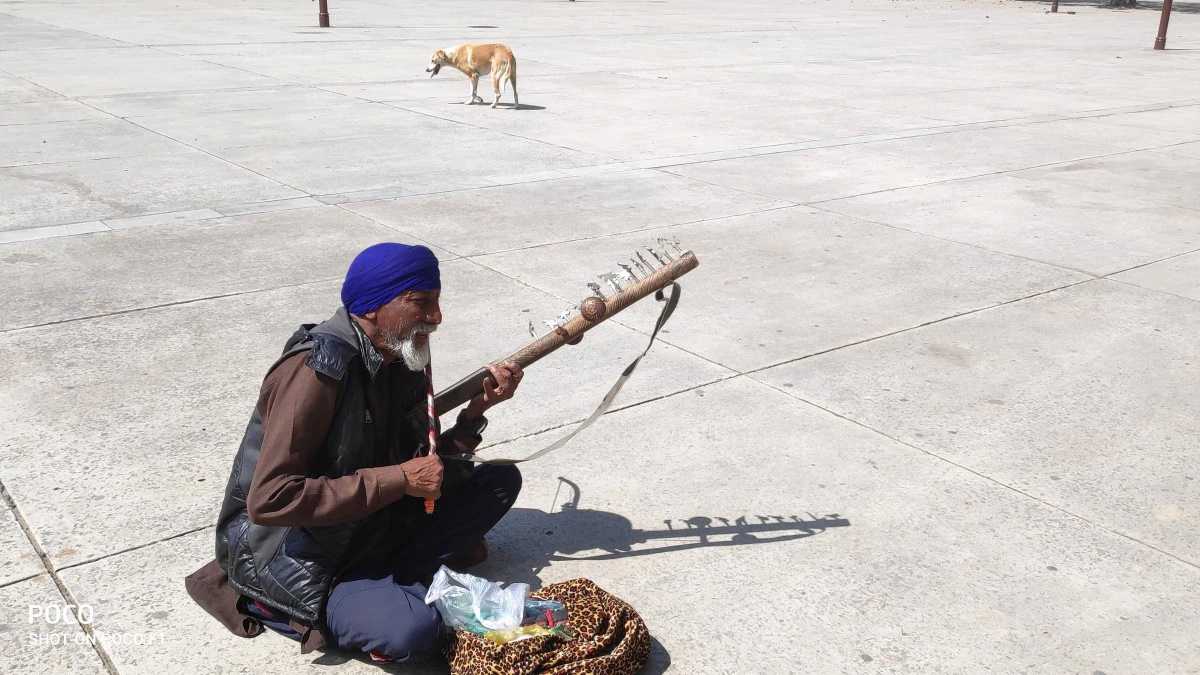
Street singer and musician Jograj Daulatnath plays an instrument in a deserted market
Jograj Daulatnath, a 70-year-old street singer and musician, often comes to Chandigarh’s Popular Plaza in sector 17 to earn his livelihood. He has been doing this for the last 38 years.
He sits in the middle of the streets and grabs the attention of people by playing his instrument and singing a folk song. This is a routine day for Jograj.
However, from the last one week, his income has witnessed a major drop. The markets bear a deserted look following the novel coronavirus outbreak.
People informed him it is some disease which has compelled everyone to stay indoors. When asked about the same, he expressed ignorance about the novel coronavirus scare. “I don’t know why people are not in the market. It is some disease which is keeping the people confined to homes” Jograj reveals.
Jograj is a patient of asthma. He also showed us an inhaler pump and said it was empty.
He hails from Churu, Rajasthan and lives in a slum near Chandigarh. He came to Chandigarh in the year 1982 and has been singing from the age of 10. He has six daughters out of which three are married.
“I own an Aadhar card but the Chandigarh administration refused to give me the social security pension as I do not have a birth certificate. I have to feed three daughters and have no money” says Jograj.
Jograj is not an isolated case of people affected by the lockdown. There are hundreds of people who have been affected because of the outbreak and have lost their daily earnings.
India has closed the iconic Taj Mahal and other monuments to visitors, citing the coronavirus epidemic. The cultural sites will remain closed until the end of the month, the Culture Ministry announced. The ministry declared all 3,691 monuments and sites protected by the Archaeological Survey of India would remain shuttered until March 31 following a high-level Group of Ministers meeting devoted to Covid-19 on Monday.
Closing the historic sites is part of a larger plan agreed upon by the Group of Ministers to ramp up containment measures relating to the coronavirus. The plan includes tightening travel restrictions and shutting down some businesses.
“Important measures including the closing of schools, swimming pools, malls, allow employees to work from home, less use of public transport, one-metre distance between people should be maintained till March 31,” the Joint Secretary of the Union Health Ministry told reporters on Monday.
India has prohibited travel from EU and European Free Trade Association countries, as well as Turkey and the UK as of March 18, while a 14-day compulsory quarantine will take effect for visitors from Qatar, Oman, Kuwait, and United Arab Emirates.
Four new cases of the virus were announced on Monday, bringing the total for India to 114, with two deaths, three patients treated, and 10 discharged.
Some 5,200 people who have had contact with India’s known coronavirus patients are under surveillance, the secretary said.
India officially declared the coronavirus epidemic a “notified disaster” over the weekend, elevating it to the level of earthquakes, avalanches, and other natural disasters and giving local governments access to a special fund earmarked for disaster response.
The history of Jyotiraditya Scindia’s family-the man currently making waves in the political world-is in some ways strongly linked to important moments in Indian history. In 1761, at the Third Battle of Panipat-fought between the Marathas and the Afghan Ahmed Shah Abdalli-the Scindia contingent of the Maratha army saw grievous losses, including the deaths of commanders like Tukoji Scindia and Jankoji Scindia. This battle involved what is considered one of the greatest massacres in the history of war, with perhaps 50,000 Maratha soldiers and non-combatants killed, alongside 20,000 Afghan soldiers.
The Past
A man who providentially escaped the battle field was the grievously injured Mahadji Scindia, possibly Jyotiraditya’s most illustrious ancestor. He went on to be, in many ways, central to the resurgence of Maratha power after battle of 1761, becoming the arbitrator of Emperor Shah Alam’s affairs in Delhi, leaving a rich legacy of diplomatic vision and bravery. Some rank him as the third most important hero in Maratha history, after Chattarapati Shivaji and Peshwa Bajirao. The great historian Jadunath described Mahadji as a colossus, whose bravery and farsighted diplomacy delayed British dominance over India by almost 20 years. In fact, some say his death in 1794 began the disintegration of the Maratha Empire and the dominance of the British.
Mahadji Scindia, as ruler of Gwalior, left a rich legacy. His tolerance and policies to manage Hindu-Muslim unity established a model that in many ways informs Indian society today. He is noted for welcoming moderate Muslims, but is also known to have been severe with their radical cousins. One reason credited for his policies was an experience on the battle field of Panipat-his life was saved by a Muslim, Rana Khan. The model of composite culture that Mahadji left behind was visible in Gwalior till princely rule ended in 1947. It included attempts to foster unity, like Hindus being requested to wear green clothes during Id and Muslims being encouraged to actively participate in key Hindu festivals.
However, British rule in India also involved painful decisions for Indian rulers, some of which are still potent as accusations today. One such is the decision by another of Jyotiraditya’s ancestors, Jayajirao. During the Indian revolt of 1857, Jayajirao Scindia, as ruler of Gwalior, sided with the British during the Indian revolt, helping to suppress it. However, what is also true is that he was not alone in his decision-many other Indian rulers also sided with the British, doing the same.
The Scindia family retained its importance after India’s independence. Sardar Patel and the then ruler of Gwalior-Jyotiradita’s grandfather, Jiwajirao-shared a brief but warm relationship between 1947 and 1950, when Patel died. During the merger of Princely States with the Indian Union, Sardar Patel held in high esteem those rulers who were found to have ruled their people well. Jiwajirao was one of those princes, in Patel’s eyes. According to V.P. Menon, his manfriday during the enormous administrative exercise of the merger, Patel had found Gwalior’s finances to be in excellent condition and had developed quite some respect for Jiwajirao and his administration, even noting the fact that the court of Gwalior had maintained a special fund, Gangajali, to help its poorer citizens get healthcare and other social benefits. The friendship that developed was strong enough that after Patel died, Jiwajirao had a painting of him commissioned and hung in Parliament, where it still hangs today.
Saturday night in Bengaluru amid the coronavirus scare was like any other Saturday night. Pubs and bars were open on the 100-feet-road and the on by-lanes of Indiranagar, Koramangala, Lavelle road and other parts of the city. This, despite the fact Chief Minister BS Yediyurappa had ordered the closure of pubs for a week from Friday midnight onwards.
Residents of Indiranagar are up in arms as they say this is a ‘sitting time bomb’ for Covid-19 to spread. Indira Vishwanath, an Indiranagar resident, tells India Today TV that at 8 pm almost all the pubs and bars were open.
“We want them to shut down in order to maintain the social distance between people. Even if one customer has this deadly virus, he or she can spread it to everyone there, including the employees,” Indira Vishwanath said.
She added that if schools and colleges are closed and the government is encouraging people to work from home then, why the “non-essential establishments” in their neighborhood are not shutting down.
City Police Commissioner Bhaskar Rao also told India Today TV that all pubs and bars should be shut.
“Countries around China have imposed self-discipline. We can give directions. We have to make sacrifices. We can treat 100s now, we can’t treat 1000s,’ Bhaskar Rao said.
The police commissioner also says that if pub and bar owners do not follow the rules, then the next step is to use strict action against them.
“Tomorrow we will take a review. Day before yesterday we did that. We can’t go overboard suddenly also. It is not something I am privy to. The whole world knows what’s going on all over. If you want to make a quick buck there, you can browbeat me but not the virus,” Rao added.
To control the spread of Covid-19 in the limits of Bengaluru City, the authorities ordered that places of mass gathering like cinema theatres, malls, marriage halls, night clubs, etc. will be closed. The order was promulgated under the regulation of the Government of Karnataka.
Pub owners have found a loophole in the orders passed by the Excise department. The Excise Department order does not mention that bars had to be shut. Apparently, bars, where people can sit and drink, are allowed to be open.
Night clubs are where there are dance floors. These are to be closed because they are categorised as crowded areas.
The Excise Department has issued separate licenses for different kinds of establishments. Night clubs have CL-4 licenses while the Excise Department categorises bars as refreshment rooms and issues the CL-9 license to such establishments. Hotels are given CL-7 license.
But, citizens are complaining that on one hand pubs are allowed to be open, the police are forcibly downing the shutters of big supermarkets.
India has stepped up its efforts to tackle the coronavirus spreading throughout the country, labeling the virus a “Notified Disaster.” The designation allows local governments to tap into a special disaster-relief fund. Covid-19 virus, which has already infected over 80 people across India, was formally branded a “notified disaster” by the Ministry of Home Affairs on Saturday. Such a designation has effectively put the outbreak on a par with earthquakes, tsunamis, avalanches and other major natural disasters. The classification enables state governments to spend more money from the State Disaster Response Fund (SDRF) on tackling the outbreak. Apart from funding hospitalization of Covid-19 patients and paying compensation to the relatives of coronavius victims, the funds can now be funneled into procurement of essential protection and lab equipment. While India has been affected by coronavirus rather mildly, with over 80 confirmed cases (including two deaths), the country is apparently bracing for a large-scale outbreak. Earlier in the day, India’s sports authorities suspended all domestic cricket matches until further notice and football games were put on hold until the end of the month.
In a surprise move, PM Narendra Modi called upon the countries of the South Asian Association for Regional Cooperation (SAARC) to come together and tackle the virus spread in the region. India has been distanced from the eight-nation bloc for the past several years because of its tensions with Pakistan.
In Gujarat in western India, fabric producer Sidwin Fabric is preparing to ship several tonnes of spunbond non-woven fabric to China next week, capitalising on the mainland’s huge facial mask-making boom during the coronavirus pandemic. China’s desperation for the raw materials used to make the masks is resulting in a bonanza for Indian companies, which have been shipping more of their high-grade products to China, eclipsing the amount sold locally. China, the world’s biggest mask maker, went from producing 20 million masks a day to 116 million since late-February when Beijing started directing its powerful state-owned enterprises to lead the increase in production. Encouraged by Beijing’s incentives to make more masks, including lower taxes and subsidies, many private Chinese operators have added mask production lines to their factories, or expanded existing operations. But China’s ability to direct resources to where they are needed in the economy meant a bottleneck formed in the supply of key products such as non-woven fabric. Factory owners in China said raw materials for masks were difficult to source, even after transport impediments had eased following the initial lockdown across Chinese. A thousand kilometres away in Haryana, near New Delhi, Aditya Nonwoven Fabric is also preparing to ship out three to four orders to Hong Kong and China. A company representative did not say how much was being sent, but an average daily order for the firm is around 20 tonnes. The company has fielded many calls from China during the coronavirus outbreak, having previously fulfilled mainly local orders, while also selling to neighbouring Pakistan and Bangladesh. “Now our target first is to export,” the representative said.
Islamabad has signaled willingness to partake in a joint response to the coronavirus with a bloc of South Asian nations, after Indian PM Narendra Modi broke years of stalemate with the regional body and called for coordination. Pakistani Foreign Ministry spokesperson Aisha Farooqui said on Friday that the country’s Special Assistant to the Prime Minister (SAPM) on Health Zafar Mirza would participate in a joint teleconference with leaders from the South Asian Association for Regional Cooperation (SAARC) to formulate a combined action plan to contain the outbreak.
“The threat of #COVID-19 requires coordinated efforts at global and regional level,” Farooqui said in a tweet. “We have communicated that SAPM on Health will be available to participate in the video conference of #SAARC member countries on the issue.”
The announcement comes hours after Modi suggested leaders of SAARC countries come together to sketch a general blueprint for tackling the illness and halting its spread in the region – a surprise change of position for New Delhi after distancing itself from the eight-nation bloc for the last four years over intense disagreements with Islamabad.
“I would like to propose that the leadership of SAARC nations chalk out a strong strategy to fight Coronavirus,” the PM said in a tweet. “We could discuss, via video conferencing, ways to keep our citizens healthy. Together, we can set an example to the world, and contribute to a healthier planet.”
The SAARC’s last summit was planned for Pakistan’s capital in 2016, but the meeting was called off after a terrorist attack launched by Islamist militants in disputed Kashmir near the Line of Control left 19 Indian soldiers dead, prompting New Delhi to boycott the conference. In the wake of the attack, India accused Pakistan of supporting terrorists responsible for the killing, with Islamabad rejecting allegations it had any involvement.
The incident became one of the deadliest attacks on Indian security forces in the disputed territory, and led to a major flare-up between the two countries. India subsequently claimed it took out dozens of militants in “surgical strikes” on the Pakistan-administered part of the region. Islamabad, however, denied that any bombing ever took place.
While short of outright rapprochement between the nuclear-armed neighbors, the agreement to work out a combined response to Covid-19 comes as one of the most significant steps toward cooperation in years, a move that was welcomed by some Indian netizens and members of the press.
Police in the Indian city of Nagpur have been hunting down patients who fled the isolation ward of a local hospital where they were interned after showing flu-like symptoms. Three out of five runaways have been tracked down.
The patients, two women and three men, were placed in a special isolation ward in Indira Gandhi Government Medical College and Hospital (Mayo) in the western Maharashtra state late on Friday after they complained of symptoms similar to those reported by people stricken with the deadly Covid-19 virus. All of them came to the medical facility of their own volition, the Times of India reported, citing medical sources.
At least one female coronavirus suspect is believed to have been in contact with a person who has the illness. The woman’s employer, his wife and a colleague are being treated at the same hospital after testing positive for Covid-19.
It’s unclear if the woman, who works as a house help, has contracted the virus herself, with the results of her test and that of the other three fugitives expected to come back on Saturday. One man has tested negative.
The runaways reportedly tricked doctors into letting them out of the ward by approaching the staff one by one and saying that they wanted to use the bathroom and help themselves to a tea.
While it is still unknown what prompted the patients to break loose, a large-scale effort to track the runaways has been launched, Deputy Commissioner of Police (DCP) Rahul Maknikar said.
“Police have been put on high alert.”
At least three patients have been since located by police, which demanded they return to the medical facility, the Times of India reported, citing sources, while the chase is underway for the other two.
India has reported over 80 cases of the coronavirus, including two that resulted in fatalities. As it’s grappling with the outbreak – declared a pandemic by the World Health Organization (WHO) earlier this week – Indian PM Narendra Modi called on all the nations comprising the South Asian Association for Regional Cooperation (SAARC) to band together to stop it from spreading.
Indian Prime Minister Narendra Modi has offered his nation’s traditional no-contact ‘Namaste’ greeting as a substitute for handshakes for everyone to adopt as the world actively seeks new ways to stem the spread of coronavirus. The prime minister has called on India to return to its cultural roots and revive old traditions to fend off the threat of the novel coronavirus officially known as Covid-19. He also urged the world to borrow some of his nation’s useful everyday practices to reduce the risk of contracting the disease that has killed some 3,000 around the globe, mostly in China, where it originated. Modi particularly spoke of ‘Namaste’ – India’s traditional greeting, which involves a slight bow with hands pressed together, palms touching, fingers pointed upwards and thumbs close to the chest. The gesture associated with some Indian religions is quite popular in many other Asian countries and beyond.
“If, for some reason, we have left this habit, it is the right time to adopt this habit once again, instead of going for a handshake,” Modi said, adding that the gesture has already gained some popularity throughout the world.
Israel’s Prime Minister Benjamin Netanyahu was one of those, who also encouraged his fellow countrymen to follow India’s example when it comes to greeting, in a move welcomed by the Indian embassy. Although, he actually suggested that fellow Israelis do anything to avoid shaking hands.
As the world races to cope with Covid-19, many have ditched the typical germ-ridden handshake for India’s ancient “Namaste” greeting, which may soon catch on after President Trump and the UK’s Prince Charles embraced the gesture.
The US president could be seen taking up the no-contact greeting – which involves a small bow with hands clasped together at the chest – when he met with Irish Taoiseach (Prime Minister) Leo Varadkar on Thursday, noting the Indian custom has put the country“ahead of the curve”when it comes to the fast-traveling pandemic.
“Well, we didn’t shake hands today. We looked at each other, we said ‘What are we going to do?’ You know, it’s sort of a weird feeling,”Trump joked to reporters at the White House while seated alongside Varadkar, who happens to be of Indian origin.
Home Minister Amit Shah, who has been at the target of Opposition parties for allegedly not doing enough to control Delhi riots, on Wednesday gave a detailed reply on all queries raised in the Lok Sabha. Amit Shah answered burning questions surrounding the cause, scale, prevention and probe of Delhi riots, which ripped through the northeast region of the national capital in February last week.
Replying to debate on Delhi riots in Lok Sabha, Amit Shah condoled the lives lost during the violence and assured the families of the victims that no one behind the violence will be spared.
The home minister applauded the Delhi police for its efforts to contain the ‘pre-planned’ violence from spreading any further than it had. He also gave an account of the number of arrests made and the technologies used to identify culprits.
Here are the 10 pointers of Home Minister Amit Shah’s reply on Delhi riots in Lok Sabha:
1) Home Minister Amit Shah defended Delhi Police, which has been receiving brick-brats from public, media and Opposition for its alleged inaction during the first two days of violence. The home minister said that the police did a great job controlling the riots within 36 hours. “These riots were taking place in a place which has a population of 20 lakh. They did a great job in controlling the riots from spreading any further,” Amit Shah told Lok Sabha.
2) Giving details of the probe undertaken by the Delhi Police so far, Home Minister Amit Shah said prima facie the violence appears to be a pre-planned conspiracy. He said that around 700 FIRs have been registered. Police have recovered over 150 arms and have registered 49 cases under Arms Act, he said.
“The spread of riots on such a big scale in such a short time is not possible without a conspiracy. We have registered a case of conspiracy to probe this angle. Three people have been arrested for financing the violence in northeast Delhi,” Amit Shah said.
Amit Shah informed the House that using a facial-recognition system, Delhi Police has been able to identify 1100 instigators of violence, out of which at least 300 came from Uttar Pradesh. He said the technology does not discriminate between communities and religions, “We entered Voter ID data, Aadhaar and driver license information to identify people who were involved in the riots.”
3) Amit Shah said that the riots, which took place between February 23-24 claimed 52 lives and injured 526 others. The home minister said that the rioters gutted 371 shops and 142 houses. He told the Lok Sabha that the government has written to the Delhi High Court seeking permission to claim compensation for the riot victims from the rioters. He said that the government is seeking HC permission to seize the property of rioters to ensure compensation for the riot victims.
4) Reacting to the questions raised on his absence from the riot-hit areas, Home Minister Amit Shah said that he did not want to visit the affected areas during violence as it would have diverted police resources. On the Opposition’s allegation that he was busy with Donald Trump visit during the riots, Amit Shah said that he has to attend the pre-scheduled event in his constituency, but he did not attend any events in Delhi.
“The US president’s program was pre-scheduled, it was in my constituency, my visit there was also pre-scheduled. The next day, when the US president visited Delhi, I wasn’t present at any event. The whole time I was sitting with police officials. I only requested NSA Ajit Doval to visit the area to boost the morale of the police officials,” he said.
5) During his reply to the debate, Amit Shah also trained his guns at the Opposition. Without naming Sonia Gandhi, Amit Shah claimed that her speech from Ramlila Maidan in Delhi in December incited violence. “Ek badi party ki rally hui, “Ghar ke bahar niklo”, “Yeh aar paar ki ladai hai” kaha gaya, yeh hate speech nahi lagti aapko? (A big party’s rally took place. Speeches like ‘come out of the houses’, ‘this a do or die battle’ were made. You don’t think these were hate speeches?),” he said. Amit Shah also slammed AIMIM leader Waris Pathan for a speech in which he said that 15 crore people can outweigh 100 crores in what was later perceived as a reference to religious divides in India’s population. Congress staged a walkout from the Lok Sabha during Amit Shah’s speech.