Prime Minister Narendra Modi on Thursday said India should be the world’s largest coal exporters considering the size of reserves it has and unlocking of coal mining for commercial players is a step in that direction.
Launching the virtual auction process of 41 coal blocks for commercial mining, expected to garner Rs 33,000 crore of capital investment in the country over next 5-7 years, the Prime Minister said it is a major step in the direction of achieving ‘self-reliance’.
He also said that the coronavirus pandemic has taught India to be self-reliant.
The launch of the auction process not only marks the beginning of unlocking of the country’s coal sector from the “lockdown of decades”, but aims at making India the largest exporter of coal, PM Modi said.
Despite being the world’s fourth largest producer at present, he said India is the second-largest importer of the dry-fuel.
“The country which the fourth-largest in terms of coal reserves and is the second-largest coal producer, that country is not exporting coal. But is the second-largest importer of coal. The big question is if India is the one of the largest coal producers in the world, then why can’t we become the largest exporter,” Modi said.
The PM further said, “To make India self-reliant in the energy sector, a major step is being taken. In the near future, we will be the major exporters of the products that we import now “.
He said, “India will turn this COVID-19 crisis into an opportunity. It has taught India to be self-reliant and we will reduce our dependence on imports.”
The Prime Minister also said that the government has set an aim of gasification of 100 million tonnes of coal by 2030 with an investment of Rs 20,000 crore.
Petrol price on Wednesday was hiked by 55 paise per litre and diesel by 60 paise a litre, marking the 11th consecutive day of increase in rates that now totals to Rs 6.02 for petrol and Rs 6.4 for diesel.
Petrol price in Delhi was hiked to Rs 77.28 per litre from Rs 76.73, while diesel rates were increased to Rs 75.79 a litre from Rs 75.19, according to a price notification of state oil marketing companies.
Rates have been increased across the country and vary from state to state depending on the incidence of local sales tax or VAT.
This is the 11th straight day of increase in rates since oil companies on June 7 restarted revising prices in line with costs, after ending an 82-day hiatus in rate revision.
The freeze in rates was imposed in mid-March soon after the government hiked excise duty on petrol and diesel to shore up additional finances.
Oil PSUs Indian Oil Corp (IOC), Bharat Petroleum Corp Ltd (BPCL) and Hindustan Petroleum Corp Ltd (HPCL) instead of passing on the excise duty hikes to customers adjusted them against the fall in the retail rates that was warranted because of fall in international oil prices.
In 11 hikes, petrol price has gone up by Rs 6.02 per litre and diesel by Rs 6.4 a litre.
Petrol price hiked by 55 paise/litre, diesel by 60 paise; 11th straight day of increase
Twenty Indian Army personnel including a colonel were killed in a fierce clash with Chinese troops in the Galwan Valley in eastern Ladakh on Monday night, the biggest military confrontation in over five decades that has significantly escalated the already volatile border standoff in the region.
The Army initially said on Tuesday that an officer and two soldiers were killed. But in a late evening statement, it revised the figure to 20 saying 17 others who “were critically injured in the line of duty and exposed to sub-zero temperatures at the standoff location succumbed to their injuries.”
Government sources said the Chinese side too suffered “proportionate casualties” but chose not to speculate on the number. An ANI source has speculated that at least 43 Chinese soldiers have been seriously injured or killed in the clash.
INDIA LOSES 20 SOLDIERS
Indian Army confirmed that 20 men have died in the clash at Galwan Valley, however, identities of only 3 personnel have been made public till now.
Initially claiming that three men had died in the clash, later the Army said, “17 Indian troops who were critically injured in the line of duty at the standoff location and exposed to sub-zero temperatures in the high altitude terrain have succumbed to their injuries, taking the total that were killed in action to 20.”
The officer killed in the clash was identified as Colonel Santosh Babu, Commanding Officer of the 16 Bihar Regiment, and a native of Telangana.
The other soldiers identified were Havaldar K Palani and Sepoy Kundan Ojha from Tamil Nadu and Jharkhand respectively.
India’s army says 20 of its soldiers have been killed in clashes with Chinese troops at a disputed border site in the western Himalayas, in a major escalation of a weeks-long stand-off between the two Asian giants.
Key points:
An Indian government source said no shots were fired but soldiers attacked each other with rocks and metal bars
China accused Indian troops of provoking and attacking its forces
Both countries have rival claims to vast swathes of territory along their mountainous border
China’s foreign ministry confirmed there had been a “violent physical confrontation”, but made no mention of casualties. India’s foreign ministry said there had been casualties on both sides.
An Indian government source said the troops fought with iron rods and stones, but that no shots were fired.
The clashes happened in Ladakh, along a contested border between India and China.
The Indian army initially issued a statement saying three Indian soldiers had died, but later updated the number to 20 and said 17 “were critically injured in the line of duty at the stand-off location and exposed to sub-zero temperatures in the high altitude terrain”.
“They attacked with iron rods, the commanding officer was grievously injured and fell, and when that happened, more soldiers swarmed to the area and attacked with stones,” said the Indian government source, who had been briefed on the matter.
The two sides had been discussing ways to de-escalate but at some point the People’s Liberation Army turned on a group of Indian soldiers, the source said. The Chinese side brought in reinforcements and the brawl went on for a couple of hours.
“Both sides suffered casualties that could have been avoided had the agreement at the higher level been scrupulously followed by the Chinese side,” Indian foreign ministry spokesman Anurag Srivastava said in a statement.
The first statement from the Indian army had said that: “During the de-escalation process under way in the Galwan Valley, a violent face-off took place [last] night with casualties on both sides.”
A Colonel-rank officer and two soldiers of the Indian Army were killed in a “violent face-off” with Chinese troops in the Galwan Valley area of Ladakh on Monday night. The officer was commanding an infantry battalion of the Army. The face-off took place during efforts to de-escalate the prevailing tensions along the Line of Actual Control (LAC) in eastern Ladakh.
Casualities have also taken place on the Chinese side, the Army said.
In an official statement, the Army said, “During the de-escalation process underway in the Galwan Valley, a violent face-off took place yesterday (Monday) night with casualties on both sides. The loss of lives on the Indian side includes an officer and two soldiers.”
The statement added that senior military officials of the two sides are currently meeting at the venue to defuse the situation.
Details of what exactly led to the violent face-off are not clear at the moment. Speaking to India Today TV, defence sources privy to the development said no bullets were fired during the face-off. The sources said stones and metal clubs were used to attack the soldiers and they succumbed to their injuries.
In the violent border clash with the Chinese forces in Galwan Valley of Ladakh, which resulted in three casualties on the Indian side, no shots were fired.
As per sources, privy to the developments in Ladakh, Indian soldiers clashed with the Chinese to push them back to the LAC. While stones, metal clubs were used to attack, there were no shots fired, the sources added.
An Army Colonel, two soldiers were killed in the violent clash in Ladakh. At least 11 other Army soldiers have received grevious injuries and are being treated, sources added.
Last time, killings took place on the India-China border in 1975 when four soldiers of the Assam Rifles jawans were killed.
In the statement on Tuesday, the Indian Army said, “During the de-escalation process underway in the Galwan Valley, a violent face-off took place yesterday night with casualties on both sides. The loss of lives on the Indian side includes an officer and two soldiers. Senior military officials of the two sides are currently meeting at the venue to defuse the situation.”
The Army has said senior military officials of the two sides are presently holding a meeting in Galwan Valley to defuse tension.
A large number of Indian and Chinese troops were engaged in an eyeball-to-eyeball situation in Galwan Valley for the last five weeks. The incident comes days after Indian Army Chief Gen MM Naravane said both sides have begun disengaging from Galwan Valley.
An Indian Army officer and two soldiers were killed in Ladakh’s Galwan Valley on Monday night during “violent face off” with Chinese military, officials said.
It is believed to be first such incident along the border with China that Indian armed forces personnel have been killed after a gap of nearly 45 years. Four Indian soldiers had lost their lives in an ambush at Tulung La in Arunachal Pradesh in 1975.
The violent face-off between Indian and Chinese military forces took place along the Line of Actual Control (LAC) in Ladakh region amid heightened tensions over the border dispute between the two countries.
Senior military officials of the two sides are holding a meeting in Galwan Valley to defuse tension.
Actor Sushant Singh Rajput’s death has made people realise how mental health plays an important part in everyone’s life. As the topic trends on social media, it has kickstarted a long-due conversation on mental health of actors in the film industry.
Rajput’s battle with depression for the past six months and then his death have put the spotlight on the role of mental health care in lives of celebrities. Many personalities have spoken up since Sunday to underline that the society needs to take mental health as seriously as physical health and without waiting for a moment of crisis.
Many from the industry like Shruti Hassan, Priyanka Chopra, Mahesh Bhatt, and Deepika Padukone expressed their grief on social media handles and stressed on the importance of mental health.
Film director Mahesh Bhatt drew attention to the mental health crisis saying that the society has not equipped itself to deal with it. “This monumental tragedy that has hit the nation hard with the passing of Sushant screams out just one message. When it comes to the area of mental health we are not equipped to deal with the storm that will erupt right from the ground beneath our feet,” he said.
The pandemic has not been kind to Delhi. The state government, no stranger to pugilist moves in politics, is locked in a grim battle. Even since the lockdown was eased, horror stories have been escaping out of city hospitals like ghouls out to torment the populace. The city’s Covid graph is soaring; overloaded hospitals are turning away patients, letting them die without proper medical care. But what’s a crisis if not an opportunity for some extra lashings of mayhem?
We were not disappointed: two contentious decisions came along from chief minister Arvind Kejriwal to set off a right royal row. One was on barring admission to patients from outside Delhi to state-run hospitals. The order was sent back to the pavilion by the lieutenant-governor, Anil Baijal, before you could pronounce N95. The other was a revised testing strategy—that asymptomatic people will be restricted from testing. Again, the L-G scalped it, directing the state to adhere to guidelines set by ICMR. The soundness of the decisions—or the lack of it—in terms of ethics or effective epidemic policy is one thing. But the episode framed a central conflict at the heart of India’s Covid-19 battle—central being an accidental word there. The key question is: who owns an epidemic?
Kejriwal’s U-turn—from being a votary of aggressive testing to a subdued line—baffled all, and gave enough ammunition to the Centre to train its guns on the state. Not only because this was flip-flop—a pandemic is a dynamic flux, and policy needs to be alive rather than rigid. The real issue was whether a state could adopt its own strategy, in tune with its needs, but at variance with the broad national template. There are competing formal frameworks at play here. Health is a state subject under the Constitution. At the same time, a pandemic is a national event—indeed, global. Rich migrants courier in infection from abroad, poor migrants connect it to the last mile. It calls for national collaboration to solve it, a measure of uniformity in policy. But how much uniformity? And who examines the content of that policy for its soundness? Whose perspectives would feed it? Does it reflect India’s multiple experiential realities? Is it consultative enough? A restriction on autonomy at state level, essentially, creates the spectre of a monopoly in policymaking. In short, it seems to have fallen upon a tiny virus you cannot see to invoke another thing you cannot see much in India these days: a federal spirit.
印度为控制新冠肺炎病毒疫情从3月25日采取全国封锁措施后,经济停摆2个多月,加上经济改革不力,最近连向来对印度最为友善的穆迪信评(Moody’s Investors Service Inc.),1日把印度主权评级由原本的Baa2调降一个等级到Baa3,也就是俗称的“垃圾级”,前景展望维持“负面”,成为22年来首次。高盛(Goldman Sachs)也鉴于印度今年4到5月的经济比去年同期大幅衰退45%,远超过原先预期衰退20%,把印度这个财政年度的经济展望从原先的-0.4%,下修为-0.5%。
This is a question that has mutated right in front of our eyes, almost as if to mock us. It was in the air, minus the ‘not’, all of spring and early summer, tremulously asked, and perhaps frequently (and prematurely) presumed to have an answer in the affirmative. A sense that the virus was somehow less virulent here; that if there was a specific India story to Covid, purely epidemiologically speaking, it was that we were speaking of a more modest dystopia. Merely a stronger version of a passing flu. The data curve was such that it could help foster that impression.
It was around three months ago, in March, that the COVID-19 season properly began in India. Soon, the dizzying spiral in Italy had gripped the world’s attention. Then, within days, that graph was replicating itself in the US. Naturally, the spectre of Covid effortlessly conquering new territories evoked fears.
But even by April, India’s statistics were nowhere near the worst-case scenario. The question naturally arose: was there something at work besides a stringent lockdown?
Nearly every possibility was speculated upon—perhaps the virus was behaving differently here, maybe it was a milder ‘strain’. Maybe there were different ‘strains’ in India itself….one thing in Gujarat, another in Gurgaon. The questions were not surprising: we knew little of the novel coronavirus, except that it was beset by signs of seemingly inexplicable randomness. So how do we begin to put the pieces of the puzzle together? We put the question to various experts.
A 4-month-old baby recovered from Covid-19 after being on ventilator for as many as 18 days in Andhra Pradesh’s Visakhapatnam.
The baby was discharged on Friday evening after a health check-up, media reports said.
The toddler was tested positive for Covid-19 after her mother, a tribal woman from East Godavari, was infected with the virus in May.
Thereafter, the toddler was shifted to Visakhapatnam VIMS Hospital on May 25.
“She was put on ventilator for 18 days and was discharged from VIMS hospital on Friday after testing negative,” Vinay Chand, Visakhapatnam’s district collector said.
Meanwhile, on Saturday, Andhra Pradesh reported 222 new Covid-19 cases, including 2 deaths.
This one executive decision was deemed at first to be a no-brainer. Perhaps a faint dread preceded it, blended with a resigned sense of inevitability—as if for an elemental event beyond our control, the way we may anticipate news of a solar eclipse sweeping the land that would offer no clear promise of when the sun would shine again. Still, for a country blessed with frighteningly fractious opinions on everything, there had been near-unanimity on this. No political party, no social segment, no corporate lobby, nor even any healthcare expert had offered a serious objection. Stunningly simple at one level, it was also profound in the way it straitened our primary conditions of living. Poets, historians and sociologists will have their say another day. But the immediate, practical question is: did it work? As Week 9, 10 and 11 of the lockdown saw public transport and air travel thaw out messily from a freeze—as India daily counts a new crest in numbers, and balks at counting the social and economic costs of internal migration on a never-before scale—one prediction can be safely made. This question will be hotly debated even months from now, in ever-new forms. Questions proper to governance in the socio-economic realm cannot really be delinked from the growth path of an epidemic—they are connected inextricably. But they are also subject to opinions beyond the scope of medicine proper. The original question still stands: was the lockdown effective in controlling the India story of COVID-19?
Health department officials of Ladakh are saying that the region is witnessing a sharp rise in Covid-19 positive cases due to an inflow of people coming back from different parts of the country as lockdown eases.
A health department official said 104 people tested positive for Covid-19 in Ladakh on Friday, with 36 from Leh and 69 are from Kargil. With this, the number of Covid-19 active cases in Ladakh has gone up to 176, comprising 74 in Leh and 102 in Kargil district.
Even on June 3, there were only 33 active cases of Covid-19 in Ladakh.
“There is an inflow of stranded people back to Ladakh. Most of them are elderly. They are not tested in Delhi as a large number of them cannot afford testing in Delhi and other places, and we see the rise in the Covid-19 cases because of them,” said the official. He said many students have also returned.
Health department officials, however, say all 176 active cases of Covid-19 in the Ladakh region are stable. They said 57 samples were sent to NCDC New Delhi for testing on Friday.
On June 8, a Joint Deputy Director of the ITBF and his five-year-old child tested positive for COVID-19 in Leh. According to officials, the sample of the child was collected after he complained of fever. The family members of the officer had reached Leh on May 30 by an Air India flight from Delhi and later they had visited different places and had met the senior functionaries of the government. The district magistrate Leh, Sachin Kumar Vaishya on June 9 placed the ITBF officer’s mess near the main market in Leh under containment.
The DM’s order says, “the objective of this cluster containment is to stop transmission, morbidity and mortality due to COVID-19.”
“Further, for the purpose of active surveillance, the whole of the containment zone shall be supervised by their own medical officers and staff nurses. All the relaxations ordered by the Ministry of Home Affairs shall not be applicable to the containment zone,” the order says.
“Joint Deputy Director, ITBF, Leh shall ensure strict home quarantine of all the contact officers, officials during the office work and meeting hours,” it adds.
Earlier in April and May Ladakh had managed to control Covid-19. The region had witnessed its first Covid-19 positive patient on February 28. It was a 68-year-old-man from Chuchot village, around 20 km from Leh. The man had returned from Iran on February 26 and developed few symptoms of COVID-19. He had started coughing and had developed high fever. He was admitted at Sonam Norboo Memorial Hospital (SNM), Leh, where his samples were taken for Covid-19 and then, he was declared the first Covid-19 positive case in the region. Later, his son, who had no travel history, had contracted the virus from his father.
Coronavirus cases have crossed the 3,00,000 threshold in India after new numbers from Maharashtra and other states came in today. The official number of total coronavirus cases, however, remains at 2.97 lakh as the Union Health Ministry’s data dashboard is updated in the morning.
The first Covid-19 case in India was reported on January 30 in Kerala. It took India more than 100 days to reach the 1 lakh-mark on May 18. The 2 lakh-mark was breached a fortnight later on June 2. The total number of Covid-19 cases in the country crossed 3 lakh in just 10 days.
In Delhi, a record number of 2,137 new cases were detected to take its tally to 36,824, while its death toll rose to 1,214, authorities said.
Maharashtra, the worst-hit state, saw its own tally cross the 1-lakh mark after 3,493 new cases were reported to take its total to 1,01,141, while its death toll rose to 3,717.
The state also reported a large number of recoveries. As many as 126 cancer patients, who had tested Covid-19 positive, have also recovered in Mumbai itself.
In Tamil Nadu, another badly hit state, the tally saw a record one-day jump of 1,982 cases to cross the 40,000-mark, while the toll reached 367.
Gujarat reported 495 new cases and 31 more fatalities, taking its case count to 22,562 and the death toll to 1,416.
Uttar Pradesh reported 20 more Covid-19 deaths and 528 fresh cases, the biggest single-day spike so far for the state. This took the state’s death toll to 365 and the case count to 12,616. However, more than 7,600 people have recovered already, giving a recovery rate of over 60 per cent.
Petrol and diesel prices have been rising sharply for the past few days in India in the wake of a sharp rebound in international crude oil prices and weak rupee-dollar exchange rate.
In the past four days, the price of petrol has increased by approximately Rs 2.14 per litre while diesel rate has increased by Rs 2.23.
In coming months, petrol and diesel rates may rise further as oil companies attempt to recover losses Another reason behind the hike is a strong recovery in global crude oil prices over the past few days, albeit a recent fall due to oversupply fears.
Several reports suggest that petrol and diesel prices may rise further if global crude oil prices strengthen further and the rupee continues to remain weak.
It may be noted that international crude oil prices and rupee-dollar exchange rates are crucial factors used by PSU oil firms to determine daily prices. The recent rise in global oil prices coupled with weak currency means India will have to spend more to procure oil.
This is why oil companies in India have passed on the hike to customers and customers may have to shell out more if there is further improvement in the global oil market outlook.
But whether oil price will keep rising remains uncertain as major oil producers are still wary about an oil glut.
Many experts and analysts tracking the oil market say the fundamentals remain weak and prices could fall again due to lower demand. They feel that the market will gradually recover only if the thirst for oil rises.
On Monday, unknown militants shot at a sarpanch in Anantnag area of south Kashmir. Ajay Bharti was associated with the Congress party. Many such assassinations of panchayat members have happened in the Kashmir Valley but after a very long time a Kashmiri Pandit was targeted.
It is proving out to be a rather hot summer in Kashmir. Tensions over militancy and anti-insurgency have been soaring. Close to 100 militants have been killed in Kashmir this year till May. There are clear indications of this being a very active year in Kashmir.
Even as the coronavirus pandemic rages across the country, including Jammu and Kashmir, militants have been targeting security forces, civilians and activists. Sensing the situation, security forces have also upped the ante against the threats.
RISE IN MILTANT ACTIVITY AND ENCOUNTERS
Encounters have been taking place in Kashmir almost every second day and mostly in south Kashmir. More than 14 militants have been killed in last four days including five on Wednesday.
“Over the last couple of months we have been getting intelligence reports of their plans to attack security forces, carry out kidnappings, IED attacks etc. Our operations have managed to thwart those plans,” said Rajesh Kumar, IG CRPF while speaking to the media.
After the big decision on abrogation of Article 370 in August 5, 2019, there were apprehensions about possibilities of increase in militancy in the Kashmir Valley. Sources believe attempts by the terror groups to push their men from across the borders have gone up. Many infiltrations have been successful as well.
Even though the security grid feels the situation after Article 370 on the civilian front was managed well, checking the level of militancy has been a challenge. South Kashmir is emerging as the hotbed.
Most of the militancy-related activities and the anti-insurgency operations are taking place in this belt. “I would not like to use terms like success but these are definite steps we are taking in the right direction, at the end of it I would go back to the issue that we are here because the population or the government is inconvenienced, so any militant neutralised will bring normalcy,” said Lt Gen BS Raju, Corps Commander 15 while speaking on the recent increase in the number of encounters.
He further added that when it comes to South Kashmir alone there is a figure of close to 125 active militants. Among these there are around 100 locals while others are foreign nationals.
A telephone conversation between Donald Trump and Narendra Modi, at a time when Indian and Chinese soldiers are locked in a boundary face-off in Ladakh and Sikkim for nearly a month, is bound to spark off speculation in diplomatic and political circles. Ostensibly, the US President wanted to invite the Indian Prime Minister for the forthcoming G7 Summit—a desire that Trump had aired a few times recently. On May 29, he had expressed his desire to mediate between India and China on the rising tension at the LAC, claiming that he had spoken to Modi about it. That offer was politely turned down by New Delhi; the claim that the two had spoken quietly refuted.
However, in their actual confab on June 2, Modi expressed concern over the civil unrest in the US; Trump also wanted to know about the situation at the LAC. He was told it was under control and that India and China were aiming to resolve it through dialogue. But many are trying to divine the true import of the US President’s call, inasmuch as he is engaged in a tussle with China over global dominance.
Meanwhile, Indian and Chinese defence officials and diplomats were engaged in hectic parleys to bring the current stand-off between their soldiers at the un-demarcated frontier in Eastern Ladakh to an early end. On June 6, military officers at the Lt. General-level are scheduled to meet to find a solution to the crisis. There have been no fresh skirmishes in the area, even though soldiers of the two sides have consolidated and reinforced their positions along important points in the LAC. With the leadership of both sides keen to resolve the issue, tension may finally be defused in the next few weeks. As long as the situation does not escalate, both sides are willing to wait. Yet, the question remains on how temporary structures built in the points of contention by Chinese soldiers well into Indian territory can be dismantled with tact and through amicable negotiations.
There is a bigger, bothersome question as well—in the absence of a mutually agreed Line of Actual Control (LAC)—a firmly demarcated line behind which soldiers of the two sides are supposed to stand—there remains the possibility that the neighbours could be dealing with a similar military crisis in future.
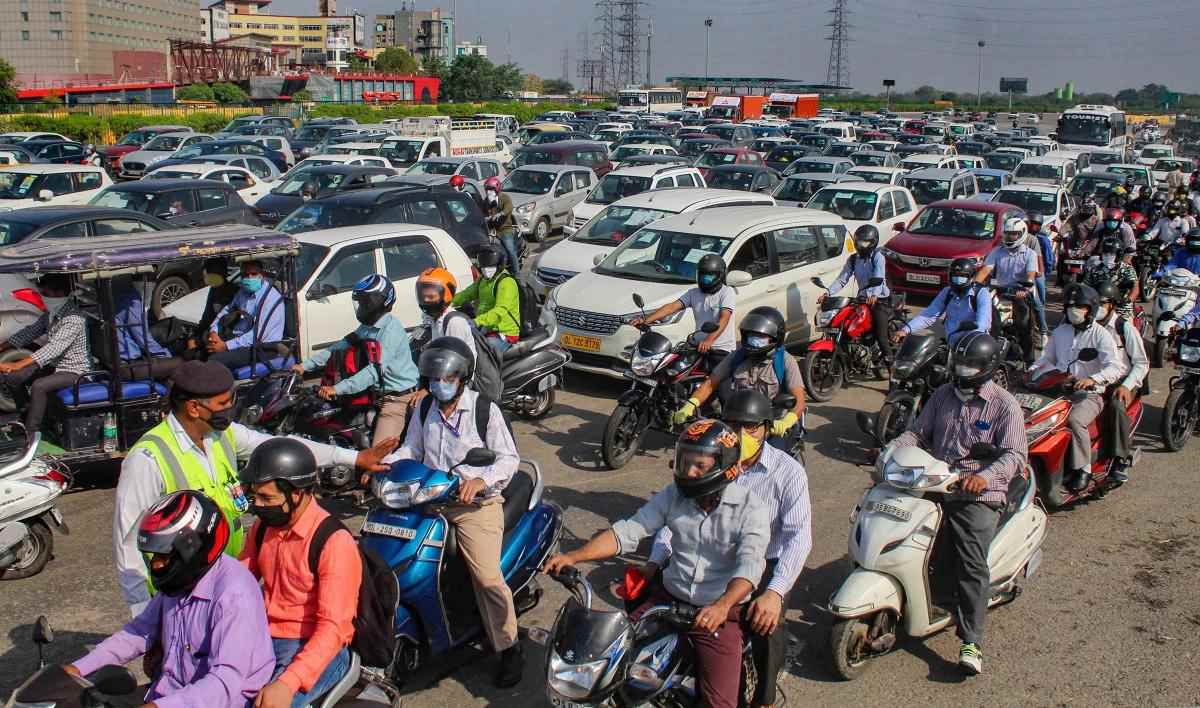
While traffic snarls were witnessed in various cities, few of them saw any big rush at malls and restaurants.
In Delhi’s Select City Mall, for instance, as shop assistants arranged shelves and brought out mannequins, signs of “We missed you, Welcome Back’ were put up in greeting. But only a few braved the coronavirus scare to venture into the mall, now all about functionality and not leisure.
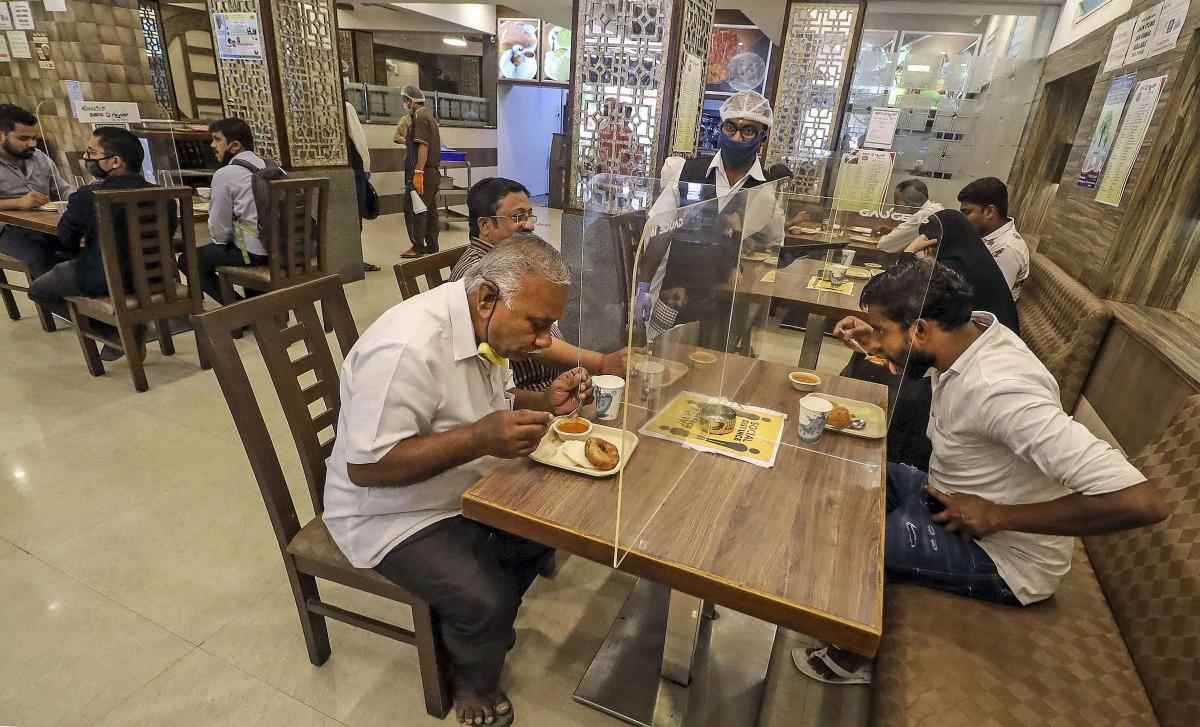
Some restaurants opened but waiters, in scenes that could be straight from a futuristic sci-fi film, were in face shields and the customers, at tables placed a safe distance from each other, in masks till the food arrived. Stay away zones were marked with big crosses as were escalators to ensure there was no crowding.
MAHARASHTRA EMBARKS ON MISSION BEGIN AGAIN AS CASES SOAR
Mission Begin Again took off in Maharashtra, where the number of cases has crossed 85,000 with more than 3,000 deaths, in a truncated form without malls or religious places but with offices and several shops back in business.
In the state capital Mumbai, offices opened in many places, including the Bandra-Kurla Complex and Lower Parel. Shops in key market areas of Dadar, Colaba and Kurla also opened for businesses.
Though the lockdown is in force till June 30, the Maharashtra government, as part of the phase-wise reopening of the economy and public activities, has allowed private offices to resume operations with 10 per cent staff.
There were other signs of a return to normalcy.
About 2,100 buses hit the city roads till noon, a BEST statement said.
Maharashtra’s overall tally of people having tested positive for the novel coronavirus infection has now exceeded the numbers recorded by China, Qatar, Bangladesh, Belgium and Belarus, among a host of several other countries.
India may face devastating climate change effects, including killer heat waves and severe flooding, in the next 80 years, says a study that calls for urgent steps to reduce greenhouse gas emissions to avert associated risks to the country’s population, ecosystems and economy.
Annual mean temperatures across India are likely to increase by 4.2 degrees Celsius under a high emission scenario by the end of the 21st century, the researchers, led by Prof Mansour Almazroui from the King Abdulaziz University in Saudi Arabia, said.
“India is the most densely populated region in the world, with relatively high sensitivity and low resilience to changes in its climate, all of which makes it very exposed and vulnerable to any changes that may occur during the rest of the 21st century,” Almazroui told PTI in an email on World Environment Day on Friday.
“A large part of India’s population, ecosystems, and economy are all exposed to high risk in the face of future climate change,” he said.
The study, published in the journal Earth Systems and Environment last month, suggests that northwestern India is at “particularly high risk” to flooding from snow and glacier melt caused by temperatures projected to rise by the end of the 21st century.
The researchers also forecast killer heat waves over the plains, adding that severe flooding is likely to take place with annual rainfall over India projected to increase under all emission scenarios in the 21st century.
Using a supercomputer to analyse global climate models, the research team observed a potentially large increase of more than 6 degrees Celsius under a high emission scenario over northwestern India, comprising the complex Karakorum and Himalayan mountain ranges.
India and China will, for now, continue to hold further talks at to resolve the ongoing standoff in eastern Ladakh after the meet between commanders of both armies on June 6 yielded no immediate results. Top commanders of India and China met at Maldo on the Chinese side, opposite Chushul.
Efforts are being made both at military and diplomatic levels to resolve the issue in eastern Ladakh where both Indian and Chinese troops have engaged in military buildup along the Line of Actual Control (LAC), sources said. A future date for further military talks will be announced as soon as both sides deliberate and decide, added sources.
India and China have agreed to “peacefully resolve the situation in the border areas in accordance with various bilateral agreements”, the Ministry of External Affairs (MEA) said on Sunday. The statement was made a day after the much-talked about military meet where India was represented by 14 Corps Commander Lt General Harinder Singh.
The talks were requested by India and were held at the Border Personnel Meeting Point in Maldo on the Chinese side of the Line of Actual Control (LAC) in Eastern Ladakh.
“It took place in a cordial and positive atmosphere. Both sides agreed to peacefully resolve the situation in the border areas in accordance with various bilateral agreements,” the MEA maintained.
For the fifth day in a row, India recorded a spike of over 9,000 in the number of new novel coronavirus infections reported from across the country. As of June 7, India has 2,46,628 confirmed cases, including 1,20,406 active cases, 1,19,293 recoveries and 6,929 casualties as per the Ministry of Health and Family Welfare’s Covid-19 bulletin on Sunday morning.
The number of confirmed Covid-19 cases in Maharashtra, the Indian state with the most cases, crossed that of China on Sunday with a tally of 85,975. Maharashtra’s Health Department reported 3,007 new cases on June 7.
Even as confirmed cases continue to rise rapidly, shopping malls and places of worship are gearing up to reopen from Monday while abiding by SOPs part of the Ministry of Home Affairs’ “Unlock-1” notification. This is part of the Government of India’s three-phased plan to gradually reverse the nationwide lockdown first enforced on March 25 by Prime Minister Narendra Modi.
86% cases in Tamil Nadu asymptomatic
Second only to Maharashtra in infections, Tamil Nadu on Sunday reported 1,515 new cases of Covid-19. The state’s tally now stands at 31,667. This figure is inclusive of 14,396 active cases, 16,999 recoveries and 269 casualties.
Chief Minister K Palaniswami said on Sunday that 86 per cent of Tamil Nadu’s Covid-19 cases have been found to be asymptomatic. Tamil Nadu has a lower mortality rate than any other Indian state and even some other countries, CM Palaniswami said, adding that the state’s recovery rate was the best in the country.
China-Plus-One. This is the new strategy being pursued by countries and companies, policy-makers and entrepreneurs, to survive in the re-imagined, re-aligned post-COVID world. Nations went through near-death experiences as they were economically strangled by the closure of China, the ‘Factory to the World’, and global supplier of most goods. As governments struggled to catch their breaths, given the manufacturing churn and choked throats, they witnessed the decimation of their globalised production models.
The destruction, not just of a well-oiled and seamless global supply chain, but also of a mindset, led to the concept of China-Plus-One. No one wants to put their eggs in a single manufacturing basket; no one wants to depend on a single source for their needs. Hence, there is a mad scramble to spread out, to seek out alternate suppliers. China may yet remain the No. 1 or No. 2 vendor for most nations, but it will not be the only one, not even a major one. This has presented an unprecedented opportunity to India.
India’s Prime Minister Narendra Modi sensed that this could be the moment of a lifetime, a time to catch the bull by its horns. He realised that if he played the cards right–and he had a couple of aces up his sleeves–India could emerge as the new global manufacturing hub, a preferred destination for foreign investments over the next few years. He unleashed a slew of reforms, pushed states to enact controversial changes in laws, and re-wooed foreign investors to ‘Make in India’ in a bid to ‘Re-Make India’. Modi hopes to garner a whopping Rs 2,500,000 crore ($330 billion) in the next few years.
The role of the Delhi Police, during the anti-CAA protests, the Northeast Delhi Riots and the coronavirus-induced lockdown, is enough to send shivers down any law abiding citizen’s spine. The objective of the anti-CAA protests – writ large on posters, street art, social media posts, etc – was to ‘Save the Constitution of India’. There was nothing anti-national about the protests or the protestors (mostly students and Muslim women). It is these students and women, fighting as they were, to preserve the spirit of India’s Constitution and our democratic traditions, who have now been tagged as ‘anti-national’ and ‘gaddar’ – not under the law of the land, but by the whims of those in power.
For any discussion on the ongoing spate of arrests of students and activists accused by the Delhi Police of instigating and participating in the Northeast Delhi riots of January this year, there’s a chronology that needs to be made clear. As the anti-CAA protests raged, first came brutal police action against the protestors – the tear-gassing of peaceful protestors and the beating and manhandling of students and women. Then came the arson, looting and massacre of Muslims in Northeast Delhi – the worst-ever pogrom Delhi has witnessed since the 1984 anti-Sikh riots. The attack was goaded on by the slogan of ‘Desh ke Gaddaron ko, Goli Maaron Saalon ko’ given in full public view by BJP’s Kapil Mishra and broadcast on TV news channels and social media platforms for days before the rioting actually began.
Religious places inside containment zones shall remain closed for public and those outside will be allowed to open, according to the SOPs issued by the Union Health Ministry on Thursday to contain the COVID-19 spread at such venues.
Places of worship get frequented by a large number of people for spiritual solace and to prevent COVID-19 spread, it is important that required social distancing and other preventive measures are followed in those premises, the ministry said.
In view of the potential threat of the spread of the infection, as far as feasible recorded devotional music or songs may be played and choir or singing groups should not be allowed, the Standard Operating Procedures stated.
Common prayer mats should be avoided and devotees should bring their own mat or piece of cloth which they may take back with them.
“No physical offerings like prasad/distribution or sprinkling of holy water, etc should be allowed inside the religious place,” the ministry said, underlining that community kitchens, langars, ‘Ann-Daan’ etc at religious places should follow physical distancing norms while preparing and distributing food.
The ministry advised persons aged above 65, having comorbidities, pregnant woman and children below the age of 10 years to stay at home and avoid visiting religious places.
According to the SOPs, all religious places should ensure hand hygiene (sanitizer dispenser) and make thermal screening provisions at the entrance mandatorily. They should allow only asymptomatic persons in the premises and allowing those using face cover or masks.
Audio and video clips to spread awareness on preventive measures for COVID-19 should be regularly played while posters on preventive measures should to be displayed prominently, it said.
“Staggering of visitors to be done, if possible. Foot wears to be preferably taken-off inside own vehicle. If needed they should be kept in separate slots for each individual/ family by the persons themselves. Any shops, stalls, cafeteria etc, outside and within the premises shall follow social distancing norms at all times,” the SOPs stated.
The SOPs underlined maintaining physical distancing of a minimum of six feet at all times when queuing up for entry and washing hand and feet with soap and water before entering the premises.
“For air-conditioning/ventilation, the guidelines of CPWD shall be followed which inter alia emphasises that the temperature setting of all air conditioning devices should be in the range of 24-30 C, relative humidity should be in the range of 40- 70 per cent, intake of fresh air should be as much as possible and cross ventilation should be adequate,” it said.
Touching of statues, idols and holy books should not be allowed and large gatherings remain prohibited.
The death of an elephant in Kerala’s Palakkad district has enraged citizens across the country. Preliminary reports suggested that the wild female elephant ate a pineapple stuffed with firecrackers which exploded in her mouth. This rendered her incapable to eat or drink anything.
Experiencing insufferable pain, the pregnant wild elephant stood for a whole day in the Velliyar river area in Palakkad district before collapsing to her death on May 27.
Ever since a forest ranger posted pictures of the elephant and other officials claimed to have narrated her ordeal, the incident has sparked a new debate about animal cruelty in India. While some aspects of the animal’s unfortunate demise have been cleared up by concerned departments of the Kerala administration, other details about what led to the incident are still unclear.
Background
In a statement he issued on Thursday, Kerala Chief Wildlife Warden Surendra Kumar said that the wild elephant was first noticed by locals in Palakkad district on May 23. The animal went back into the forest before returning on May 25, added Kumar.
The state’s top IFS officer, Surendra Kumar also confirmed that the pregnant wild elephant stood for a whole day inside the Velliyar River before collapsing to her death.
Surendra Kumar also said that while theforest department is probing the circumstancesof the elephant’s death, it is difficult to believe that someone would have willingly fed the elephant a pineapple. No one would dare to go near a wild elephant in the first place, Kumar said.
Inquiry
Responding to claims and concerns,Kerala Chief Minister Pinarayi Vijayantook to Twitter on Thursday to say, “An investigation is underway, focusing on three suspects. The police and forest departments will jointly investigate the incident. The district police chief and the district forest officer visited the site today. We will do everything possible to bring the culprits to justice.”
India recorded single-day spike of 9,304 Covid-19 cases, the highest so far, taking the nationwide tally to 2,16,919, the Health Ministry said.
The death toll also crossed the 6,000 mark with 260 new fatalities reported in last 24 hours.
The Health Ministry said that the total number of cases in the country include 1,06,737 active cases, 1,04,107 cured/discharged/migrated and 6,075 deaths.
Maharashtra has so far reported 74,860 cases, more than any other state in the country.
In Tamil Nadu, 25,872 cases have been detected so far while Delhi has reported 23,645 coronavirus cases.
According to the Indian Council of Medical Research (ICMR), 1,39,485 samples were tested in the last 24 hours whereas 42,42,718 samples have been tested till date.
The death toll has reached 53 in Karnataka, 47 in Punjab, 34 in Jammu and Kashmir, 25 in Bihar, 23 in Haryana, 11 in Kerala, eight in Uttarakhand and seven in Odisha.
Himachal Pradesh, Chandigarh and Jharkhand have registered five COVID-19 deaths each, Assam has recorded four deaths while Chhattisgarh has reported two deaths so far. Meghalaya and Ladakh have reported one COVID-19 fatality each.
According to the ministry’s website, more than 70 per cent of the deaths were due to comorbidities.
It’s possible through the eyes, but not likely through the ears.
As with the nose and mouth, doctors say the eyes may be a route of infection if someone with the virus coughs or sneezes nearby. Infection is also possible when rubbing your eyes with hands that have been exposed to the virus.
Tears from an infected person could also spread the virus.
Frequent hand washing, social distancing and the use of facial coverings in public are ways to keep the virus from spreading, including through the eyes.
Glasses may also offer added protection, according to the American Academy of Ophthalmology. Health care workers are advised to use safety goggles when treating potentially infected patients.
Ears, on the other hand, are not believed to be a route of COVID-19 infection, according to the U.S. Centers for Disease Control and Prevention.
The skin in the outer ear canal is more like regular skin, unlike the tissue in the mouth, nose and sinuses.
That creates a barrier that makes it difficult for the virus to enter, according to Dr. Benjamin Bleier at Massachusetts Eye and Ear in Boston.
India vice-captain Rohit Sharma reacted sharply to the killing of a pregnant elephant in Kerala, saying no animal deserves to be treated with cruelty.
The news of the elephant dying after chewing on an explosive-filled pineapple fed to her in Malappuram has triggered a massive outcry across the country. With cartoonists poking the conscience of people, several on social media have condemned the act of human cruelty.
Rohit Sharma, who has been leading campaigns in association with the World Wildlife Fund to bring awareness about animal conservation in the country, said he is heartbroken’ by the death of the elephant in Kerala.
“We are savages. Are we not learning? To hear what happened to the elephant in Kerala was heartbreaking. No animal deserves to be treated with cruelty,” Rohit Sharma wrote on Twitter.
The death toll due to the novel coronavirus infection in India crossed the 6,000-mark on Thursday morning to settle at 6,075. India’s Covid-19 toll registered an increase of 260 fatalities on Thursday.
India also the biggest one-day jump in novel coronavirus cases on Thursday. According to the latest data by the Union Health Ministry, as many as 9,304 new cases of coronavirus were recorded in the last 24 hours.
The fresh cases of novel coronavirus on Thursday took India’s case tally to 2,16,919. As per the Health Ministry data, the total number of cases in India include 1,06,737 active cases, while 1,04,107 patients recovered/discharged/migrated.
Thousands of migrant labourers who are leaving quarantine centres and those who are under home quarantine across Bihar are getting condoms from State Health Society amid the coronavirus lockdown.
“Migrant labourers are going to their homes after completing the 14-day institutional quarantine. Since there are chances of unwanted pregnancies, so we properly counsel them (migrant labourers) and give them tools (such as condoms) to avoid unwanted pregnancy,” a senior Health department official told news agency PTI.
The official, who is entrusted with Family Planning in State Health Society, also said “it is purely a family planning measure and has nothing to do with COVID-19. As a health professional, it is our responsibility to control the population. We have been taking the support of our health partner Care India to implement the initiative.”
The official said unwanted pregnancies have witnessed a surge the world over during the lockdown and it was against this backdrop that the initiative was launched.
The initiative will continue till the quarantine centres are functioning, he added.
Of the 28 to 29 lakh migrants who have returned to the state, 8.77 lakh people have been discharged as they have completed their 14-day quarantine period. Besides, 5.30 lakh migrants, till date, are living at block and district level quarantine centres across the state.
After the lockdown that has been imposed due to the spread of Coronavirus, one of the challenges the filmmakers are likely to face is shooting the intimate scenes without risking the health of the actors.
The challenge has got the movie makers into thinking whether shooting intimate scenes would be a thing of the past post-pandemic or should there be a set of rules and processes that need to be followed while filming such scenes.
Cine & TV Artistes’ Association(CINTAA), the Screen Actors Guild American Federation of Television And Radio Artistes have also teamed up to work on the SOPs that may be needed too follow during shooting intimate scenes.
Amit Behl, Senior Joint Secretary and Chairperson of the Outreach Committee CINTAA told Outlook: “Since CINTAA is the oldest and the biggest actor’s association in the country and we are affiliated to the Federation of International Actors, world’s biggest body of performing artists across 83 countries, we are actually awaiting the proper guidelines issued by our parent union, FIA supported by the Screen Actors Guild of American Federation of Television and Radio Artists. Their guidelines, which are definitely going to be approved by the WHO, is going to be implemented worldwide and it is going to be the same for all.”
“In India also, we are basically looking at virologists on the set, somebody approved by the ICMR who can handle intimacy guidelines and also we are concerned about asymptomatic carriers on the sets,” Behl added.
Google intervened on Tuesday after millions of Indians rushed to download a service that promised to help them rid their smartphones of Chinese apps.
Remove China Apps, from the Indian developer OneTouch AppLabs, was downloaded 4.7m times in India between May 27 and June 1, according to Sensor Tower data.
The app was briefly the most popular on India’s Google Play Store before the Silicon Valley company removed it on Tuesday, according to App Annie, another app data provider. Google’s policies forbid Android apps that help people to delete or disable other apps.
The popularity of Remove China Apps, which promised to alert users to any Chinese-made apps on their phones, comes after unease over the influx of Chinese tech companies and a move by New Delhi to tighten foreign direct investment rules for Chinese firms.
It also coincided with the rise in tensions on the India-China border, noted Parv Sharma, an analyst at Counterpoint Research.
In response, Indian engineer and reformerSonam Wangchukcalled for a boycott of Chinese products. In his tweets and videos, Mr Wangchuk said that Indians should “USE [their] WALLET POWER” rather than rely solely on military force to beat Beijing.
Indian prime minister Narendra Modi had also spoken about the importance of self-reliance, said Mr Sharma. Both Mr Wangchuk and Mr Modi were mentioned by the developers behind Remove China Apps.
As of the first quarter of 2020, Chinese smartphone makers made up over 70 per cent of the Indian market, according to Counterpoint Research. Chinese apps have also made major inroads in the country.
SensorTower estimated that TikTok had 636m downloads in India, excluding third-party Android stores. That compares to 277m downloads for Instagram and 99m for Snapchat from 1 January 2014 to the present.
Hannah Bailey, a researcher at the Oxford Internet Institute, said the three biggest concerns around the spread of such apps were censorship, data security and the potential for computational propaganda and dissemination of a pro-Beijing agenda.
Mr Sharma said that since the device checked for the installed application package rather than details about storage or location, there were no apparent issues with the app from a security perspective.
While it had a rating of 4.9 stars on the Google store, comments before it was taken down showed that Remove Chinese Apps did not pick up apps with well-known Chinese connections, such as Shenzhen-based internet giant Tencent’s battle-royale PUBG mobile, as well as pre-installed apps on Chinese smartphones.
OneTouch’s website only said that the country of origin was discovered “based on the market research” but did not guarantee accuracy.
OneTouch did not respond to requests for comment.
Mr Sharma also said that some apps would be difficult to replace. Mitron, a TikTok rival that reached 10m downloads in India in a month and a half, was removed this week from the Google Play Store amid accusations in the Indian media about security flaws and recycled code. “Developing an app that is secure, with a focus on privacy and an interactive user interface, takes a lot of effort and testing,” said Mr Sharma.
The Delhi borders will be shut for a week, said chief minister Arvind Kejriwal on Monday, adding that essential services will be allowed. The CM added that people having passes will be allowed to enter the national capital.
“Delhi borders to be sealed for the next one week. Essential services are exempted. We will take a decision again in one week to open borders after suggestions from citizens,” said the CM.
The constituent assembly adopted two names, India and Bharat for the country after Independence. Many members favoured Bharat as the primary name. A petition is in the Supreme Court now seeking to drop “India” from the Constitution and keep “Bharat” as the only name.
“What’s in a name,” celebrated playwright William Shakespeare had his most famous heroine Juliet say in his Romeo and Juliet play. “That which we call a rose. By any other name would smell as sweet.”
But most people wouldn’t agree with Shakespeare in their daily lives. For, a name is the most prominent identity of a person, a family, a caste, a religion or a country. Every name has a history.
This was hotly debated in the constituent assembly when India got Independence from British rule. The British called India “India”. Before them, the Mughals, the biggest empire in India, called it Hindustan.
After an intense debate, the Constitution adopted two names for the country, India and Bharat. Now, a petition has been filed in the Supreme Court seeking removal of ‘India’ as the name of the country and keeping just Bharat as the solitary identity of the nation.
The petitioner, Namah – a resident of Delhi, has sought to amend Article 1 of the Constitution, which names the country and defines its territories.
Article 1 (1) of the Constitution reads, India, that is Bharat, shall be a Union of States. The petitioner says the name “India” is a “symbol of slavery” while seeking to recognise “Bharat” or “Hindustan” as the only name for the country.
The petitioner has quoted from the constituent assembly debates to support his arguments in favour of the name change. He has also referred to places whose names were changed over the years.
The constituent assembly debated Article 1 of the then draft constitution prepared under the chairmanship of BR Ambedkar. It was a heated debate that saw sharp exchanges among the members on November 18, 1949 – just eight days before the Constitution was adopted by “We, the people”.
The debate opened with HV Kamath, a constituent assembly member from the Central Province and Berar. Kamath objected to the Ambedkar committee’s draft that had two names – India and Bharat.
Kamath proposed amendments to Article 1 putting Bharat or alternatively Hind as the primary name for the country and pronouncing India only as the name in the English language.
He went on at length in the constituent assembly to assert that the Namakaran (the naming ceremony) should be taken up more seriously. He enlisted names such as “Hindustan, Hind and Bharatbhumi or Bharatvarsh” to have been suggested by people.
When Kamath began elaborating the origin of the name of Bharat, Brharatbhumi or Bharatvarsh dating it to ancient times, Ambedkar interjected for cutting short his speech.
Kamath snapped back at Ambedkar telling him to let the chairman, Rajendra Prasad run the house. An exchange took place between Prasad and Kamath following which he moved “Bharat” as the amended name for India. Kamath was strongly opposed to the language of Article 1(1) that says, “India that is Bharat”.
Another prominent name to oppose the language was Seth Govind Das, who said, “India, that is, Bharat” are not beautiful words for the name of a country. We should have put the words “Bharat known as India also in foreign countries.”
Das cited the Vedas, the Mahabharat, couple of Puranas and the writings of Chinese traveller Hiuen-Tsang to say that Bharat was the original name of the country, hence India should not be put as the primary name in the constitution post-independence.
He also invoked Mahatma Gandhi saying that the country fought the battle of freedom raising the slogan of “Bharat Mata Ki Jai” asserting that Bharat could be the only plausible name for the country.
The petitioner cites MA Ayyangar of Madras province as proposing names of Bharat, Bharat Varsha and Hindustan as substitutes for India in Article 1.
Among others who supported India being named only as Bharat included KV Rao from Andhra Pradesh. Rao went to the extent of suggesting that on the basis of historical nomenclature, Pakistan could be named as Hindustan.
He said, “we can now call ‘Pakistan as Hindustan because the Indus river is there. Sind has become Hind : as (‘sa)’ in Sanskrit is pronounced as (Ha) in Prakrit. Greeks pronounced Hind as Ind. Hereafter it is good and proper that we should refer to India as Bharat.”
BM Gupta, Sriram Sahai, Kamalapati Tripathi and Har Govind Pant were among other constituent assembly members who vociferously supported India be named only as Bharat. In fact, Tripathi and Ambedkar had some heated exchanges during the debate on naming of the country that day.
Tripathi was going at length to reinforce his point for “Bharat” saying the country was “in bondage for a thousand years, this free country will regain its name” prompting an interjection from Ambedkar asking, “Is this all necessary, Sir?”
everal cities across the country saw the lockdown restrictions being eased with even traffic snarls returning back on roads on day 1 of the government’s Unlock 1 as the nationwide tally of confirmed Covid-19 cases crossed 1.9 lakh.
STREETS COME ALIVE AGAIN IN TAMIL NADU
After a hiatus of 68 days, government-run buses resumed operations in a limited manner in Tamil Nadu on Monday except in Chennai and three nearby districts while autorickshaws, which were already plying in other parts of the state, hit the roads in Chennai.
Also, intra-state passenger train services were back on track in Tamil Nadu
connecting key places for the first time since the Covid-19 lockdown was announced on March 24 and the resumption of public transport, albeit, curtailed, brought cheers to the general public.
NO TAKERS FOR RAJASTHAN MONUMENTS
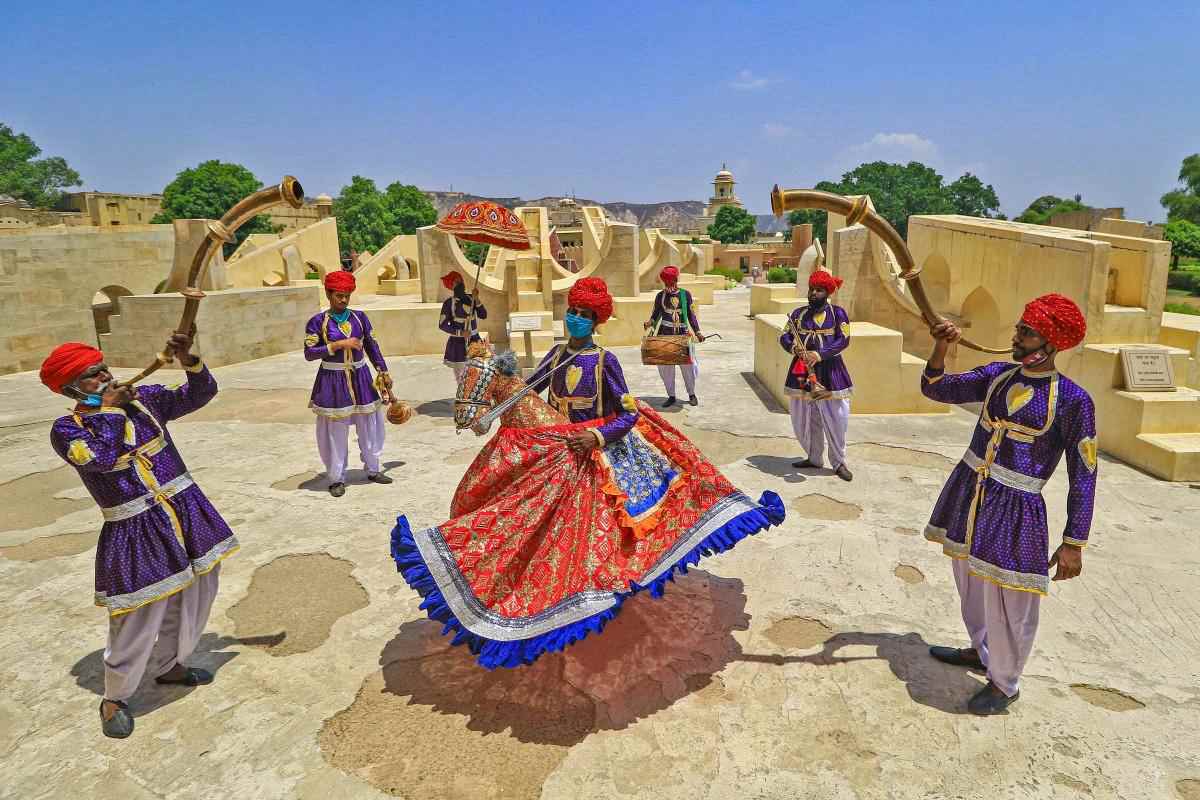
After over two months of closure due to the coronavirus lockdown, monuments and tourists places in Rajasthan reopened on Monday with cultural events and performances by folk artists, but there was no footfall.
Domestic tourists mostly visit these places during the summer season and they can be expected in the next few days.
Folk artists perform at Jaipur’s iconic Jantar Mantar.
Barring the high-risk areas where the authorities have clamped a curfew to check the coronavirus spread, shops reopened in the Jaipur’s walled city after over a gap of two months on Monday.
However, the response from people remained lukewarm as a majority of shops in the main markets of the walled city reopened.
LUCKNOW BOUNCES BACK TO LIFE
In Lucknow, Alambagh, Nahariya Chauraha, VIP Road and Rae Bareli road tri-section, which had virtually turned into zones of silence following the imposition of lockdown, witnessed a flurry of activities and clamorous honking of vehicles.
After relaxing curbs on movement, traffic congestion also witnessed at some places in Lucknow as the government allowed two people (rider and pillion) on two-wheelers and private cabs to ply as well.
Markets opened in the city on the basis of the left-right formula as directed by the district administration.
In Allahabad, shops in Civil Lines opened, and the Hanuman Mandir Chauraha, which wore a deserted look since Holi, witnessed the movement of people and vehicles.
Shops in Banda also opened on Monday and UPSRTC buses to other districts of the state also started plying.
ODISHA ANNOUNCES WEEKEND SHUTDOWN
Amid a spike in Covid-19 cases and reports suggesting that outbreak might peak in June, Odisha on Monday announced weekend shutdown for the month in 11 districts of the state, anticipating that people might venture out in large numbers as the Centre has eased lockdown curbs.
The state government has also prohibited all sorts of public congregations across the state till month-end, Chief Secretary A K Tripathy said.
“Educational institutions, including schools, colleges, coaching centres, will remain closed till the end of July, while places of worship will be shut for devotees up to June 30. Similarly, shopping malls, cinema halls, swimming pools and gyms will also remain closed till June-end, he said.
Hotels, however, will be allowed to reopen with just 30 per cent occupancy, but their restaurants will be operating only for in-house requirements, the chief secretary said.
The two-day shutdown would be implemented in Bolangir, Nayagarh and nine coastal districts, including Khurda, Cuttack, Puri, Kendrapara and Balasore, in view of “high-case load” in these places, he said.
CENTRE GIVES BOOST TO MSMES, FARMERS, STREET VENDORS
The Micro, Small and Medium Enterprises (MSMEs) and farm sectors received major boosts on Monday as the Union Cabinet approved relief packages announced earlier by Finance Minister Nirmala Sitharaman along with a few new reliefs.
The Cabinet approved a package worth Rs 20,000 crores which will benefit 2 lakh MSME units, Union minister Prakasha Javadekar said. The government also approved a Rs 50,000 crore package for the street vendors. Under this package, street vendors, including hawkers, cobblers and salons, can get a loan of Rs 10,000. The Union minister said that at least 50 lakh vendors will benefit from this scheme.
Unlock Day 1: Cities come alive with eased curbs even as total coroanvirus cases cross 1.90 lakh
Several cities across the country saw the lockdown restrictions being eased with even traffic snarls returning back on roads on day 1 of the government’s Unlock 1 as the nationwide tally of confirmed Covid-19 cases crossed 1.9 lakh.
Life returned to near normal in many parts of the country as several restrictions were eased in the fifth phase of the lockdown that began on Monday.
Roads bustled with traffic as people came out in large numbers to visit markets, which are now open for longer hours.
After the Centre allowed lifting of restrictions on inter-state movement of people, several states also began allowing various activities that have been restricted since March 25, when the nationwide lockdown came into effect to fight the coronavirus pandemic.
DELHI OPENS BARBERSHOPS, CLOSES BORDER
In the national capital, Chief Minister Arvind Kejriwal announced the reopening of barbershops and salons, among various other relaxations, but said spas will remain closed for now. A complete lockdown in containment zones will continue till June 30.
Kejriwal also said there will be no restrictions on the number of people travelling in four-wheelers, two-wheelers, auto-rickshaws, e-rickshaws and other vehicles in the city.
A traffic jam was seen on the Delhi-Haryana border after CM Kejriwal’s announcement.
Now, all shops in the markets will be permitted to function, Kejriwal said.
He, however, said Delhi’s borders with Haryana and Uttar Pradesh will be sealed for a week in the wake of rising coronavirus cases in the city and sought suggestions from the people by Friday to reopen them.
GUJARAT OPENS UP AGAIN
In Gujarat, life returned to near normal in many parts including in Ahmedabad, the state’s worst coronavirus-hit district, as several restrictions were eased.
In Ahmedabad, a limited number of city buses began plying with 50 per cent seating capacity to maintain social distancing, while autorickshaws hit the roads for the first time in ten weeks, though the reduced number of passengers they have been permitted to ferry was a dampener.
On May 20, it was the phase of the waning crescent, just one day to the new moon…the time for very high natural tides! So the threat from Amphan was extreme—the tidal surge would have swallowed more and more high ground. And seawater did indeed push 25 km inland. Shrinking high ground would mean no ‘social distancing’. Putting prey within reaching distance of predator, with no escape route, sounds like nature playing a cruel joke on one species. But again, a tiger is not a wanton killer. It only kills when hungry. This writer has seen tigers pass by bait without making any attempt to kill them. Under Amphan, the universe of both predator and prey was equally threatened. No one would have been thinking of just a meal, literally.
Talking of meals, the day after, the fast receding waters of the estuary leave ample fish in the eddies created on the shoreline and on the large cavities on the forest floor left by uprooted trees. It happens in the cities too. In an incident reported to the BBC on May 21, 2020, a unique sight had been spotted near the gates of Presidency University on College Street, Calcutta. A small catfish, marooned as the street waters receded back to the Hooghly, was being preyed on by a street dog. So imagine places where nature is bountiful! Tigers, fishing cats, otters having the time of their life; free meals literally, with no workload on their shoulders. The Amphan holds no bias, like a herd of elephants passing through a forest, and pulling down the high branches to the ground, scattering succulent leaves on the forest floor that would otherwise have been out of reach for the herbivores. As fresh rainwater trickles down the trunks of trees and drips off the tips of cupped palms of leaves, all take turns to sip at the nectar, for they had been drinking saline water till then.
Why should humans be left out of their share of nature’s bounty? The huge cache of freshwater received by coastal river systems offers a chance for a sizeable influx of the dream fish of Bengal, the Hilsa! Wait for it to happen.