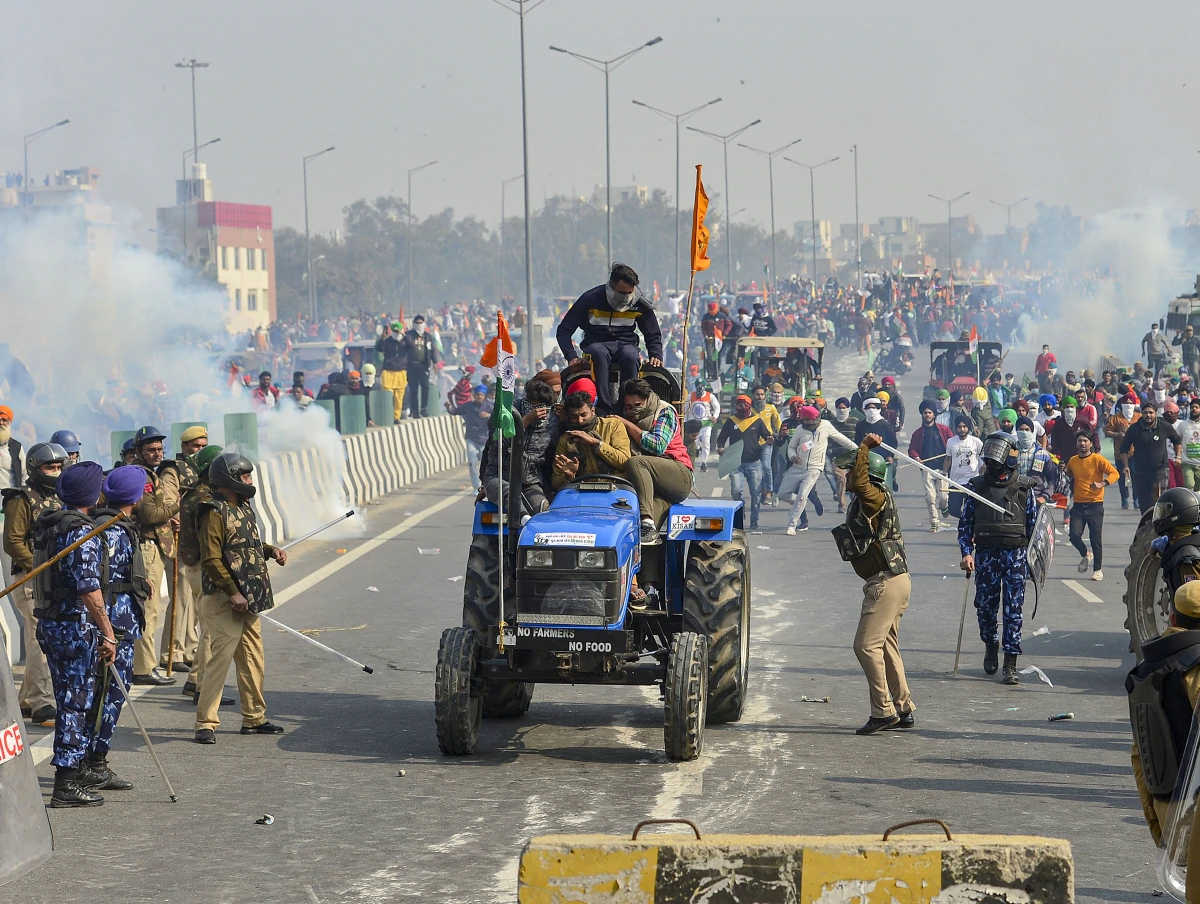
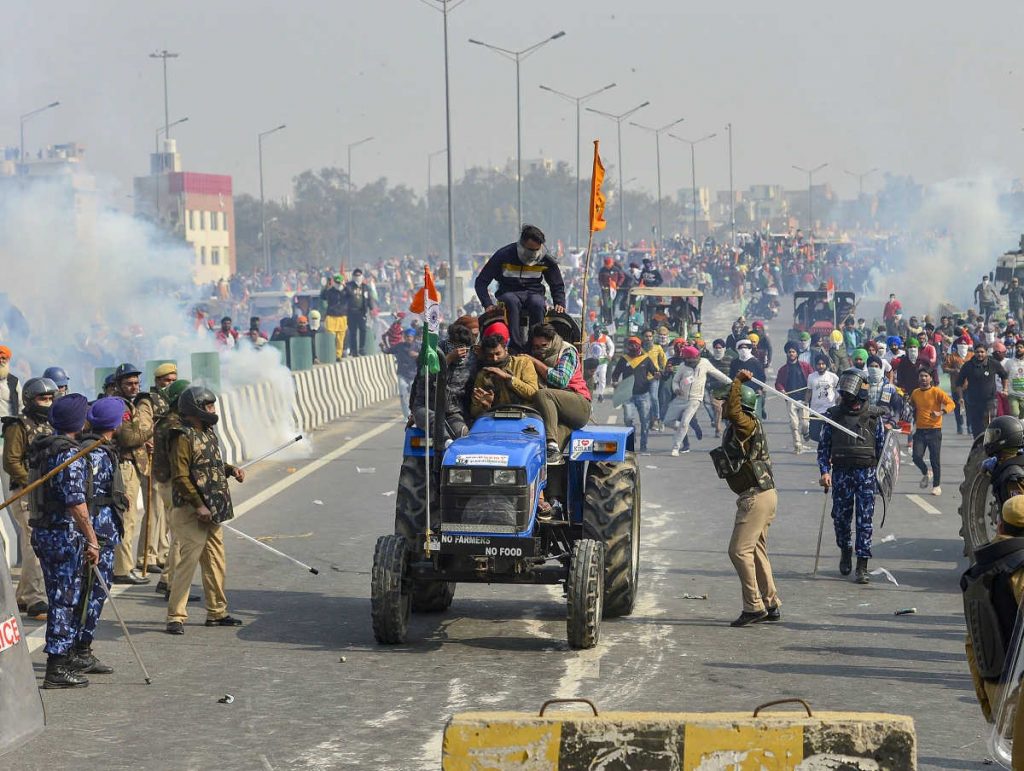
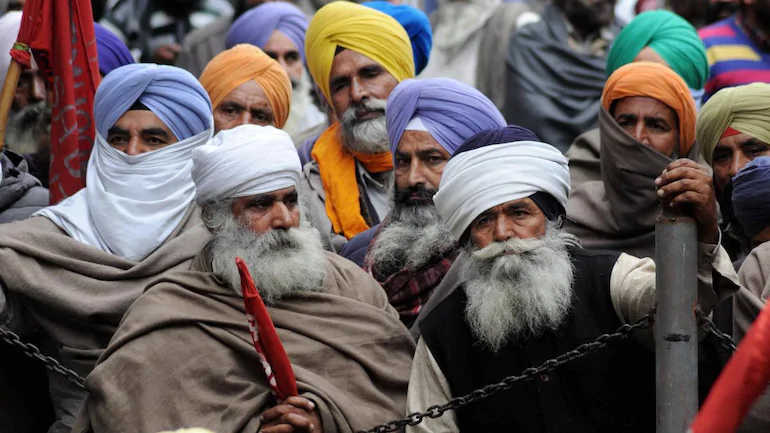
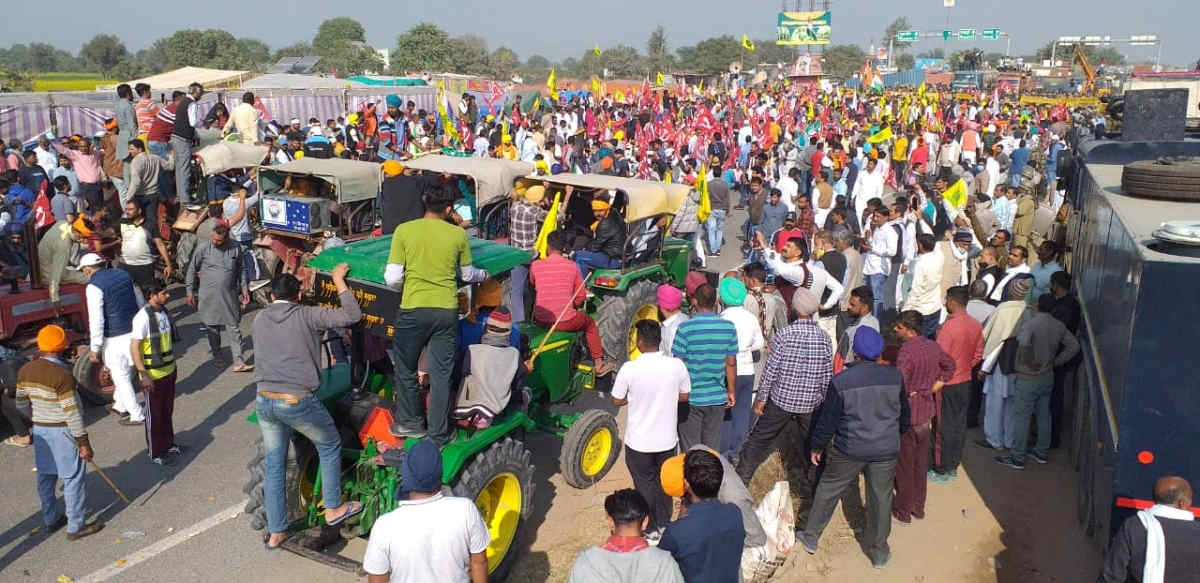
Here are the top 10 updates from the farmers’ protest: 1) January 26, 2021 was a Republic Day like no other, at least in recent memory. The national capital, that generally turns into a secured fortress for the occasion, appeared defenceless as hundreds of protesters barged through police barricades, resulting in violent confrontation with the cops.
2) Farmers atop tractors, on motorcycles and some on horses, broke police barricades to enter Delhi at least two hours before they were supposed to start their tractor march.
As per news agency PTI, the march was supposed to start at noon once the Republic Day Parade on the Rajpath had ended.
“The protesters violated conditions fixed for the rally. The farmers began tractor rally before scheduled time, they also resorted to violence and vandalism,” Delhi Police PRO Eish Singhal said.
3) The protesters broke through steel and concrete barriers leading to pitched battles with cops in several areas of the national capital. At some places, the crowds were seen chasing cops with sticks after they fired teargas shells to disperse them.
Police resort to lathicharge and use teargas to disperse protesting farmers who were attempting to break barricades at Ghazipur border during their tractor march on Republic Day in New Delhi.
4) ITO in Central Delhi resembled a war zone with a car being vandalised by angry protesters and shells, bricks and stones littering the wide streets.
The farmers’ tractor rally on Republic Day in New Delhi that was meant to be peaceful and a platform to express their demands, took a violent turn as a section of protesters broke through police barricades and entered parts of the national capital not permitted for their protest. The path taken by this section reportedly deviated from the route that farmers’ unions had agreed upon in their talks with the Delhi Police.
Soon, there were clashes between the protesters and cops, during which several people were injured and vehicles overturned.
The police resorted to lathicharge and fired teargas shells to disperse the protestors, but to little avail.
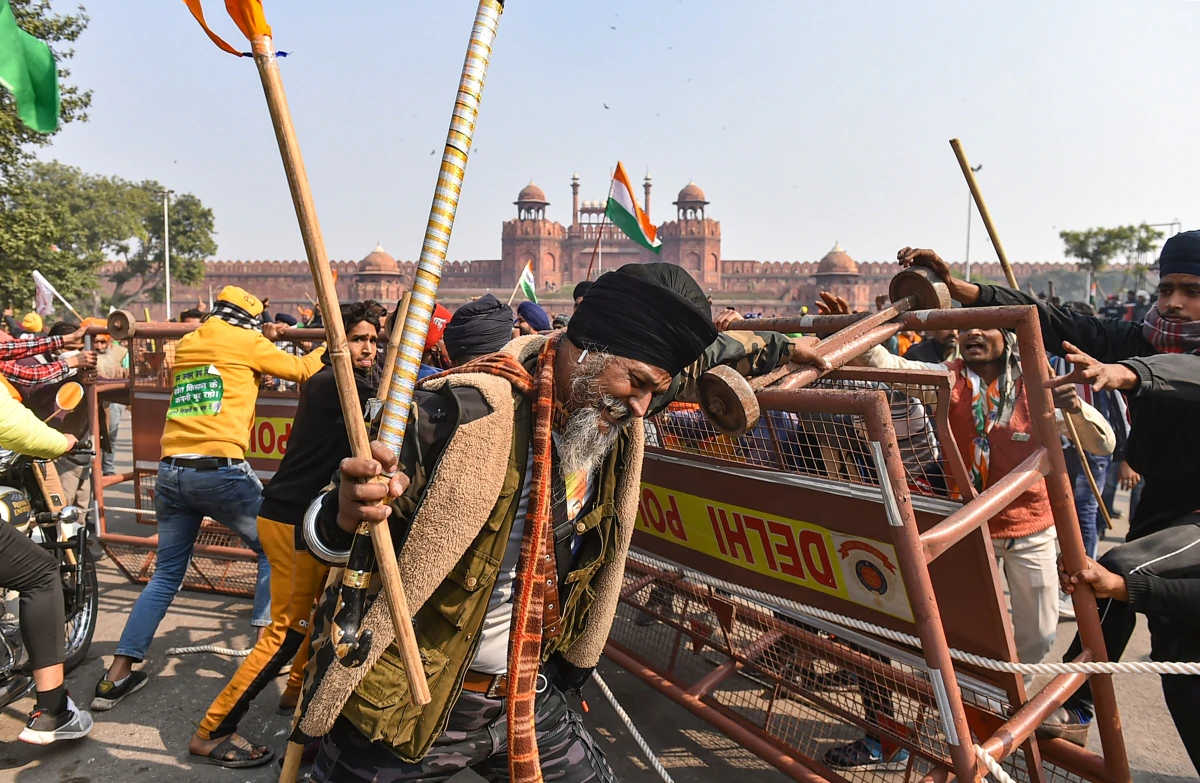
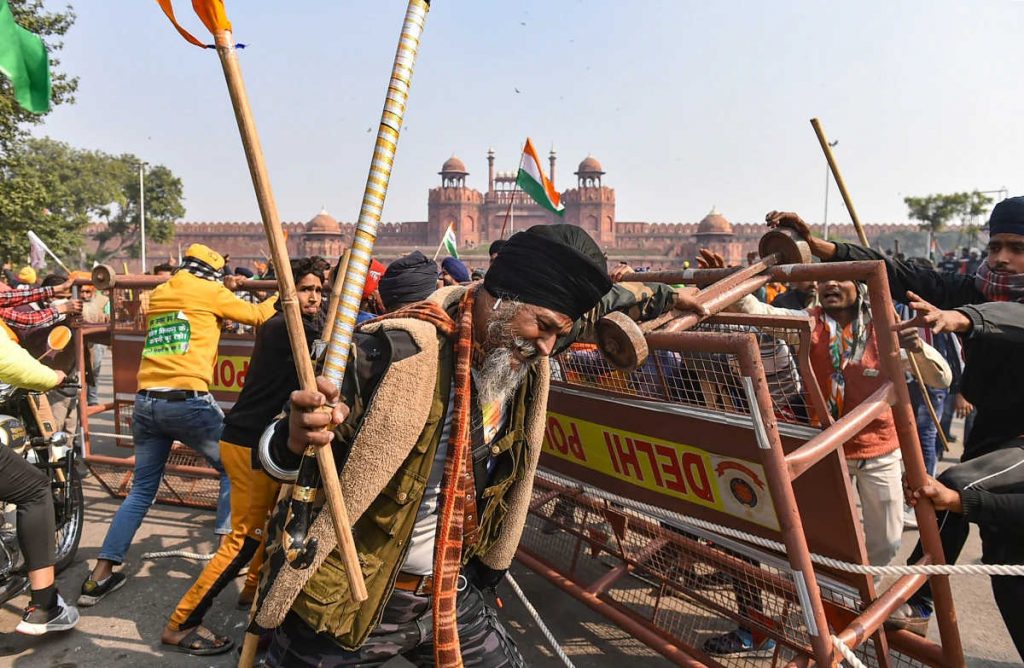
Protesting farmers trying to remove a police barricade near the red Fort on Tuesday
The protestors continued breaking through police barricades and several of them stormed into the Red Fort, waved and hoisted their flags from its ramparts.
The leading farmers’ unions have condemned the violence and dissociated themselves from those involved in it.
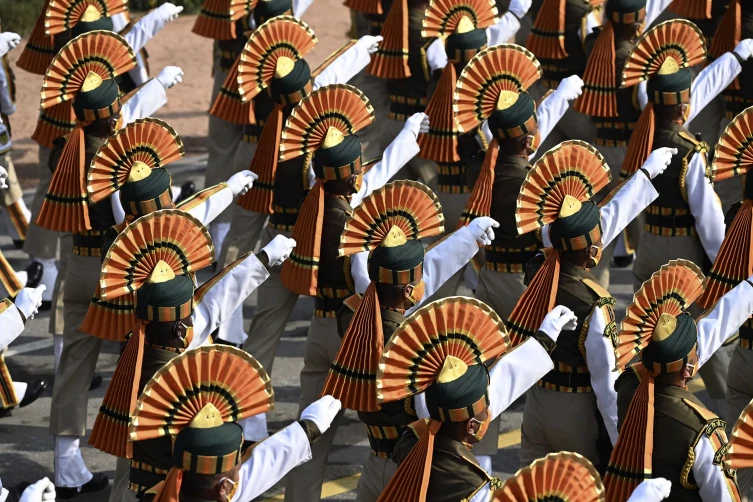
India is celebrating its 72nd Republic Day on Tuesday. In this image, cadets are seen marching along Rajpath during the Republic Day Parade in New Delhi on January 26,
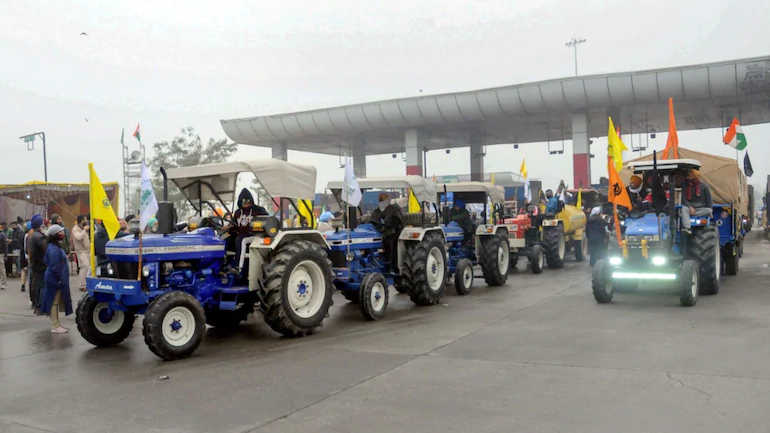
Haryana farmers welcome farmers of Punjab moving towards Delhi to take part in the Republic Day tractor rally.
The national capital is set to witness a massive tractor rally led by farmers on Republic Day on Tuesday. The farmers’ union has reached an agreement with the Delhi Police to carry out the tractor march peacefully on Republic Day.
The rally will be held from Delhi’s three border points — Singhu, Tikri and Ghazipur — and adequate security will be provided to it, police said. Hundreds of farmers from western Uttar Pradesh, Haryana, Punjab, Rajasthan and Madhya Pradesh will arrive in the tractor parade.
Tractor rally to be 250 kilometers long As per officials, the rally at Ghazipur border will be about 50 kilometers long, 100 kilometers long at Singhu border and 125 kilometers long at the Tikri border. In total, the tractor rally will be 250 kilometers long.
Dharmendra Malik, national media in-charge of the Bharatiya Kisan Union (BKU), says that in addition to the border areas, farmers across India will also carry out the rally in their respective districts.
“Two and a half million tractors are arriving in Delhi. The large number of tractors is a response to some leaders who said that only 60 thousand tractors took part in the rehearsal rally on January 6 whereas there are about 40 lakh registered tractors in the country. Hence, in this rally, farmers will show their strength to the government,” he said,
So far there are no reports of celebrities joining the tractor rally. Each tractor will carry a tricolour and there will be folk music and patriotic songs.
“The tractor rally at Ghazipur will go up till Akshardham Temple and return back. The speed limit has been fixed at 10 kilometers per hour. No outsider will participate in the parade, only the registered tractors will be allowed,” said BKU chief Rakesh Tikait.
Farmer unions beef up security A private agency has been roped by the farmers in to keep security arrangements in check during the tractor rally. The number of volunteers has been increased from about 150 to 500. The number of CCTV cameras is also being increased from 8 to about 20. They will be deployed at different posts.
A war room has been set up at each protest site to ensure effective coordination during the parade. There will be 40 members, including doctors, security personnel and social media managers, in each of these rooms, the SKM member said.
Around 40 ambulances will be stationed along the route to attend to any medical emergency, reported PTI.
Another farmer leader said around 3,000 volunteers have been deployed to ensure that the parade remains peaceful and no untoward incident takes place. The volunteers have been given badges and identity cards.
A team of ex-servicemen participating in the protest will also keep an eye on the security situation. A team of mechanics has also been created to repair tractors if the need arises, reported PTI.
R-Day tableaux to depict farmers’ protest
The Republic Day tractor parade by agitating farmers will feature a number of tableaux from across states depicting village life, the protest against the Centre’s contentious farm laws, and hailing their courage, according to organisers.
“The rally will start at 11 am after an ‘ardas’ (prayer),” said Jitendra Singh Jitu, spokesperson for farmers.
Farmer unions issue instructions
“Never before in history have the people of this Republic been part of a parade of this nature on the Republic Day. Through this parade, we have to tell the country and the world about our plight. We have to bring forth the truth about the three Anti-Farmer Laws. We’ve to take care that this historical parade is not stained at any cost,” said an official statement from Sanyukt Kisaan Morcha (SKM).
SKM has come up with some unanimously agreed instructions for the parade and has also issued helpline number 7428384230.
Preparations before the parade by SKM
Trolleys will not be allowed in the parade. Only Tractors and other vehicles will be allowed. Trolleys with special tableaux may be exempted.
Pack 24 hours of ration and water with you. Make sure you have proper arrangements for protection from cold. It might be required if you are stuck in a traffic jam.
Sanyukt Kisan Morcha appeals that every tractor or cart should be fitted with the flag of the farmers’ organizations as well as the national flag. There will be no flag of any political party.
Do not carry any weapon with you, not even sticks or Do not use banners with any provocative or negative slogans.
If you wish to inform of your participation in the parade, give a missed call on 8448385556.
Instructions to be followed during the Parade (issued by SKM):
The parade will be led by cars with farmer leaders. NO car/tractor shall overtake that car. Please follow the directions of our volunteers dressed in green jackets.
The route for the parade has been pre-decided and marked. Police and traffic volunteers will guide you. Any car/tractor found deviating from the route will be acted against.
SKM has decided that if any car/tractor halts/occupies an area without any reason, that car/tractor will be removed by volunteers. All the cars/tractor in the parade will return to the starting point after completing the parade.
A maximum of 5 people including the driver can ride on one tractor. No one will ride on the bonnet, bumper or roof of tractors.
All tractors must proceed in a line and there will be no overtaking throughout the Parade. Please don’t overtake the vehicles of farmer leaders leading the parade.
Please don’t play music in the tractor. This will ensure that all announcements are heard by everyone in the parade without any hindrance.
Use of any drugs before or during the parade is prohibited. Any one found in possession/consuming drugs will be reported to the traffic volunteer.
Please remember that our intent is to gracefully carry out the Parade and win hearts of our fellow citizens. The policemen are also part of us, we must not indulge in any quarrels. Representatives of all news channels must be respected.
Please do not pollute the surroundings by throwing garbage on roads. You are kindly advised to carry a bag for disposal of waste.
Guidelines for emergency (issued by SKM)
Ignore any rumors. If you want to check something or verify something, then have a look on the Facebook Page of Kisan Ekta Morcha to verify the truth.
Ambulances will be in the vicinity of the parade. Arrangements have been made with hospitals. If there is a medical emergency, call the helpline number or tell the nearest volunteer.
In case of any issue with the tractor or the car, place it on the side and contact Volunteer or call the helpline.
Helpline number of Sanyukt Kisan Morcha will be open for 24 hours for this parade. If you have any question or want to inform something, please call immediately.
If there is any unfortunate incident, then you can report it to the police control room at number 112.
Delhi Police on alert “We have five-six long discussions with the Samyukt Kisan Morcha and told them about our security arrangements. We repeatedly said that there should be no disturbance as this [Republic Day Parade] is an event of national pride,” Special Commissioner of Police (Intelligence), Delhi Police, Dependra Pathak said.
“We have reached an agreement that the farmers’ rally take place peacefully and with rules in place. Barricades will be removed from Tikri border and a route of 52-63 km will be opened, a route of another 60 km will be cleared from Singhu border and a route of 46 km will be opened from Ghazipur border,” Special CP Dependra Pathak told media outlets on Sunday. The parade will cover more than 100 km inside Delhi’s borders.
Haryana officials issue advisories Authorities in Haryana have also issued advisories against unnecessary travel towards Delhi over the next couple of days, reported PTI.
The Haryana Police said there would be disruptions in vehicular movement on the national highway from Karnal and Rohtak towards Delhi during January 25-27.
“Traffic on KMP-KGP expressway will also be impacted and interchanges at Kundli, Assaudha and Badli will not be accessible to traffic movement on these dates,” a police advisory said.
“Therefore, all commuters are being advised not to use these routes on these dates to avoid any inconvenience,” it added
Route, timings of Jan 26 tractor parade According to the Delhi Police, the first route will begin from Singhu border and will move from Sanjay Gandhi Transport Nagar to Bawana. Similarly, the second route will pass through Nangloi-Najafgarh and Jharoda after originating from Tikri border. The third route will lead to Apsara border and Hapur after starting from Ghazipur. All of these processions will converge at Kundli Manesar Palwal Expressway (KMP).
“Three routes, originating from Singhu, Tikri and Ghazipur border points, have been finalized for the march,” Gurbachan Singh Chabba, spokesperson of the Kisan Sangarsh Committee said.
Those starting from the Singhu border will traverse Sanjay Gandhi Transport Nagar, Bawana, Qutabgarh, Auchandi border and Kharkhoda toll plaza. The entire route will be 63 kilometers long.
The 62-km long second route, starting from the Tikri border, will pass through Nagloi, Najafgarh, Jharoda border and Rohtak bypass and Asoda toll plaza, the farmer leaders said.
Tractors starting from Ghazipur will drive through Apsara border, Hapur road and Lal Kuan. Covering 68 kilometers, it is the longest route for the march.
The farmer leaders will be at the front in their cars.
‘Pakistan-based Twitter handles’ The Delhi Police also said that it received inputs between January 13 and January 18 about efforts underway to create disturbance during the tractor rally on January 26.
“Timings, arrangements and safety of the rally are important. As many as 308 Twitter handles originating from Pakistan are conspiring to create trouble during the rally,” Delhi Police said.
Addressing a press conference on Sunday, the Special CP Dependra Pathak went on to add, “Pakistan-based terror outfits have their eyes on the tractor rally. All security arrangements will be made.”
Tractor rally in Mumbai Thousands of farmers from across Maharashtra reached Mumbai on Sunday evening to participate in a rally at the state capital on Monday against the Centre”s three new farm laws.
Police have stepped up security at Azad Maidan, the rally”s venue in south Mumbai, and personnel of the State Reserve Police Force (SRPF) have also been deployed there. Drones will also be used to keep an eye on the event, a police official said.
The farmers are prepared to protest till May 2024, a farmer leader said
The Supreme Court said on Monday that the farmers’ proposed tractor rally on Republic Day is a matter of law and order and has to be decided by the police. During the hearing on a plea seeking an order against the tractor rally planned by the farmers, the Supreme Court also told the Centre that it has all the authority to deal with the matter.
The Supreme Court was hearing a plea of the central government, filed though the Delhi Police, seeking an order against the protesting farmers’ tractor march or any other kind of protest “which seeks to disrupt the gathering and celebrations” of Republic Day on January 26.
“Police is the first authority to decide who should be allowed to enter Delhi. The question of who should be allowed to enter the city [Delhi] and how many people can be allowed to enter are matters to be decided by the police,” the Supreme Court said, adding, “We cannot interfere.”
Addressing the Centre, the court said, ” We are not going to tell you what you should do. We will take up this matter on Jan 20.” “Does the Union of India want the Supreme Court to tell it what powers you have under the police Act? Why do you need the court to tell you that you have power?”
“We have not taken charge of the matter the way you think we have. Apparently, the intervention of the court has been strongly mistaken by you [Centre]” the court said, adding, “It is for the police to decide on the plea for permission for demonstration in Ramlila maidan.”
Meanwhile, the farmers who have been protesting against the farm laws for close to two months are firm on holding the proposed tractor rally on Republic Day and continue their sit-in demonstration till the agriculture laws are repealed.Bharatiya Kisan Union (BKU) leader Rakesh Tikait said on Sunday that the farmers are prepared to protest till May 2024. “Our demand is that the three laws be taken back and the government provide a legal guarantee on the MSP,” Rakesh Tikait said.
During the 9th round of talks between farmers and the government over the farm laws, BKU leader Rakesh Tikait had said that the farmers will withdraw the tractor rally on Republic Day if the Supreme Court orders. However, the farmers are now firm on their stand to hold a tractor rally on Republic Day.
The Supreme Court will also hear pleas on the issue of farm bills and ongoing protests on Delhi’s borders for over 50 days.
Addressing a press conference at the Singhu border protest site, union leader Yogendra Yadav said, “We will carry out a tractor parade on the Outer Ring Road in Delhi on Republic Day. The parade will be very peaceful.”
“There will be no disruption of the Republic Day parade. The farmers will put up the national flag on their tractors,” he said.
Meanwhile, farmers continue to organise mock tractor rallies in various parts of Punjab to encourage more and more people to join the proposed ‘Kisan Tractor March’ in large numbers.
ACP (Connaught Place) told media outlets on Sunday, “In view of Covid-19, we are trying to reduce the gathering to 25,000 as compared to 1.5 lakh people earlier. People must follow coronavirus guidelines. We have restricted children below 15 years and adults above 65 yrs to the program.”
Prime Minister Narendra Modi’s speech, as well as the government’s latest letter inviting farmers to talk, may have moved the logjam a little. Thirty-six out of 40 farm union protesting against the new farm laws met on Friday to discuss the Centre’s fresh request for talks and a few of the farm leaders have indicated that they may decide to resume dialogue with the government. The final decision will be taken after a meeting of all 40 unions, under the banner of Samyukta Kisan Morcha, on Saturday.
Prime Minister Narendra Modi addressed the farmers on Friday through a virtual platform. During the address, PM Modi released an installment of PM Kisan scheme, transferring Rs 18,000 crore to the accounts of 9 crore farmer across the nation. The PM took the opportunity to clarify that the new farm laws do not mean the end of MSP or APMC mandis. “I want to tell the farmers that with the new laws, you can sell your produce anywhere you want, anywhere you get a better price. You want to sell at mandis, to buyers, you will be able to sell to anyone. When the farmers are getting such freedom, what is wrong in this reform? Some people are only interested in spreading lies that mandis and MSP system will be gone with these laws,” the PM said in his address.
In his address, PM Modi also targeted the Mamata Banerjee government in Bengal for not implementing the PM-Kisan scheme in the state, “All states of different political ideologies have given the PM-Kisan benefits to their farmers except for West Bengal where the government is not letting them have it over their political reasons. The farmers from Bengal have even written to the Centre asking for the benefits. Bengal government doesn’t even have to spend anything to give these benefits. It pains me to see the Opposition playing political games over the farmers.”
PM Modi’s remarks attracted sharp reactions from opposition parties. While Congress claimed that the government does not want to solve farmers’ problem and trying to “wear them down”, former ally Shiromani Akali Dal chief Sukhbir Singh Badal said the Centre should stop defaming farmers and hold talks with them on ways to repeal its contentious agriculture laws. A sharp reaction also came from AAP chief and Delhi CM Arvind Kejriwal who claimed that the new farm laws will not benefit farmers in any way and do a lot of harm.
PM Modi’s speech may have irked the opposition leaders, but the farmers seem to be considering resumption f dialogue after it. The farm unions have indicated their interest in resuming talks with the government as proposed in a fresh letter by the Union agriculture ministry. The final decision on talks will be taken after a meeting of Samyukta Kisan Morcha a group of 40 farm unions on Saturday. Speaking to India Today TV, some of the farmers’ leaders said their demand to repeal the three farms laws will continue. General secretary of Bhartiya Kisan Union (Daoba), Satnam Singh Sahani claimed that during their meetings with the central government, the government accepted that these new laws need some amendments. “When a new law needs more than 10 amendments, then it means it was not made in a proper manner after reasonable thought. This is why we need all three farm laws to be repealed,” he said.
Meanwhile, farmers continued to pour in from various parts of Uttar Pradesh and Uttarkhand, increasing their strength at the Ghazipur (Delhi-UP) border to over 12,000. A large number of protesters also blocked the Delhi-Jaipur highway on Friday.
All India Kisan Sangharsh Coordination Committee (AIKSCC) on Friday said that a large number of farmers from UP and Uttarakhand are reaching the Ghazipur border. According to a statement issued by AIKSCC, the number of protesters at the Delhi-UP border has reached 12,000 and more farmers are expected to reach through the night. A similar situation was witnessed at Shahjahanpur on Rajasthan-Haryana border, as protester blocked traffic on both sides of the Delhi-Jaipur highway. According to AIKSCC, over 1,000 protesters from Maharashtra had joined the protests at Shahjahanpur.
US pharma giants Pfizer and Moderna have released the results of clinical trials of their respective experimental coronavirus vaccines. Both vaccine candidates have reportedly shown an efficacy rate of over 90 per cent.
At the same time, the first batch of the Russian Sputnik-V coronavirus vaccine is set to arrive at the Ganesh Shankar Vidyarthi Medical College in Kanpur, Uttar Pradesh. Clinical trials for this Covid-19 vaccine candidate will be held as per the agreement between Dr Reddy’s and the Russian Direct Investment Fund (RDIF).
As per the Ministry of Health and Family Welfare’s coronavirus dashboard, last updated at 8 am Tuesday, India has 4,53,401 active cases of coronavirus. As many as 82,90,370 patients have been discharged after recovering from the infection while Covid-19 has claimed 1,30,519 lives across the country to date.
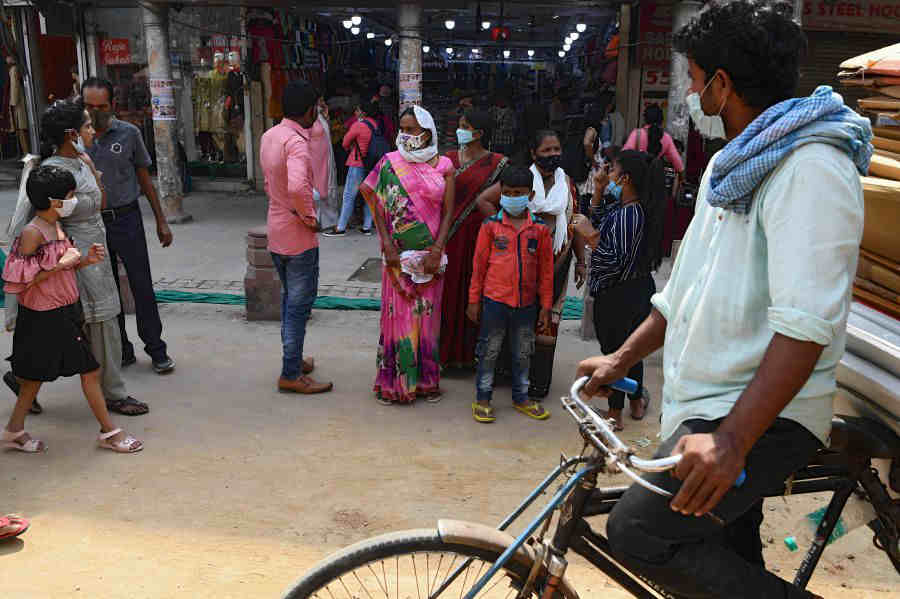
Shoppers wearing facemasks as a preventive measure against the Covid-19 coronavirus stand in a market area in the old quarters of New Delhi on October 11, 2020. – India’s coronavirus cases surged past seven million on October 11, taking it ever closer to overtaking the United States as the world’s most infected country
The figures have baffled experts, with explanations ranging from the young population to immunity given by other endemic viral diseases and under-reporting.
Here are some of the questions and theories raised by India’s pandemic statistics:
India said on Sunday there had been 108,334 fatalities from Covid-19 since the first death was reported in mid-March.
The world’s second-most populous nation has the lowest number of deaths per 100 confirmed cases – the observed case-fatality ratio – among the top 20 worst-affected nations at 1.5 per cent, according to a Johns Hopkins University tally.
In comparison, the United States, the most infected country, has a death rate of 2.8 per cent. India’s number of deaths per 100,000 population is 7.73, compared with 64.74 in the United States.
Older people suffering from conditions such as diabetes and heart disease have become a particular target of the pandemic but India has a young population with a median age of 28.4, according to the UN World Population Prospects report.
In comparison, France – which has reported almost 700,000 cases and more than 32,000 deaths for a death rate of 4.7 per cent – has a median age of 42.3.
The Indian government says the first infection was detected on Jan 30, with numbers passing 100 in mid-March.
By that time, the epidemic was already raging across Europe. Italy had reported more than 24,000 infections and almost 2,000 deaths, while France recorded nearly 5,500 cases and around 150 deaths.
Prime Minister Narendra Modi ordered a nationwide lockdown from March 25 that severely limited movement. That gave India time to prepare for the pandemic, while experts say the strict lockdown may have helped doctors learn from the experiences of other countries.
“Many of the treatment protocols were much better stabilised (by that time), whether it was oxygen use or ICU use,” Anand Krishnan, a community medicine professor at the All India Institute of Medical Sciences in New Delhi, told AFP.
Virologist T. Jacob John and other experts told AFP it is possible that other viral diseases such as dengue fever, which is endemic in India, may have given the population some antibody protection against the coronavirus.
Others say it is also plausible that exposure to other milder coronaviruses could give some cross-immunity. But all experts say more research is needed into this line of defence.
India already does not count all deaths. The problem is more acute in rural areas where 70 per cent of the population live. Many rural deaths are not recorded unless the person has been in a hospital.
This has been accentuated during the coronavirus. In many cities, tallies given by city governments and at cemeteries and crematoria do not match. Activists accuse some states of deliberately blaming other conditions for Covid-19 deaths.
“Our poor routine death surveillance system… misses many deaths in the first place,” Bangalore-based community medicine expert Hemant Shewade told AFP. He reckons that only one in five deaths is recorded with a cause.
Shewade, who has been analysing India’s official toll data, said many suspected Covid-19 deaths were not being recorded.
Government-conducted serological surveys – which test blood for antibodies to estimate how many have fought off the virus – indicate that 10 times the official number of people may have already been infected, meaning many deaths could have gone unreported, he added.
Meanwhile in some cases, the coronavirus may not be listed as the cause of death for patients with other medical conditions.
Experts say greater toll accuracy is possible if is there is more testing, better recording of deaths and post-mortem examinations are carried out on suspected victims.
Monitoring excess mortality – the number of deaths above the “normal” figure – as well as deaths at home could also shed some light on the real toll, Shewade said.
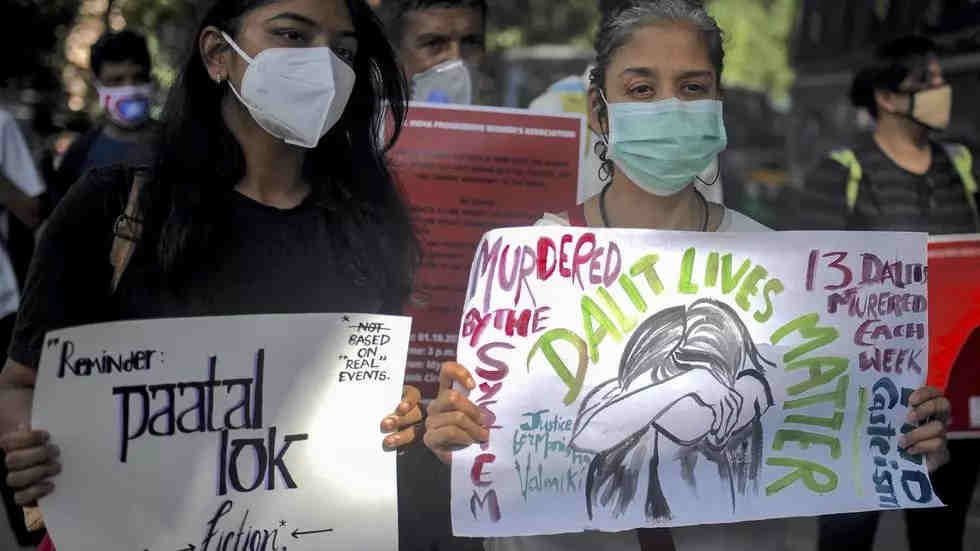
Des militantes indiennes de l’ONG All India Progressive Women’s Association (AIPWA) lors d’un rassemblement le 1er octobre à Bangalore, après le viol d’une intouchable (Dalit) dans l’Uttar Pradesh
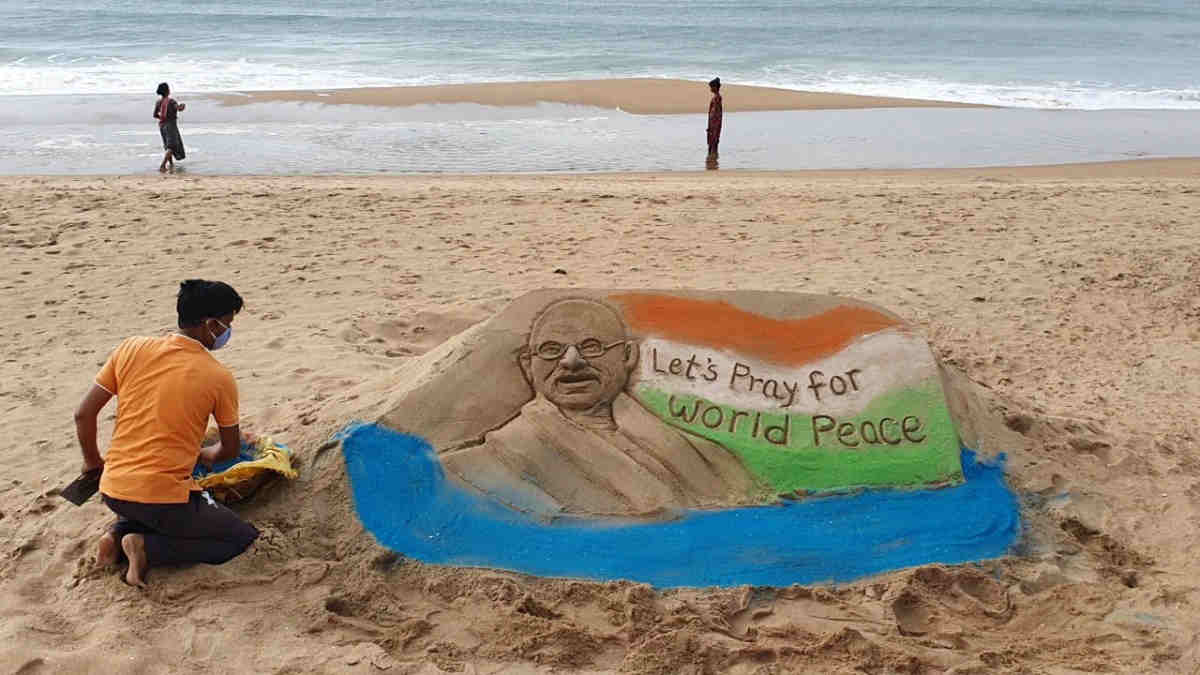
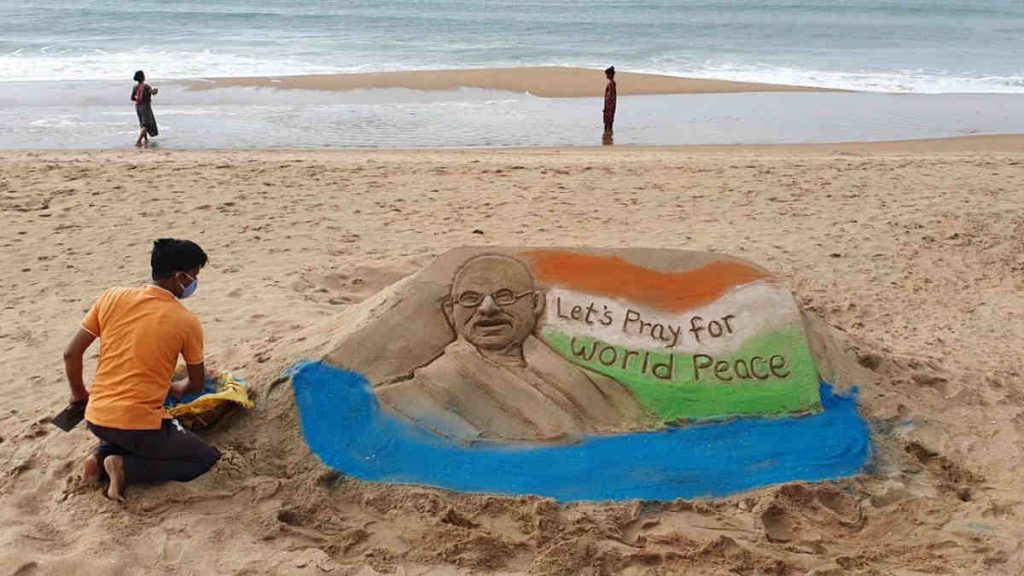
Acclaimed Odisha artist Manas Kumar Sahoo paid tribute to Mahatma Gandhi on the occasion of Gandhi Jayanti and made a sand sculpture of the Father of the Nation on the Marive Drive beach in Puri.
His sand art features a sculpture of Mahatma Gandhi with a message of world peace. He made a 10 feet sculpture of Gandhiji and inscribed beside it, “Let’s Pray For World Peace”.
To make the sculpture, Manas used five tones of sand and took nearly five hours to finish it.
See his sand art here:
Manas Kumar Sahoo paid tribute to Mahatma Gandhi with sand art.
Pakistan’s rejection of Jayant Khobragade as India’s new chargé d’affaires in Islamabad citing his seniority for the post as a reason for rejection is in keeping with the bitter antagonism between India and Pakistan that has intensified in the last few years. It has reached almost a dead-end since the scrapping of Kashmir’s special status last August.
Islamabad’s official explanation is that Khobragade having already served as ambassador earlier was not eligible for the post which is normally slated for diplomats at a lower rung. The Foreign office spokesman said it was India’s way of subverting the downgrading of diplomatic ties announced by Pakistan after article 370 was abolished by New Delhi. The spokesman said it must be made clear that ties between the two nuclear-armed neighbours were linked to the resolution of the Kashmir dispute.
It is part of the diplomatic norm to send the name of senior diplomats for the host country’s approval. In normal times not much fuss is made over this. But when India-Pakistan ties are strained diplomats become easy targets. Khobragade rejection is mainly to needle India and convey to ordinary Pakistani citizens that Prime Minister Imran Khan is not lowering his guard against India at every little turn.
In 2003, when India-Pakistan was going through another bad patch, Pakistan’s acting high commissioner in Delhi, Jalil Abbas Jilani was forced to leave the country over allegations of funding Kashmiri separatists. Jilani said then that the charge was a crude attempt at harassing Pakistan, high commission officials. He was declared “persona non grata” but when relations improved he returned to India at the head of a Pakistan delegation for talks, as the Vajpayee government began re-engaging with Islamabad.
But unlike in the past, chances of an India-Pakistan rapprochement soon appear dim. Kashmir has always been a major stumbling block and now after India’s latest move on August 5, 2019, it has become a Gordian knot.
And Pakistan does not let an opportunity go by without dragging in Kashmir. Even in the case of rejecting Khobragade the foreign office spokesman statement contained these lines on Kashmir. “A just and lasting solution of the Jammu and Kashmir dispute is critical for durable peace and stability in South Asia. Accordingly, India is once again reminded of its international obligations with regard to the Jammu and Kashmir dispute. India must listen to the voices of the Kashmiri people and the world community.”
In a way, Kashmir has helped Prime Minister Imran Khan to galvanise the public behind him. At a time when his government was fumbling with little to show as achievement, New Delhi’s decision on Kashmir helped to bolster his image as a crusader for the rights of Kashmiris. He did not leave a stone unturned in projecting Indian atrocities in the valley. Unfortunately, Khan got little traction from the international community. A few countries supported him on the abolition of special status for Kashmir, which Delhi said was its internal issue. But there was criticism from several international quarters on the lockdown and the communication embargo imposed on Kashmiris.
After a few cases in Kerala of atrocities against elephants, a project aims to reduce atrocities against elephants in captivity by collecting blood and faecal samples of the estimated 2,700 captive elephants The plan is being carried out under the aegis of Project Elephant Presently, most of India’s captive elephants are in Assam (nearly 1,000), followed by Kerala (500) and Tamil Nadu (300) After a few cases in Kerala of atrocities against elephants, a project aims to reduce atrocities against elephants in captivity by collecting blood and faecal samples of the estimated 2,700 captive elephants.
The plan is being carried out under the aegis of Project Elephant.
This exercise, Noyal Thomas, director of Project Elephant told TOI, will give a unique identity number to the elephants “just like an Aadhaar card which will be generated based on their DNA”.
A farmer’s attempted suicide in Punjab on Friday signaled more problems for the Narendra Modi government over three contentious bills which have led to cracks in the BJP-led ruling alliance at the Centre amid an intensifying peasant agitation across the country.
Harsimrat Kaur Badal of the Akali Dal, one of the BJP’s oldest allies, quit the Modi cabinet on Thursday in protest against the bills, which the government says would double farmers’ income through greater market access and unburden agricultural trade from all restrictions. The bills seek to open up the farm sector to more competition, modernise supply chains by allowing bigger agribusinesses to engage directly with farmers and create seamless access to markets.
Critics, including opposition parliamentarians, however, say that the bills will dilute the country’s public procurement system and lead to exploitation by private companies. The bills have already been passed by the Lok Sabha, where the ruling alliance has a brute majority.
Assembly elections are due in Bihar by October-November and a few other states by mid-2021 and Prime Minister Modi on Friday defended the bills, saying they will do away with middlemen who have been eating into farmers’ profits over the years. In an address to people in Bihar where he inaugurated several rail-related projects, Modi also hit out at the opposition for spreading “misinformation” about the proposed laws.
Around 60 percent of India’s population depends on farming for livelihood and the government faces the tough task of pacifying this crucial segment of voters, already reeling under the impact of the coronavirus pandemic which had dealt a crippling blow to the economy.
Farmers’ organisations appeared to be in no mood to relent as they announced plans to intensify their agitation from September 20, when they are likely to go for blockading highways and railway tracks.
“With the government withdrawing from its responsibility of assuring fair returns and leaving farmers at the mercy of the private sector, we have no recourse except to step up our agitation,” said Shamsher Singh, spokesperson of the Bhoomi Bachao Sangharsh Samiti, an influential farmers’ body which is among those spearheading the agitation.
Prabhakar Kelkar, vice president of the BJP-allied Bharatiya Kisan Sangh, said anticipated intensification of agitation by famers’ outfits across the country. The farmers’ discontent, according to Kelkar, is over uncertainty of payments, which as per the new ordinance, have to be made within three days. But in reality, many of the small farmers in Madhya Pradesh, for instance, are facing problems of not finding buyers or alternatively being pressurised to bring in larger quantities.
At present, farm produce are sold mainly in notified wholesale markets run by the agricultural produce marketing committees (APMCs) under state laws. The APMCs require farmers to only sell to licensed middlemen in these markets rather than in open markets, which economists say hurt the possibility of more profits. One of the bills enables farmers and buyers to trade outside these tax-free markets.
However, critics say that the small time-frame are forcing farmers to approach undocumented traders. Unlike in APMC-managed mandis, where records of transactions are maintained, there is little means to track these unregistered traders. This has led to many farmers being cheated of their dues, the critics allege.
In many instances, traders and mandi workers are behind rising agitation as opening of more sales avenues has led to mandi-based traders fearing a sharp drop in their business and market influence. In direct correlation to the drop in mandi business is the fear of workers in the yards, their numbers can be anywhere between a few thousands to around 50,000, that their avenue for wages will be hit.
After initially stating that the central government does not have any data on migrant deaths during the lockdown, the government has now said 97 migrants were reported to have died till September 9 onboard Shramik Special Trains.
The information came to light in a government response to a question in Rajya Sabha days after a row broke out over the Centre having no data on migrant deaths in the country.
In response to a question raised by Trinamool Congress MP Derek O’Brien in Rajya Sabha on Friday on details of total deaths that occurred onboard the Shramik Special trains, Railway Minister Piyush Goyal said, “Out of these 97 cases of deaths, state police sent dead bodies for post mortem in 87 cases. 51 post mortem reports have been obtained from respective state police so far, in which the reasons for deaths have been shown as cardiac arrest/heart disease/brain hemorrhage/pre-existing chronic disease/chronic lung disease/chronic liver disease etc.”
The railway minister’s response comes amid a political storm caused earlier this week by the labour ministry’s response in Lok Sabha in which he stated that no data is available on the number of migrant workers who died during the lockdown enforced in March.
In the month of May, it was reported that almost 80 migrants died onboard Shramik Special trains, between May 9 and May 27, citing data from the Railway Protection Force.
Shramik Special trains began operation on May 1 to ferry migrant labourers back to their home states during the lockdown period.
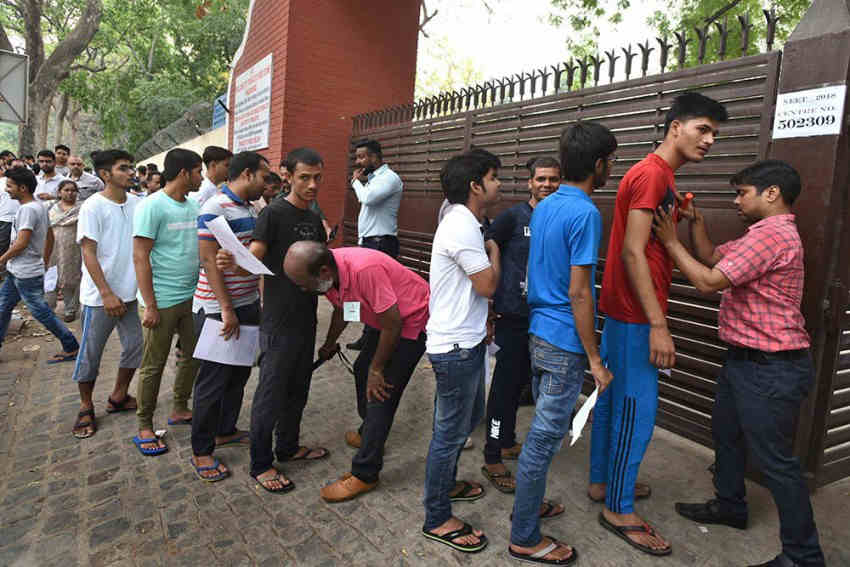
The National Testing Agency (NTA) will conduct undergraduate medical and dental programmes on Sunday. It will conduct the entrance test at a total of 3,862 examination centres under strict Covid-19 safety precautions across the country.
A total of 15.97 lakh medical aspirants have registered for the nationwide test. Out of them, over 15 lakh students downloaded their admit cards for writing the exam till evening on Saturday, official sources said.
“The test will be conducted under strict covid-19 safety precautions,” they added. To avoid crowding at the examination centres and ensure that social distancing is maintained outside and inside the test venue; provisions have been made for staggered entry and exit of the students to be appearing for the exam.
While the 3-hour long test will start at 2 pm, entry of the students will begin at 11 am in small batches. After the test is over, students will be allowed to leave the venue in the same manner, an official said.
Though, all the candidates have been asked to reach their examination centres with masks and sanitisers, they will be provided with fresh three-ply masks at the examination centre before they enter the examination hall.
“They will have to take examinations wearing the fresh masks, to be provided by the authorities at the examination centre. The seating arrangements has been made in such a manner that there remains 6 feet physical distance among students inside the examination halls as well,” the official said.
“I am confident that all the candidates will appear for the NEET exam tomorrow with patience and confidence while following the Corona safety guidelines, as the way JEE main aspirants took their test,” Union education minister Ramesh Pokhriyal Nishank tweeted, wishing all the best to the NEET aspirants for their exam.
A woman in Kerala who was a COVID positive patient, has allegedly been raped inside the ambulance by the driver while going to the hospital, said police as per a report in Indian Express.
The accused, Noufal, has been taken into custody, said Pathanamthitta district police superintendent KG Simon. Noufal belongs to Alappuzha and worked in the state health department’s “108 ambulance service”.
The SP went on to say that the accused took the ambulance to a deserted ground and raped the woman. She informed the hospital staff later on who then called the police.
The woman’s statement and the accused’s arrest have both been recorded.
For some, mathematics is surely something that can put their minds to a spin. But some truly enjoy the challenge and end up being good at it. However, there are some for whom all this is rather effortless.
We came across one such individual, who has defied odds at a very young age. Meet Tathagat Avatar Tulsi, India’s child prodigy.
Defying odds in academics Tulsi was born on September 9th, 1987, in Patna, Bihar. Son of Supreme Court advocate Tulsi Narayan Prasad, his parents noticed his pace of learning at a very early age. He was in fact one of the youngest to ever complete his high-school, graduation, masters and PhD.
He reportedly completed his high school when he was just 9 years old — an age when kids are barely done with multiplication. In just a year, he completed his BSc followed by Masters in Science from Patna Science College at the age of 12. Speaking about his skills, he told TOI, “I believe I have a gift. When I was young and while my friends were struggling to solve mathematical problems, I would solve those easily.”
Completing his PhD from IISc Bengaluru In August 2009, he got his Ph.D. from the Indian Institute of Science, Bangalore at the age of 22. Here, his Ph.D. thesis was on “Generalizations of the Quantum Search Algorithm”. He co-authored an unpublished research manuscript (“A New Algorithm for Fixed-point Quantum Search”) with Lov Grover, the inventor of a quantum search algorithm that goes by his name.
The research paper was just 35 pages long, yet he felt it had immense potential. He said in an interview with TOI, “Despite the short length, the thesis is innovative enough to qualify as a PhD work. I was always interested in quantum computers and would like to develop software for it. Quantum computers will take us one step ahead in changing the world for the better.”
Winning awards and accolades from an early age Tulsi has been in the limelight since a very young age. In 2001, he was shortlisted by the Indian Government’s Department of Science and Technology (DST) to participate in a Nobel laureates conference in Germany.
He has been even regarded as one of the seven most gifted Asian youngsters by TIME magazine in 2003, mentioned as “Superteen” by Science Magazine, while also being invited by Italian billionaire Luciano Benetton for a dinner in honor of Al Gore on 14 June 2007 in Milano, Italy.
Assistant Professor on contract at IIT Bombay In 2010, after completing his PhD, he was offered a role to teach students at the prestigious IIT Bombay, when he was barely 23 years old.
A Delhi-based woman was allegedly raped while returning home on a private bus on the Yamuna Expressway on Saturday, police said.
The woman faced the ordeal after a crew member inside the bus assaulted her, the police said, while adding that the vehicle was coming from Lucknow.
“She called the 112 helpline on Saturday morning when the bus reached Mant toll plaza in Mathura and informed us about the rape by the bus cleaner,” police further said.
The woman and the accused cleaner Ravi were instructed to get down after which the bus was checked, police stated, after which it left for Delhi. Later, the woman underwent a medical examination.
Afterwards, she was escorted back to her home in Rohini, Delhi under police supervision, while the accused Ravi, a resident of Bahraich district, has been sent to judicial custody, the police added.
SRINAGAR, India: Indian forces opened fire with shotgun pellets and tear gas on Saturday on a procession by hundreds of Muslims in troubled Kashmir, injuring dozens of people who had ignored a ban on religious gatherings, witnesses said.
Indian authorities had reimposed the ban on Thursday after clashes with Shia Muslims wanting to stage traditional processions for the Muharram holy month.
Jafar Ali, a witness, told AFP that the procession started in the Bemina area on the outskirts of the main city of Srinagar and that government forces were present in heavy numbers.
Ali and other people who saw the clashes said security forces fired pellets and tear gas to break up the gathering.
“The forces fired pellets at the procession that was mainly peaceful and included women,” said another witness Iqbal Ahmad.
At least 40 people were injured, according to witnesses.
About 25 people were taken to a nearby clinic with pellet wounds, some with their faces and bodies covered in pellet marks, a doctor there told AFP on condition of anonymity.
“We moved about a dozen people to other facilities for more advanced treatment,” the doctor said.
A police official confirmed the incident, saying: “Some people had gathered and were trying to start a procession, they were dispersed.” He did not give details of casualties.
Muharram processions, to mourn Imam Hussain, a grandson of the Prophet Mohammad, in a battle about 1400 years ago, are held around the world but have been regularly banned in Indian Kashmir since an uprising erupted in 1989.
The Muslim-majority Himalayan region is largely divided between India and Pakistan, who both claim it in its entirety and have fought two wars over it.
Last year, India took away the semi-autonomous status granted to its side of the territory. Tensions have risen since.
Muslims in the procession chanted pro-separatist and an anti-Indian slogans, other witnesses said.
Several arrests have been made this week of people shouting against Indian rule when processions have been attempted, a police official said. Some have been charged under anti-terrorism laws.
Dozens of Shia Muslim mourners were detained in Srinagar on Friday after they tried to start Muharram processions.
60-year-old Mehrunnisa Abdul Hamid Kazi was rescued on Tuesday evening after being trapped for 26 hours under the rubble of the five-storey building which collapsed on Monday evening in Maharashtra’s Raigad area.
A60-year-old woman was rescued on Tuesday evening by the National Disaster Response Force (NDRF) from the debris of Tariq Garden building in Maharashtra’s Raigad, 26 hours after the building collapsed.
Mehrunnisa Abdul Hamid Kazi was trapped under the rubble of the five-storey building which collapsed on Monday evening. Officials said Kazi lived on the fifth floor of the building.
After noticing some movement under a portion of the debris, personnel of the NDRF Force succeeded in pulling her out by 9.35 pm on Tuesday and rushed her to a hospital.
Earlier, the NDRF had rescued four-year-old Mohammad Nadim Bangi safely from the rubble 19 hours after the incident.
Twelve persons have been killed in the building collapse and nine injured. At least three more persons were suspected to be stuck under the debris.
A 17-year-old girl, whose mutilated body was found near a village in Uttar Pradesh’s Lakhimpur Kheri district earlier today, was also raped, the police confirmed Tuesday night.
The police had initially said the girl appeared to have been killed with a sharp weapon and that she had sustained injuries to her neck. The body was found near a dried-up pond, around 200 metres from her village, the cops added.
“Yes, the post-mortem report has confirmed rape. We are making all possible efforts to identify and arrest the accused. We hope to have a breakthrough soon,” Satendar Kumar, Kheri’s police chief, said.
According to the relatives of the girl, she left home on Monday to visit a neighbouring town to fill up a scholarship form. However, when she did not return the family informed the police.
“I really don’t know what to say or whom to suspect. She left around 8.30 AM on Monday. We do not suspect anyone,” her uncle told the media.
This is the second rape and murder of a teenage girl from this district in the past 10 days.
On August 15, a 13-year-old girl was raped and killed. Her body was found in a sugarcane field that belongs to one of the accused. Two men from her village have been arrested.
Her father alleged his daughter had been strangled, and had her eyes gouged out and her tongue cut off.
The police said the post-mortem report, which was released a day later, did not show her eyes had been gouged or that her tongue was cut out. The police said the autopsy did mention rape and strangulation.
Union Health Minister Dr Harsh Vardhan on Saturday expressed hope that if all goes well, India will get a Covid-19 vaccine by the end of this year. Speaking to an India Today TV reporter, Dr Harsh Vardhan said, “The world is working towards discovering a vaccine. There are 26 vaccine candidates around the world that are in the clinical trials phase. Apart from this, there are 139 candidates that are being developed on different levels and in pre-clinical trials.”
“The vaccine candidates in India have made a little more progress than them. There are around half a dozen in total. Three of them have reached the first, second and third phases respectively,” the Health Minister said.
Dr Harsh Vardhan added, “As we are analysing their progress, we are fully confident that their trials will be completed within this year itself and their results will come out in front of the whole nation and the world. And I have complete faith that we will be successful too.”
“As soon as an effective vaccine is available for the country, we will start its manufacturing in India and make it available to the public,” he further said.
Earlier on Saturday, the Health Minister also said that India has the “best” Covid-19 recovery rate of about 75 per cent, which is improving every day, and the “lowest” mortality rate of 1.87 per cent in the world.
He said India began formulating its strategy against coronavirus from January 8 as soon as the world came to know about the outbreak of the disease.
Dr Harsh Vardhan said “many intelligent people, scientists and naysayers” had estimated that India, with a population of about 135 crore, will see 300 million Covid-19 cases and about 5-6 million people will die by July-August, and the country’s healthcare system was “incapable” to combat the disease.
“However, I am happy to say that in the eighth month of the battle, India has the best recovery rate of 75 per cent and against an estimate of 300 million affected we have not even reached 3 million cases.”
“In fact, 2.2 million patients have recovered and gone home and another seven lakh are going to be cured very soon,” he said.
Pakistan on Saturday admitted that Dawood Ibrahim, one of India’s most-wanted men, lives within its territory – in Karachi, in a building called the ‘White House’.
Dawood Ibrahim, who heads a vast and multifaceted illegal business, had emerged as India’s most-wanted terrorist after the 1993 Mumbai blasts. For years, Pakistan has been denying that it was sheltering him. This was despite repeated statements and evidence that India provided from time-to-time about his presence in Pakistan.
The revelation about Dawood Ibrahim’s presence was made on Saturday when Pakistan placed his name on the list of designated terrorists operating within its territory. The list was submitted before the Financial Action Task Force (FATF), a global money laundering and terrorist financing watchdog.
Pakistan has claimed that it has directed placing travel restrictions on Dawood Ibrahim, besides putting an arms embargo and freezing his funds.
In 2003, the US declared Dawood Ibrahim as a Specially Designated Global Terrorist.
India has repeatedly asked the Government of Pakistan to hand over Ibrahim to India so that he can be prosecuted for the crimes committed by him. It is reported that Ibrahim is based in the southern port city of Karachi.
India’s silver imports are likely to fall by more than 40 per cent from a year ago to the lowest level in eight years, with investors booking profit by selling stocks after local prices rallied to a record high this month, leading importers said.
Lower imports by the world’s biggest silver consumer could weigh on global prices that have risen more than 50 per cent so far in 2020.
“Investors, who bought silver at higher levels, got an opportunity to exit after a long time. For some, even after a decade,” said Chirag Thakkar, CEO of Amrapali Group Gujarat, a leading silver importer.
Their selling will reduce import requirement for 2020 to 3,000 tonnes, the lowest since 2012, he said.
India imported 5,598 tonnes of silver in 2019, according to data compiled by Refinitiv GFMS. The country fulfills most of its silver requirement through imports.
Investors are sceptical whether silver will hold recent gains, said Prithviraj Kothari, managing director of RiddiSiddhi Bullions.
“There is rush from sellers but very few buyers are there. Sellers are forced to accept hefty discount,” he said.
Local silver futures were trading around 66,800 rupees per kg on Thursday afternoon after hitting a record high of 77,949 rupees earlier this month.
But in the spot market silver was offered at discount of more than Rs 5,000 per kg due to weak demand, Thakkar said.
India’s silver imports in the first seven months of the year nearly halved from a year ago to 1,900 tonnes and it is unlikely to rise again unless prices correct sharply, said a Mumbai based dealer with a bullion importing bank.
Transformation is key to burning away the Covid-19 fears. Not surprisingly today all of us are compelled to go beyond our form, battling over either surviving in our jobs or nursing our Covid-struck businesses.
Covid-19 has hugely impacted every section of society, paralyzed movement of people and vehicles and severely endangered our economy. However, there are sectors that have sensed the opportunity and are set to strategize with innovations.
These sectors could also be on the lookout for professionals who can add value, creating a scope for an employment opportunity.
Five sectors which will be in high demand in the post-Covid era are:
1. Ed-tech
2. Healthcare
3. Fintech/Financial services
4. OTT and Online Gaming
5. E-Retail and E-Commerce
Covid-19 is determined to bring destruction, but we are hoping that there will be phoenixes rising out of the ashes of the crisis. The pandemic has opened our eyes to gaps and challenges and awakened many industries to transform.
We are already witnessing a new wave of technologies emerging, thus signaling the dawn of another renaissance. India has a chance to grab the opportunity of attracting companies from western countries that are looking at moving out of China and Japan.
This could magnify the Government’s vision to make India a manufacturing hub, time to turn India’s vision to reality!
Assam Education Minister Dr Himanta Biswa Sarma on Tuesday said in a press conference held in Guwahati that the state government will provide scooties to 22,000 girl students of the state who passed the higher secondary final examinations with first division marks.
“The state government will deliver the scooties to girl students by October 15 this year. Each scooty will cost Rs 50,000-55,000,” Himanta Biswa Sarma said.
“The government will be launching a website sebaonline.org and the students who want electric scooty, may choose to their choice of the variant to visit the website. The students will have to bear the cost of registration and they will not be able to sell the scooties for at least three years,” he added.
The Assam minister also said that aiming the implement the National Education Policy in Assam, the state government has constituted a 40-member high-level committee.
“The committee will be divided into various subgroups and it will give recommendations on how to implement the National Education Policy in Assam. By this year, we will make a framework for implementation of the National Education Policy in Assam,” Himanta said.
On the other hand, the state government has urged all colleges of the state to increase their undergraduate seats by 25 percent this year.
“Due to the Covid-19 pandemic, CBSE could not be completed Class 12 examinations and the central board had given marks to the students just as projected marks. So, many students of the state under the Assam Higher Secondary Education Council (AHSEC) could not able to get seats in the colleges,” Sharma said.
A 13-year-old girl has been raped and murdered in India.
Her body was found in a sugarcane field in northern Uttar Pradesh state, police said on Saturday. Two neighbours in the village have been arrested.
Police have denied the father’s account that his daughter had had her eyes gouged out and her tongue cut.
Rape and sexual violence have been under the spotlight in India since the 2012 gang rape and murder of a young woman on a bus in the capital, Delhi.
That attack led to huge protests and changes to the country’s rape laws, but there has been no sign of crimes against women and girls abating.
According to recent crime figures, every fourth rape victim in India is a child. In an overwhelming number of rape cases, the victims know the perpetrators.
The latest incident occurred late on Friday in Pakaria village in the Lakhimpur Kheri district, police said.
The family went searching for their daughter after she failed to return from a toilet break out in the fields.
They say they found her body mutilated.
But police said the post-mortem examination had concluded that she had died from strangulation after being raped – but not that her eyes had been gouged out or that her tongue had been cut.
“There were scratches near the eyes, likely due to the sharp sugarcane leaves where the body was found,” police spokesman Satendra Kumar said.
A senior member of the Opposition Congress Party, Jitin Prasada, condemned the attack as “saddening”.
“The inhuman act with a girl has put humanity to shame,” he said, according to the Times of India newspaper.
The incident comes months after the case of a six-year-old girl who was abducted outside her home in Madhya Pradesh state and raped.
The attacker inflicted severe injuries to the child’s eyes, in an apparent attempt to stop her identifying him.
In February, a 25-year-old man was arrested forallegedly raping a five-year-old girlon the premises of the US embassy in Delhi.
Prime Minister Narendra Modi said on Saturday that three vaccines, that are being developed and tested in India to fight the novel coronavirus, are at different stages of testing. PM Narendra Modi also said his government will ensure every Indian gets vaccinated against coronavirus.
Addressing the nation from the iconic Red Fort in Delhi on India completing 73 years of Independence, PM Modi said the roadmap for the production of coronavirus vaccine and its distribution to every Indian in the least amount of time, is ready. He said the mass production of coronavirus vaccine will begin once scientists give their nod.
PM Modi said, “Three coronavirus vaccines are at different testing stages in India. The roadmap for its production and distribution among the Indians is also ready. The government will ensure every Indian gets the vaccine against coronavirus.”
“As soon as the scientists give a green signal, the country will begin their large-scale production,” PM Narendra Modi said, adding the talent of “our scientists is like that of rishi munis”.
“We will announce the roadmap for its distribution as soon as it gets final clearances,” PM Modi said.
He said whenever there is talk of coronavirus, the question that comes to everyone’s mind is that when will a vaccine be ready. “I want to tell people, the talent of our scientists is like that of ‘rishi munis’ and they are working very hard in laboratories. Three vaccines are in various stages of testing,” he said.
PM Modi said the government would soon announce the National Digital Health Mission under which, every citizen would get a health ID. “National Digital Health Mission will bring a new revolution in India’s health sector,” PM Modi said, adding, “Health updates will be logged in the health ID on every visit to a pharmacy or a doctor.”
India mourned the deaths of 18 passengers of the ill-fated Air India Express (AIE) flight that skidded off the tabletop runway and broke into two on landing at Kerala’s Kozhikode Airport, also known as the Karipur International Airport, on Friday evening.
Pilot of the flight, Capt Deepak Sathe and his co-pilot Akhilesh Kumar Sharma are also among the 18 who died in the tragic flight mishap.
The AIE flight (IX-1344) from Dubai with 190 people on board including a 6-member crew overshot the table-top runway while landing at the Karipur Airport and fell into a valley 35 feet below and broke into two portions.
Rest of the passengers were rescued from the crash site and rushed to hospitals for treatment. Of them, 23 are said to be in critical condition while another 23 have been discharged after initial medical assistance.
The crucial black box Air India Express flight, that could throw light on how it overshot the runway and crashed, has been recovered.
Kerala government on Saturday announced Rs 10 lakh compensation to the families of those who died in the incident. Air India Express also announced compensation for those killed in the plane crash. Air India Express said it will give Rs 10 lakh to the next kin of the deceased passenger 12 years and above, Rs 5 lakh to the passengers below the age of 12 years, Rs 2 lakh to critically injured passengers and Rs 50,000 to the passengers who are injured in the incident.
Black box of Air India flight retrieved
Officials on Saturday said that the crucial black box of the ill-fated Air India Express flight that could throw light on how it overshot the runway and crashed has been recovered.
Investigations into the cause of the crash are underway with top officials of the airlines and aviation regulator DGCA rushing to Kozhikode while Civil Aviation Minister Hardeep Singh Puri also arrived in this city in north Kerala and took stock of the situation and implementation of the relief measures.
“Digital Flight Data Recorder (DFDR) and Cockpit Voice Recorder (CVR) of the ill-fated aircraft have been retrieved. AAIB (Aircraft Accident Investigation Bureau) is conducting investigations,” Puri tweeted.
The minister said he would hold consultations “with senior civil aviation officials & professionals”, adding reasons for the mishap, in which the two pilots were among those dead, were being investigated.
The digital flight recorder and cockpit voice recorder from the Air India flight that crashed in Kerala’s Kozhikode were recovered on Saturday morning. The devices may be crucial in the investigation to know what caused the crash.
The recovered components will be crucial in learning about the last moments before the flight skidded on runway on Friday and killed 18 people including two pilots.
The Airports Authority of India (AAI) had said the Air India Express plane, carrying 190 people from Dubai, on Friday touched down near a taxiway that is around 1,000 metres from the beginning of the runway at the Kozhikode airport before breaking up into two pieces.
The pilot of the ill-fated flight — IX-1344 — could not sight the runway in the first landing attempt due to heavy rains.
The Kozhikode airport in Kerala has a table-top runway and is operated by the Airports Authority of India (AAI). Generally, table-top runways are constructed on a hilly or an elevated terrain.
At least 18 people, including two pilots, have died in the crash. An AAI spokesperson said that runway 28 was in use and in the first landing attempt, the pilot could not sight the runway and requested for runway 10.
Citing information from the Air Traffic Controller (ATC), the spokesperson said the aircraft touched down near taxiway ‘C’, which is approximately 1,000 metres from the beginning of runway 10. The total length of the runway is 2,700 metres.
Rescue operations were completed around midnight and airport operations resumed at 3 am on Saturday morning.
The Boeing 737-800 aircraft while landing overshot the runway and went down 35 feet into a slope before breaking up into two pieces.
The Coronavirus cases in India on Thursday crossed 2 million-mark, with the countrywide figure surging to 20,19,930.
This is the ninth consecutive day that COVID-19 cases have increased by more than 50,000.
On Thursday morning, the health ministry said India had recorded a single day increase of 56,282 COVID-19 cases taking the country’s virus tally to 19,64,536, while the recoveries surged to 13,28,336.
The death toll due to COVID-19 climbed to 41,573 with 891 new fatalities being reported in 24-hours, according to a PTI tally.
The fatality rate has further dropped to 2.07 per cent, the data stated.
India is behind Brazil, which has more than 2.8 million cases and the US, which is leading the list of nations hit worst by the pandemic, with close to 5 million cases.
According to the ICMR, a cumulative total of 2,21,49,351 samples have been tested up to August 5 with 6,64,949 samples being tested on Wednesday.
On Thursday morning, the health ministry update said that of the 904 fresh deaths reported in the 24 hours since Wednesday monring, 334 are from Maharashtra, 112 from Tamil Nadu, 100 from Karnataka, 77 from Andhra Pradesh, 61 from West Bengal, 40 from Uttar Pradesh, 29 from Punjab, 23 from Gujarat, 17 from Madhya Pradesh, 13 each from Rajasthan and Telangana, 11 from Delhi and Nine each from Jammu and Kashmir and Odisha.
Eight fatalities each have been reported from Bihar and Jharkhand, seven each from Haryana, Kerala and Puducherry, six from Assam, four from Goa, three from Uttarakhand, two each from Andaman and Nicobar Islands and Chhattisgarh, while Nagaland and Tripura have registered one fatality each.
Of the total 40,699 deaths, Maharashtra has reported the maximum at 16,476 followed by 4,461 in Tamil Nadu, 4,044 in Delhi, 2,804 in Karnataka, 2,556 in Gujarat, 1,857 in Uttar Pradesh, 1,846 in West Bengal, 1,681 in Andhra Pradesh and 929 in Madhya Pradesh.
So far, 745 people have died of COVID-19 in Rajasthan, 589 in Telangana, 491 in Punjab, 455 in Haryana, 426 in Jammu and Kashmir, 355 in Bihar, 225 in Odisha, 136 in Jharkhand, 121 in Assam, 98 in Uttarakhand, 94 in Kerala.
Chhattisgarh has registered 71 deaths, Puducherry 65, Goa 64, Tripura 31, Chandigarh 20, Himachal Pradesh and Andaman and Nicobar Islands 14 each, Ladakh and Manipur seven each, Nagaland six, Meghalaya five, Arunachal Pradesh three, Dadra and Nagar Haveli and Daman and Diu two and Sikkim one.
Novel coronavirus cases in India breached the 20-lakh mark on Thursday with various states such as Andhra Pradesh, and Tamil Nadu recording massive spikes in new confirmed cases of Covid-19.
As per the Ministry of Health and Family Welfare’s Covid-19 bulletin, last updated at 8 am on August 6, India’s tally of confirmed cases stood at 19,64,536. This was inclusive of 5,95,501 active cases, 13,28,336 patients discharged after recovery and 40,699 deaths.
The official number of total Covid-19 cases, however, remains at 19.64 lakhs as the Ministry of Health’s Covid dashboard is updated at 8 AM each morning.
Maharashtra, the state with the most number of Covid-19 cases in all of India, recorded 11,514 fresh cases on Thursday. This takes Maharashtra’s tally of confirmed cases to 4,79,779. A total of 3,16,375 patients have recovered from the infection in the state, 10,854 in the last 24 hours. There are 1,46,305 active cases in the state as on August 6, as per Maharashtra Health Minister Rajesh Tope.
Andhra Pradesh followed Maharashtra to report the second-most fresh cases on Thursday. With 10,328 new cases, Andhra’s tally of confirmed Covid-19 cases now stands at 1,96,789. This includes 82,166 active cases, 1,12,870 patients discharged after recovery and 1753 who succumbed to the infection to date.
Similarly, the state of Karnataka reported 6805 fresh cases, Tamil Nadu 5684 new cases and Uttar Pradesh 4589 fresh cases followed by West Bengal with 2954 new cases. As many as 1699 more cases were recorded in Odisha, 1299 in Delhi, 1298 in Kerala and 1034 in Gujarat along with 830 fresh cases in Madhya Pradesh.
On Thursday, the global tally of Covid-19 cases exceeded 1,88,51,834 with US and Brazil with the most cases followed by India, Russia and South Africa. The infection has claimed 7,08,540 lives across the globe with the US leading in casualties followed by Brazil, Mexico and the United Kingdom.
As the death toll in the Punjab spurious liquor tragedy continues to rise, the case has picked up the pace with action now being taken against some senior officials in the state. Majority of the deaths have taken place in Tarn Taran, Batala and Amritsar districts of the state since Wednesday.
While the toll in the hooch tragedy mounted to 86 on Saturday — 63 deaths in Tarn Taran, 12 in Amritsar Rural at 12 and 11 in Gurdaspur (Batala) — seven excise officials, six policemen were suspended in connection with the incident. The total number of arrests in the case has also gone up to 25. Punjab Chief Minister Amarinder Singh also announced Rs 2 lakh ex-gratia compensation to each of the families of the deceased.
1.As the death toll in the Punjab hooch tragedy rose to 86, the Punjab police on Saturday arrested 17 more persons in a massive crackdown. More than 100 raids were conducted in the three affected districts — Amritsar Rural, Gurdaspur and Tarn Taran — along with several other places in and around the Rajpura and Shambhu border. The total number of arrests in the case has gone up to 25.
2.Govinderbir Singh alias Gobinda, the mafia mastermind accused of bringing spurious liquor from Tarn Taran to the Amritsar Rural area; kingpin Darshan Rani alias Faujan; transport owner Prem Singh; Bhinda, who is a wanted criminal by Tarn Taran police; and owners/managers of various dhabas from where the illicit liquor was being supplied are among the arrested accused, DGP Dinkar Gupta said. The dhabas, identified as Zilmil Dhaba, Green Dhaba, Chhinda Dhaba on Shambhu, and Banur and Rajpura in Patiala, have been sealed.
3.As much as 750 litres of Lahan had been seized from village Baghaura from where two persons, Satnam and Rashem, were arrested while another, identified as Lakhwinder, was also identified as a culprit.
4.According to the DGP: In the raid at Jhilmil dhaba, whose manager Narinder Singh was arrested, 200 litres of Lahan ( a type of illicit liquor) was seized. The dhaba owner Harjit Singh has also been named in the FIR. At Green Dhaba near Rajpura Chandigarh Road, approximately 200 litres of Diesel like liquid was recovered, which truck drivers were selling to the dhaba owner. The dhaba has also been sealed and its owner Gurjant Singh has been arrested. One Narinder Singh, the owner of Multani Dhaba, has also been arrested in the case, said the DGP. Another 150 litres of Lahan was recovered from one Parminder Singh and 200 litres from Baljit Singh. Both these men have also been arrested. Raids were also conducted at the house of Rupinder Singh alias Bittu, who is a friend of Hardeep Singh alias Goldy who was arrested earlier by the CIA Jalandhar Rural.
5.Describing the modus operandi of the accused, the DGP said the trucks carrying spirit would be stopped at 6-7 identified Dhaba and the Dhaba owners collected the hooch from truck drivers and sold it to one Bhinda and Bittu of a village near Banur. Bhinda was also an accused in the Rajpura factory case. The spirit was being supplied to Amritsar and surrounding areas by these people.
6.Punjab Chief Minister Amarinder Singh had already ordered a magisterial probe into the tragedy, unfolding since Wednesday night. He even announced Rs 2 lakh ex-gratia compensation to each of the families of the deceased on Saturday.
7.On Saturday, seven excise officials, six policemen were also suspended over Punjab hooch tragedy. During the 13th edition of his Facebook Live #AskCaptain, Amarinder Singh announced the suspension of ETOs Lovejinder Brar from Gurdaspur, BS Chahal from Amritsar and Madhur Bhatia from Tarn Taran. Excise and Taxation Inspectors (ETIs) who have been suspended with immediate effect are Ravi Kumar (Gurdaspur), Gurdeep Singh (Amritsar), Pukhraj (Fatehabad) and Hitesh Prabhakar (Tarn Taran). He also suspended Jandiala (Amritsar) and Tarn Taran DSPs. The SHOs of Amritsar’s Tarsikka, Batala City, Tarn Taran Sadar and Tarn Taran City were also suspended.
Earlier, Bikramjit Singh, the station house officer at the Amritsar’s Tarsikka police station, was also suspended.
The Supreme Court today dismissed a PIL filed requesting for a CBI probe into actor Sushant Singh Rajput’s death. The court asked Alka Priya, the lawyer who filed the plea to let the police do their job instead. The lawyer further added that Sushant Singh Rajput had done a lot of work for children by facilitating their training at NASA, and therefore, his death needs to be looked at. To which, Chief Justice S Bodbe said that that has nothing to do with if he was good or bad person. Sushant Singh Rajput died by suicide on June 14.
There’s been a growing demand for a CBI probe into Sushant Singh Rajput’s death case with several political figures and film personalities weighing in. Amid all this, yesterday, Maharashtra Home Minister Anil Deshmukh also said that there is no need for the case to be transferred to CBI, and that the Mumbai Police is capable of handling the investigation. The Mumbai Police has been investigating the case since June 14. They have recorded statements of over 40 people in connection with Sushant’s death, including that of Rhea Chakraborty, Sushant’s family, filmmakers Sanjay Leela Bhansali and Shekhar Kapur, and Yash Raj Films head, Aditya Chopra, among others.
Rhea Chakraborty, Sushant Singh Rajput’s girlfriend, also recently wrote to Home Minister Amit Shah requesting him to sanction a CBI enquiry into the actor’s death. In a long Instagram post, she had written, “Respected @amitshahofficial sir , I’m sushant Singh Rajputs girlfriend Rhea chakraborty, it is now over a month since his sudden demise . I have complete faith in the government , however in the interest of justice , I request you with folded hands to initiate a CBI enquiry into this matter . I only want to understand what pressures prompted Sushant to take this step. Yours sincerely, Rhea Chakraborty (sic).”
Most discussions on India’s Covid-19 outbreak centre on the high number of cases, now third in the world after the United States and Brazil. The messaging from the government has been that things are getting better. However, a broader look at the month’s data shows that cases are growing fastest in India among the worst affected countries, and improvements in India have plateaued.
Not only that, but India is gradually inching towards registering the highest number of daily new cases. Since last week, it has consistently added over 40,000 new cases every day, and on Monday, July 27, it was just 5,000 cases away from reporting the highest daily rise in cases in the world. India reported nearly 50,000 new cases, just behind the US, which added a little less than 55,000 cases on the day. Incidentally, Brazil at the third spot added less than half the number of cases as India.
Despite having the world’s third-highest caseload, India’s cases are growing faster among the 10 worst-affected countries. In fact, India has one of the world’s highest growth rates in cases; just 18 countries out of nearly 200 are growing faster, but all of them (except Argentina with 1.5 lakh cases) have only a few hundred or few thousand cases. In the worst-affected US, cases are doubling in 40 days, while in Brazil, they are taking 36 days. In India, cases are doubling in 19 days.
The seven-day rolling average of India’s daily additions is also sloping upwards and competes with that of Brazil and the US. According to ‘Our World in Data’, as of July 26, India’s average daily additions were around 44,000; the same was 45,600 for Brazil. The US tops the chart with daily additions averaging 66,600.
Epidemiologist Giridhar R Babu believes this increase in cases should not worry us as increased detection helps in early isolation. “Starting with just a few labs, India has come a really long way in detecting these many cases by expanding testing throughout the country. However, there is still scope for more testing, especially in areas with low case detection. We should not worry about the absolute number of cases, as increased detection helps in saving more lives by early isolation and timely management,” said the professor and head of lifecourse epidemiology at Public Health Foundation of India.
Whether the pandemic ends within a month or two or stretches into the long-term, business owners need to be ready to buckle down and make changes to their business strategy in order to weather the storm and beyond.
The Covid-19 pandemic and lockdown had brought hundreds of companies across the world to their knees. But with a few essential tips, you can help your business ride out this tough time.
We have for you here a few business-survival tips from several CEOs to help protect your company during the Covid-19 pandemic.
Tips from Himanshu Bindal for business growth
Himanshu Bindal, Founder of Biosup (a pioneering company in the area of pharmaceutical and surgical products) shared tips to plan for future growth:
1. Cost monitoring:Always monitor your cost and get as lean as possible even when you are not having liquidity challenges. Also, keep an eye on your balance sheet. The better you manage your cash the better your business plans will work out.
2. Contingency planning:Planning always saves you from the worst-case scenarios. Always have a Plan B and if possible, a Plan C as well so that if something goes sideways, your company will not be hit hard as it will be saved by your contingency plans.
3. Quick decision-making:Never delay in making decisive decisions in times of trouble. And never be shy about seeking help from outside.
4. Communicate with customers: Try to communicate with customers and let them know that they and their reviews on your products matter. Improve and do the changes accordingly, if needed.
5. Internet:Go online as much as possible because it always helps to reach customers who we cannot tap through offline or other forms of marketing.
6. Keep striving: Keep striving to come on top of the industry of which your company is a part of.
5 pillars of business strategy from Vikas Chaturvedi
Vikas Chaturvedi CEO of Xanadu Realty a real estate b2b consultancy firm shared 5 pillars of his strategy which includes:
1. Drive Innovation in every aspect of the business
2. Absorb and accept technology in your organization to take your product to the customers
3. Take initiative and bring smarter consumer propositions to take care of worries of a consumer while buying property
4. Reskill your teams for the new scenarios
5. Mitigate risk and judicious cash management. Most importantly stay positive during this time.